
In the recent solo exhibition of the works of Leda Catunda held last March in the Camargo Vilaça Gallery in São Paulo, the relationship between figurative and non-figurative approaches —always present in her artworks—reached the perfect ratio. In her earlier works, the imposing participation of shapes veiled the basic questions raised by her work; the shapes —now a bare suggestion— bring to the surface her discourse on the possibilities opened up by painting.
Catunda crafts paintings and objects that are built through the overlapping and sewing of fabrics of intense pictorial qualities. In many of her works, she uses thick blankets, plastic towels, doormats, wigs, or small mats. Her research never focuses on experimenting with materials but on the replacement of paint and brush with materials that open new paths for the discourse on painting. Catunda belongs to a generation of artists who, in the early 80s, supported the restoration of painting as opposed to the conceptual approaches of the 70s. The Generation of the 80s —as they became known— was the first one to experience political dissent, an event which gave support to an apolitical output which stressed artistic craft and theoretical reflections. The echoes of the Neo-Expressionist movement coming from Italy and Germany were another important contribution to the art of painters such as Daniel Senise, Sergio Romagnolo, Jorge Guinle, and Beatriz Milhazes.
A certain amount of conceptualism— a legacy of the generation before them— continued to appear in the works of the Generation of the 80s. Catunda was able to blend it with the pop visuality, a feature present in her artworks, creating a radically different discourse from the one produced by the Pop Art of the 60s. Nevertheless, there is a relationship between her painting-object and the soft sculptures by Claes Oldenburg. Catunda’s works produced in the 80s transported their spectators to the infant universe of children’s tales through her furry cats with lamps in the place of their eyes, dogs made up of pneumatic fabrics, or Indscapes that remind us of cartoons.
In an exhibition held in 1992, her output adopted a new direction. Catunda seemed to have replaced shape with geometric abstraction. In a solo exhibition held in the same year in São Paulo, her series of works included procedures similar to her former ones. However, shape had completely disappeared, leaving room for circles, squares, and rectangles.
All the artworks shown in the exhibition at the Camargo Vilaga Gallery averted the former stress on pop visuality and came closer to the spatial issues developed by Lucio Fontana. However, she did not abandon shape altogether. All the works show at least a suggestion of shape. In the works Cape and Seven Veils, the overlapping of canvas-painting and fabrics demonstrates a concern with the revelation of the infinite layers of space.
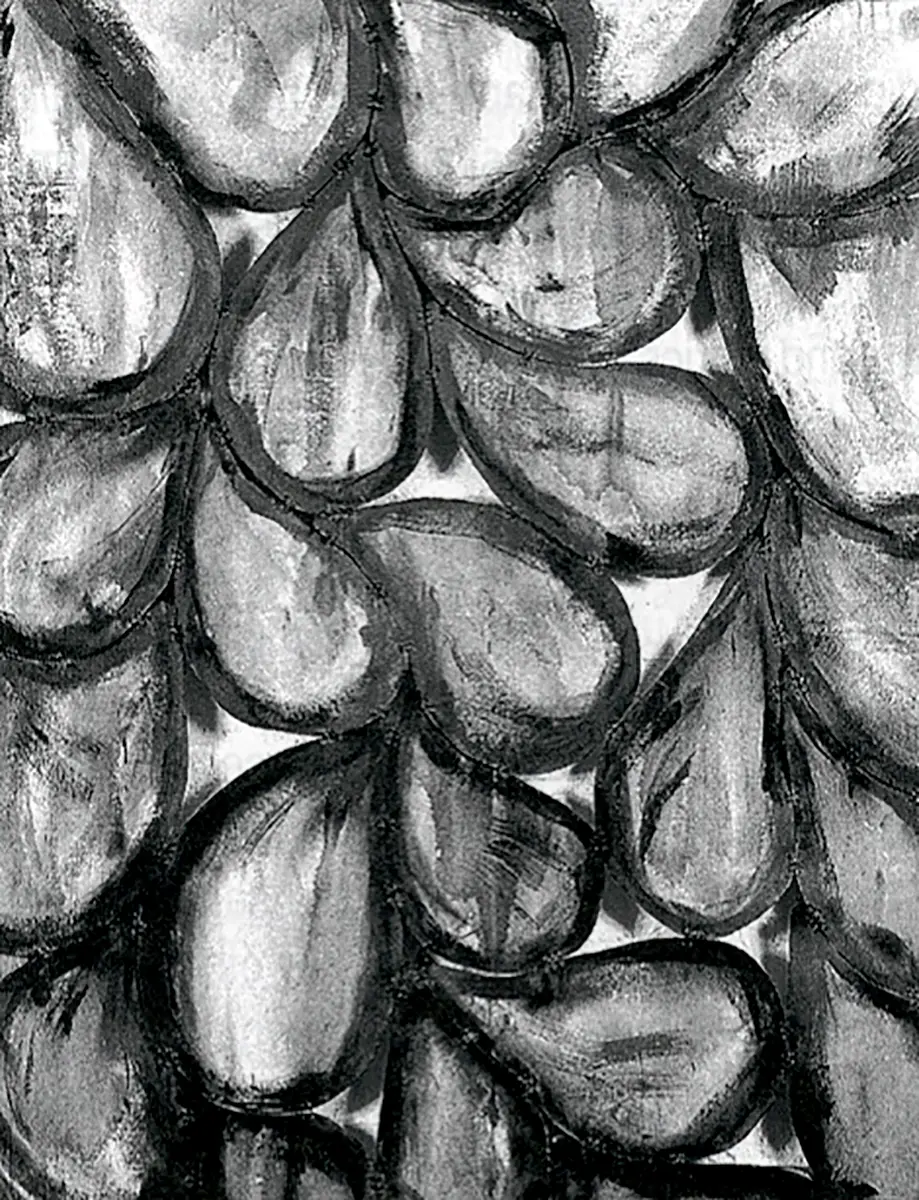
In the three works called Catunda did not use fabrics and, for the first time, painted on canvas cut in the shape of a drop. In a sensual sequence of couplings, the drops are connected by small circular rings that play the same role as the sewing shown in her other works. The playful discussion on what is and what isn’t art—which is ever present in her universe— became more subtle and less literal. The empty space located between the drops draws our attention directly to the texture and tones of the wall, thus creating ambiguity.
This exhibition stressed the perception through the sense of the body, an approach that was already present in the works exhibited at the 22nd International Biennial in São Paulo in 1994. Paulo Herkenhoff observed in the text printed in the catalogue that "in a painting by Catunda tact fluctuates between the physical training of the senses of the consumer as in the work of Oldenburg and in the phenomenical pe of the body which is dearly perceived in the work of Lygia Clark." This phenomenal perception of the body is also clear in the work Red Tongue, where the artist intercalates voluptuous layers of velvet and painted, and airy fabrics, creating a warm and comforting sensation of corporeity.
GEORGIA LOBACHEFF