
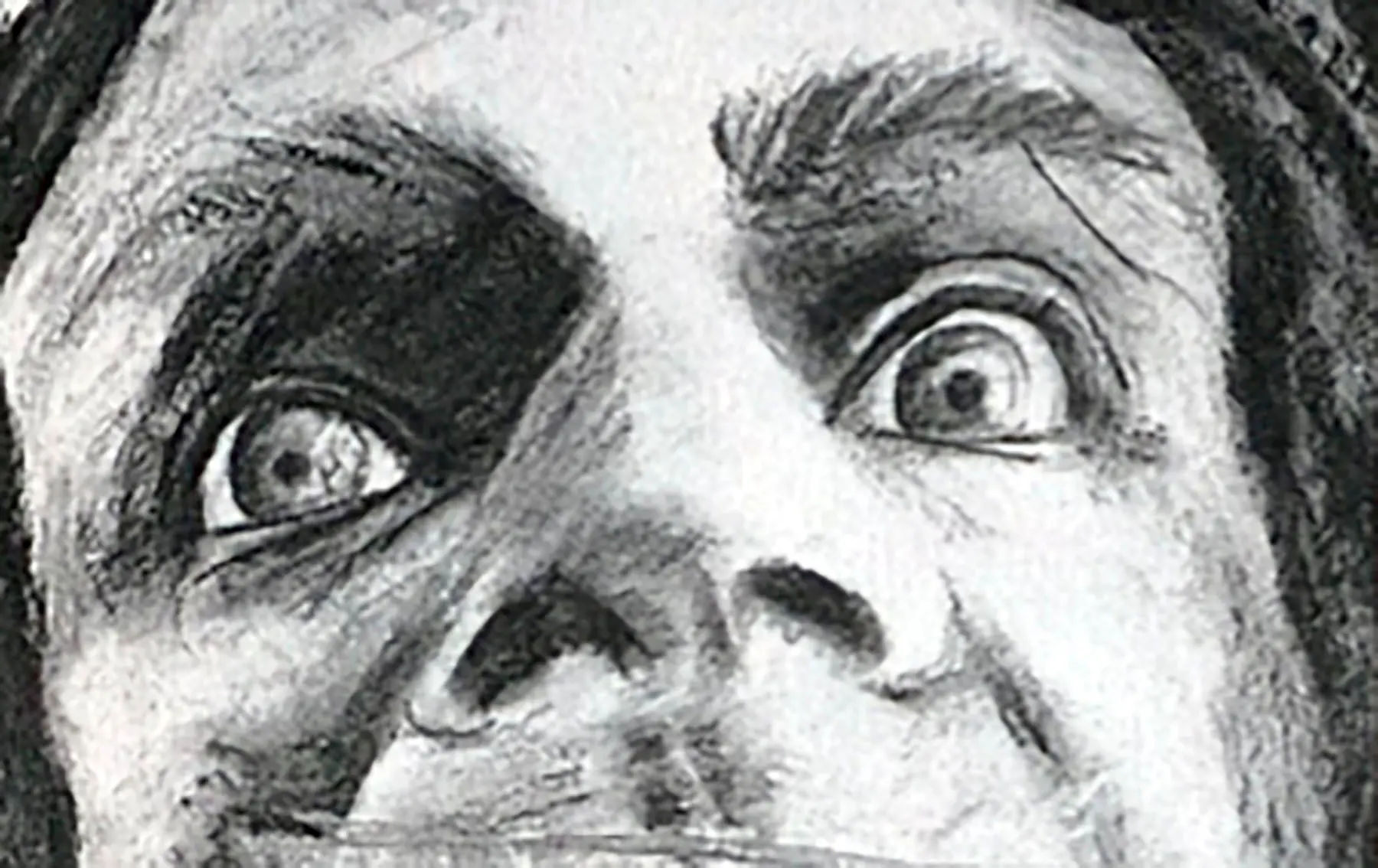
Like ominous backdrops to some Brechtian morality play, two wall-sized paintings on unstretched canvas dominated Marcelo Aguirre’s most recent solo exhibition. The related images in the two paintings, Sweet Hipocracia and Clean Hands and Without Blood (which lent its name to the show), consist of superscale faces and hands: in the former, clutching a handful of flowers, in the latter, turned palm outward for the viewer’s inspection.
Aguirre has rendered these features via a variety of painterly means. Scumbled over the surface by brush, knife, hand, and drip, Aguirre’s acrylics describe the forms of these personages in cobwebbed layers of handling that, by their marred effects and funereal palette, suggest decaying viscera rather than quick flesh. Yet, within the painterly storms that Aguirre aggregates to construct these malevolent moons, he has left as a focal point the open mouth of each. It is these that bar the images from banality, unless it is the banality of evil—there is no question as to the profane Logos that Aguirre hears from these Bacon-like embrasures. These mouths are the key to the rest of the exhibition. Aguirre’s concerns? Abuse of power, hypocrisy, and, one can surmise, a certain crisis of faith on the part of the artist.
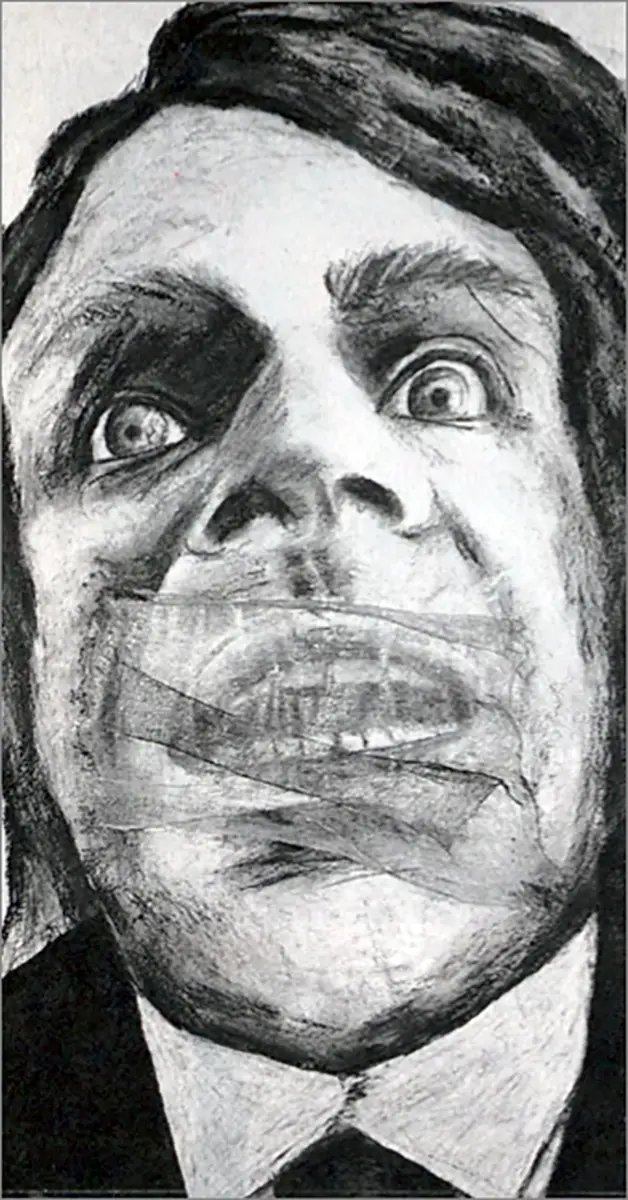
Aguirre describes as natural his evolution from the "neo-expressionist" landscapes and near abstract figuration that formerly comprised his oeuvre into these works with their more potent and specific content. He freely cites the circumstances that gave rise to their birth, one in terms of form and one in terms of content. Prior to beginning this series, Aguirre had collaborated on the stage sets for a play produced in Quito entitled The Mission by the German dramaturge Heiner Müller, while in autumn of last year he was impelled into a new body of work by the controversy surrounding the impeach ment trial of Ecuadorian vice president Alberto Dahik, the accusations of his possessing secret bank accounts containing $400 million in public funds, and his subsequent flight from Ecuador. The title of this exhibition is a quote from Dahik.
But, if Aguirre’s paintings were meant to continue his practice of responding to personal interior exigencies, rather than acting as political sloganeering, they were not to remain private for long. This same exhibition was originally scheduled to be featured in the municipal museum of Guayaquil in December, but was cancelled shortly before it was to open. Shortly after that, the Museum of Contemporary Art of Monterrey, Mexico, announced that Aguirre had won the generous MARCO prize by virtue of his related painting Passerby, then being shown in Monterrey. It likewise presented a superscale head executed in a manner somewhere between chaos and control.
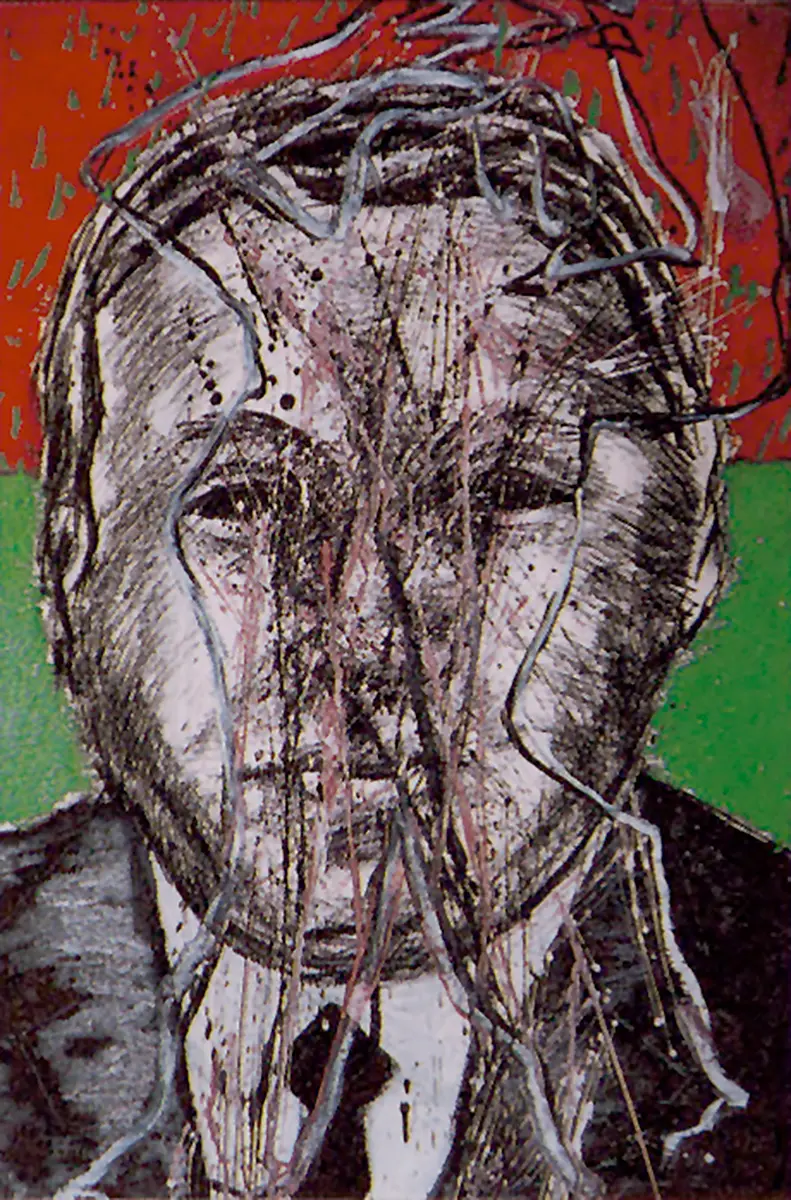
The series of paintings in general seems to owe much to German expressionism, both old and new. Painters of related sensibility include everyone from Max Beckmann, Emile Nolde, and George Grosz to George Baselitz, Per Kirkeby, and Rainer Fetting, though Aguirre prioritizes the Ecuadorian painter of Everyman, Camilo Egas, among his influences, and León Golub is an obvious analogue, too.
Each of Aguirre’s paintings is executed with blunt brio. Assembly of Notables has a tree of life form with, as "fruit," the primitivistic portrait faces of power figures all constructed in an angular, aggressive way. Dog’s Night is likewise confrontational. A frontally naked man stands at the picture plane, and a crouching naked woman is indicated in the background. The loose deployment of color over the figure and the rough-hewn brushwork recall the early Fauves, but the dark current coursing through this painting, verbalized on its surface in a handwritten García Lorca poem, does not share in a Luxe Calme et Volupté sensibility, nor do the rest of these works. Mea Culpa, a washy, sepia-toned self-portrait on paper, reveals the gravitas of a profound kind. This drawing recalls Dürer’s self-portraits and also suggests his Melancholia etchings, in which he was depicting, of course, the saturnine ponderings of a black-billed individual, one of the four temperaments of humanity then asserted to exist.
The expressionist vein of painting, certainly, has long been the vehicle of choice for registering such inner torment. Aguirre queries the nature of power in a Foucault-type analysis, but his personal commentary is a gut response to the frustration and anger arising from the realities of his country’s experience of abuse. There is a sense that the making of these pieces, with their images overlaid with scrawls and scratches, was nearly an act of mutilation. With these paintings, Marcelo Aguirre has sharpened his edge.
K.K KOZIK
American Art Historian. Lives and works in New York.