
On the surface, Marietta Berman’s works are unmistakably related to the lyric abstraction and informalist currents of the mid-twentieth century. The concerns that motivated her work, however, are far from the formal issues that concerned her contemporaries. For Berman, form was not an end in itself. Like the creators of Gothic cathedrals, she sought to create spaces capable of containing the divine.
Berman explored the expressive qualities of sculpture, painting, mixed media drawings, and lithography during her career. In each of these media, all well represented in this retrospective exhibition, she succeeded in giving tangible presence to the invisible. Her works capture the essence of light, the rhythm, and the color of music.
Finito Infinito (Finite Infinity), one of Berman’s best-known oils, is the exhibit’s focal point. The composition’s lines define a space that is both virtual and real. She painted most of the work’s lines directly onto the canvas. A section of gauze, delicately tinted with faint blue lines that indirectly reflect the painted lines, defines a space of its own atop the canvas. Berman sewed the composition’s most emphatic line over both the canvas and the gauze, affixing and uniting it to the composition by a painted red dot. The theatrical space Berman created through this technique not only seems real, it actually exists in three dimensions.
The luminous cosmos Berman painted in Finito Infinito lies beyond the composition’s intersecting lines, intimating that light itself has its own progression. The color modulations she used in Aquí estuvo Don Quijote (Don Quixote was here) reinforce this impression. Moving from the earth tones that frame the painting’s foreground, she leads the viewer’s eye step by step into a door of celestial white. The implied architecture of this journey turns the brilliant light at the composition’s vanishing point into yet another beginning. In La Puerta (The Door), Berman simplified this theme to its most elemental forms. An amorphous blue shape creates horizontal reference from which a fine black line extends on the diagonal into the light of a shining door. Here again, the lines reflect their color onto the light that surrounds them, blending with the area they occupy.
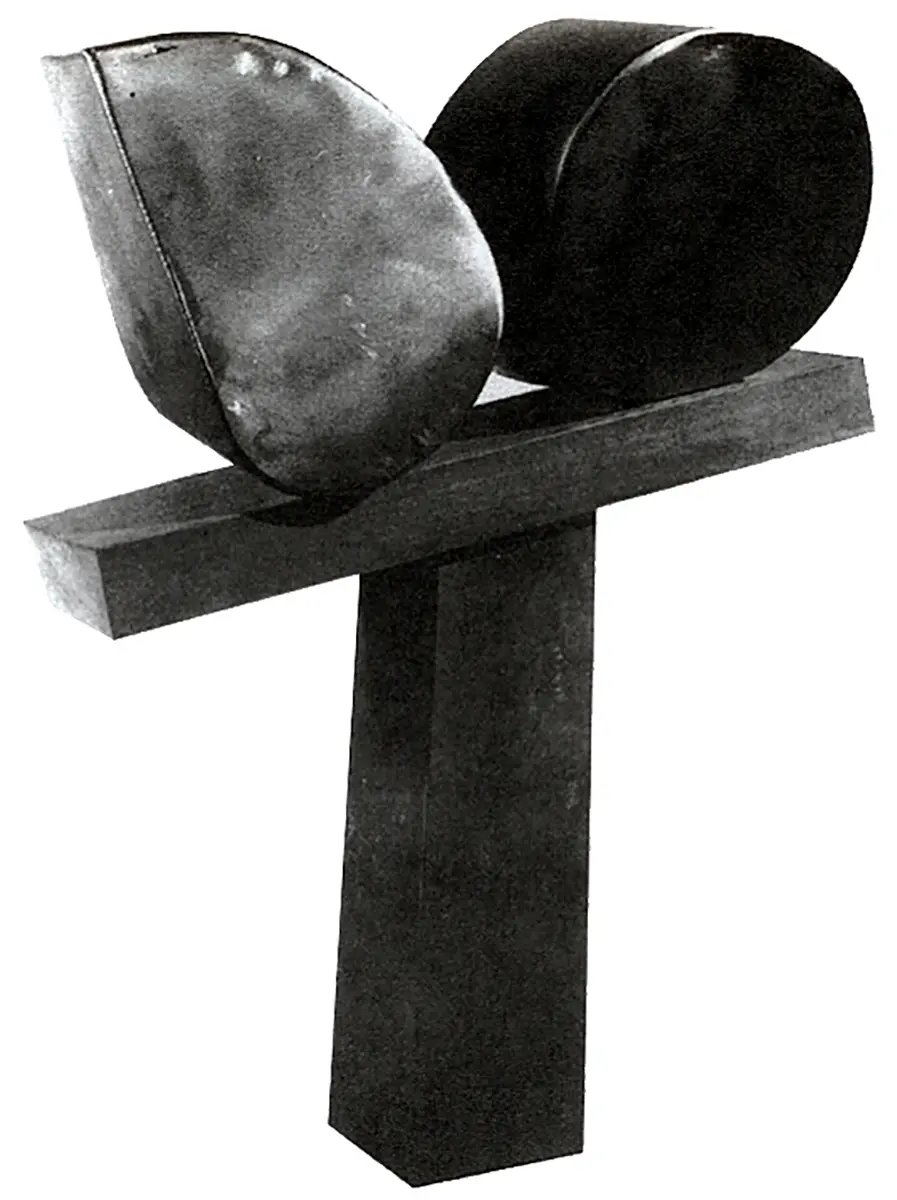
This interplay of light, space, and color is continued in Berman’s sculptures. In Variations del tema OM (Variations on the Theme of OM), Berman heated her steel until the burnished metal took on the colors of the rainbow. As a result, the ankh-like figure alternates between producing color from some inner source and reflecting color from external light. The clear plastic bar that traverses the sculpted form is analogous to the gauze overlays Berman used in her paintings. It provides a readily definable, yet transparent, element of the composition that also allows potential changes in the perception of space and the color of light.
Subtle transformations of light and space also inform Berman’s mixed media works. Two untitled studies, closely related to her sculpture Forma Absoluta (Absolute Form), use cut-out forms to create vital spaces within their two-dimensional frames. From the barely perceptible indentation of a metal plate on a sheet of drawing paper to the glowing progressions of the large-format paintings, Marietta Berman captured an immensely complex universe of simple beauty that reverberates with the sanctity of creation.
K. MITCHELL SNOW