
A Past Incomplete, curated by Gustavo Buntix, brings together more than 50 paintings made by Moiko Yaker in the last ten years. In them is evident the technical exuberance of the Peruvian artist, who mines the pictorial riches of the pre-Columbian and colonial worlds and melds them into his own magical vision of contemporary Peru. According to Buntix, Yaker himself describes his work as "an assemblage of histories, an assemblage of styles."
The exhibition may be read as one great work comprising variations on a few themes."
The artist presents a theme or image and gradually develops it in a series, as he does in The Five Senses, whose individual sections are in turn dyptichs or tryptichs in which the theme is played out in parts.
One of the predominant images in Yaker’s work is that of a martyr of Peru’s fight for independence, José Olaya, just as he was depicted by the nineteenth-century painter José Gil de Castro, impeccably dressed in white and with a letter and hat as his attributes. Yaker subverts the popular, almost banal, figure by presenting and representing it in various absurd transformations. In the series entitled The Promise, for instance, the heroic icon appears as a close relative of Watteau’s clown, with ill-fitting pants and a grotesquely small head. In other paintings, Olaya loses his head altogether and sports instead that of an ass, or else a foot, or a framed picture.
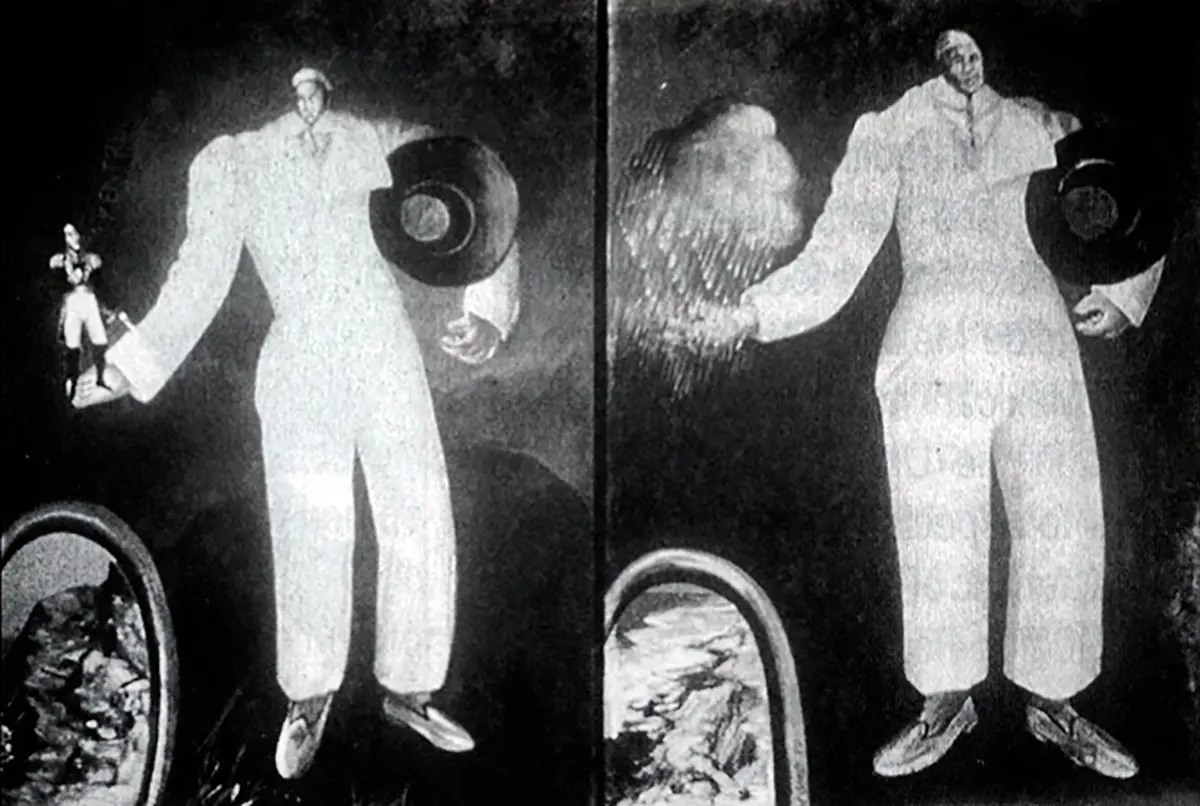
Yaker’s canvases are of dramatic dimensions, and in them his characters assume mythic proportions. As a contrast to the figure of Olaya, which represents the people, we frequently" find figures of authority, whether it is the president with his official sash, a military figure in uniform, a bourgeois gentleman in formal dress, or a cardinal in his red robes. These huge figures dominate the foreground of a painting, while in the background, apocalyptic scenes, epic battles, and endless religious processions are played out. The main characters appear as if in their last hour, covering their faces with their hands before the inevitable chaos that surrounds them. Even greater is the impact of these paintings when the artist introduces incongruous elements that play upon our expectations of a familiar image and subvert its symbolic power. In Cardinal on the Telephone, for instance, a religious image loses much of its mystery and solemnity: we see the cardinal smoking nervously while he talks on the telephone, much like the image of a contemporary politician responding to a crisis. In The Conspirancy, what clashes with the group of priests is the presence of a television, the latter showing in turn the image of a president that serves as an ironic commentary on the complexity of both powers in the oppression of the people. In ominous reference to political censorship and to the abuses of government, in the background of some of these compositions, we see apparently innocuous bourgeois portraits, which, upon closer inspection, reveal gags and blindfolds.
In his most recent paintings, Yaker takes images from nature and re-invents them to his liking in order to create compositions with less narrative and less specific references to the Peruvian condition. In previous works, curious animal forms appeared fluttering around religious figures. In works such as Profane Love, Sacred Love, insects are protagonists in fantastic compositions, their bodies and antennas mere pretexts for lively geometric designs.
PAOLA SADA