
In very simple terms, the expression "the non-pictorial" means that something is not painting, although it seems to be, or that something is painting, although it is not pictorial. Everything is possible! In our contemporary world, as we now approach the year 2000, the third millennium, a number of terms have now lost their currency, including that of “post-modernism," as old debates give way to new investigations. This is a clear example of the necessary, positive, and healthy changes at work in the process of the visual arts. The case of Pedro Fermín is an extraordinary example of all this. Here, the title of The Non-Pictorial is a paradox, a mystery, a dialectic which extends towards the future in its only possible ways: through the formal, the conceptual, and the human elements.
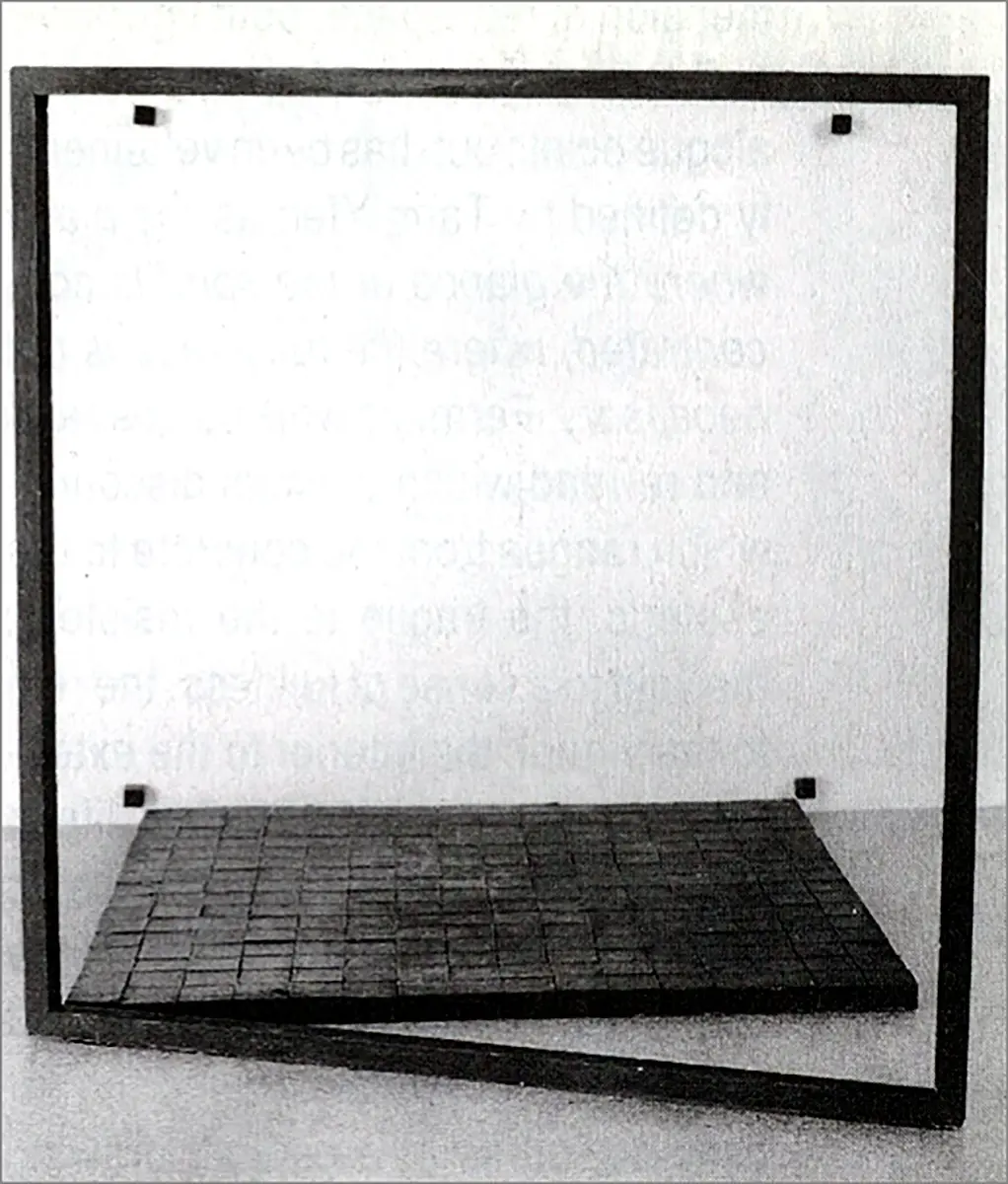
There are many traces of the work of other artists in the art of Fermín, with persistent and deliberate echoes of Jesús Soto, Víctor Lucena, Peter Halley, Richard Serra, Donald Judd, and David Rabinowitch. Only the first two are acknowledged in the catalogue; we do not know if the artist has seen the work of the others, although we sense their presence. However, it must be admitted that Fermín’s work has not been affected by any kind of fashion, or by influences or banal appropriations from other artistic proposals. Each work appears as an idea which is never abandoned, an idea which changes and is transformed through its conversion into real elements, whether two or three dimensional, and which cohabits in a real-virtual relationship. A clear illustration of Fermín’s proposal is Spatial Relation (1993), which reflects the various sources of information that have given rise to the work: information from science, philosophy, metaphysics, architecture, and the history of art. An iron window, element A, is sustained on the floor in almost a diagonal position against the wall. On it, elements B have been placed, four small cubes which act as supports, from a distance, for the angles of the window, with a relationship of transparency being established between the empty window and the wall with its four elements. They recreate, gestaltically speaking, the actual window. On the floor, element C, a lamina formed by a series of enamel squares measuring 7.9 in. x 7.9 in. x 3.9 in., with one of its edges fixed to the wall and the other three engaging in a visual interplay with the window, generating in turn a second relationship of transparency. The rhythms in perception are part of the plastic game and a characteristic of all of Pedro Fermín's work.
In this exhibition, made up of a series of works executed between 1992 and 1993, and curated by Carmen Hernández from the staff of the Bellas Artes Museum, we can easily see the development underlying Fermín’s recent production, with many of the pieces acting as seminal works for the artist’s subsequent production. For example, the work that he presented at the recent Clay of the Americas show in Caracas can be seen as a synthesis of the plastic repertoire on display in this exhibition. It is an artistic language dominated by the sensitive dimension of real space, both figurative and spiritual space, which, as the catalogue points out, has been vehemently defined by Tang Yfen as the place where the glance of the spirit is concentrated, where the full image is not necessary. Fermín’s work can be read and re-read within a visual discourse that ranges from the concrete to the esoteric, the fragile to the resistant, the void to a sense of fullness, the real to the virtual, the interior to the exterior, the bodily to the incorporeal, life to life. It was a moving experience to enter the experimental room in the Museum and to see works like kinds of original cathedrals illustrating the artistic discourse of a century drawing close to us. Works such as these make it necessary to engage in a careful rereading of the artistic languages, such as minimalism or kinetics, which have opened up new avenues towards proposals that might be valid in the new century.
In this exhibition entitled The Non-Pictorial, Fermín, a Venezuelan artist born in Carúpano, in the state of Sucre, in 1950, presented some elegant and mysterious geometries, such as the piece entitled Parallels (1992), made up of 21 bars of iron covered in gold leaf, ten resting on the wall and another ten on the floor, or Text and Context (1992), consisting of a large sheet of iron covered in gold leaf from which the artist has extracted from the upper center a sheet measuring 5.1 in. x 31.5 in. x 31.5 in. to create a kind of void through which the wall appears. This small sheet lies on the floor with the reverse side, i.e., the iron, showing. Fermín also proposed some ambiguous constructions, like that entitled Hard or Soft, which, for the artist, contains both an internal and external space that explores the relationship between those two categories, as well as that between the positive and the negative. One of the most interesting proposals was inspired by Soto’s nylon cube, but in this case, the relationship was between solid and virtual volume. With this exhibition, Pedro Fermín has clearly emerged as an important Venezuelan artist.
BÉLGICA RODRÍGUEZ