
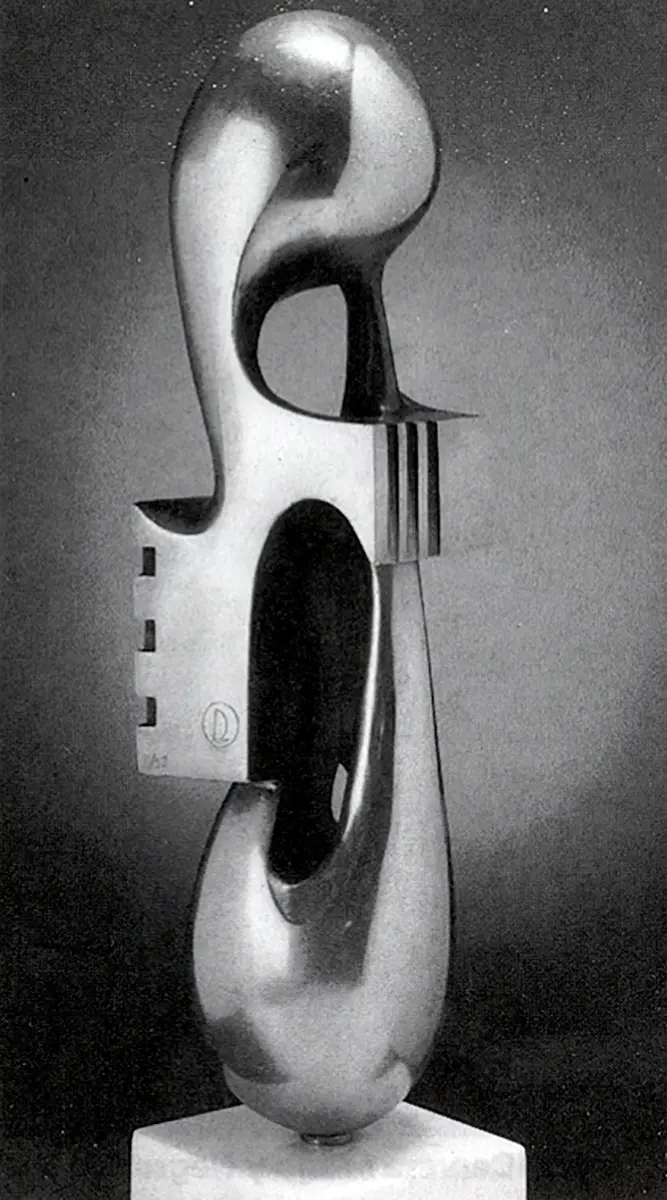
An interesting aspect of Rolando López Dirube’s sculptures is the presence of forms that seem to escape the limits of the formal, giving his compositions aesthetic relevance to any time or place. The editions of his work at the Forum de las Artes Gallery in San Juan, entitled Casicanecua and False Torus, have a creative liberty that establishes a kind of bridge between tradition and the future. They seem to express themselves in optical terms, with a sense of spatial succession that results in a harmonious and unusual interplay between matter and void. The artist’s combination of compositional features with negative space gives these pieces a sense of lightness, which contrasts with the nature of the bronze in which they are executed.
López Dirube has the virtue of creating forms that are impressive in their ability to assimilate novelty without sacrificing orthodox technique. One of his most important qualities is his identification of silhouettes from nature, to which man responds intuitively as an expression of the unconscious, abstractions based on tangible elements. López Dirube is an artist who has shown special talent in expressing himself passionately without detriment to conceptual elements. In these two works executed in Italy, there is evidence of the artist’s mathematical knowledge: the works are a response to a free-ranging geometry that goes beyond the merely mechanical considerations of calculation. They are the logical result of work that achieves the kind of autonomy possible only to those who have penetrated into the philosophical dimension of their knowledge. In this way, the power of understanding becomes a visual poetry.
Although López Dirube recognizes, assimilates, and interprets contemporary trends, he consistently reinforces his own aesthetic principles. It is precisely the interests of the self that keep the creator alert to the discourse of contemporaneity, and it is this present that acts as a point of encounter between the past and the future. By their introspective nature, the arts facilitate the dialogue between what is fleeting and permanent, a dialogue that has always been the goal of mankind in its exploration of the mystery of life. López Dirube knows that creation affirmation is a matter of premonition, and for this reason, his work expresses the tensions of idea and matter, tensions which he resolves through his interpretation of the abstract dimension of immediate circumstance.
The sculptures of artists such as López Dirube encompass intangible factors that endow them with a special kind of intensity and spiritual power. If we examine the theoretical aspects more closely, we can perceive traces of the legacy of Jean Arp. At the same time, these works have a classical sense of balance which creates a sense of programmed introspection and harmony in the spectator, a maximum degree of idealism which gives the linework and contours a suggestion of transmigration. Indeed, they are works which blend with both sacred and profane settings, exotic presences which reflect the artist’s interest in the projection of movement. At the same time, their pure sensualism evokes sublime sentiments which go well beyond purely visual effects, since the artist is seeking, like the cubists, to give simultaneous expression to all the facets of things in a single glance. He does so through simple forms of delicate finish, the sinuous nature of which acts as the non of traditional sculpture. López Dirube’s language seeks out the essential nature of things, and thus shuns the superficial and purely anecdotal. There is an emphasis on self- centered cycles which seek to perpetuate themselves in endless movement, gestures moving through space in a celebration of autonomy. A closer look at these sculptures confirms the artist’s ability to transmit emotion, which at the same time evokes private associations, the consequence of the artist’s sense of self-criticism, which constantly obliges him to exploit his full potential. Like many other twentieth-century artists, López Dirube is an enemy of the stultifying principles of the academy, an enemy of theoretical pretexts that only serve to paralyze taste and creativity.
López Dirube’s sculptures have the attraction of providing a response to new illusions, and his murals, monuments, pictures, and drawings have made him a leading figure in contemporary aesthetics beyond the limits we associate with such concepts as modernism or postmodernism. His work reflects the great values of art, making him one of the modern masters of Caribbean art.
JOSÉ ANTONIO PÉREZ RUIZ