
In February 1996, the Museum of Art of Fort Lauderdale inaugurated an exhibition entitled Different Worlds, which presented a representative selection of the different facets of the work of Tomás Sánchez and which included, in addition to landscapes and garbage dumps, a small sample of some of the early works recently acquired by collectors living in South Florida. The show will run through the month of May. The early part of Tomás Sánchez’s career was represented by Excursion into the Natural (1973), Our Lady of the Water Melon (1974), Levitation in the Circus (1974), and Madonna in Old Havana (1974).
This early figurative period was the result of documentary investigation carried out by the artist during his studies at the National Art School. At first sight, these pictures seem to reflect the influence of the German expressionist movement and that of the Cuban artist Antonia Eiriz. A closer look reveals other elements, such as those inspired by the works of Brueghel the Elder, Bosch, Chagall, and Enzo. As Sanchez himself has admitted, these works are a synthesis of the history of art, coupled with a dose of Cuban humor.*
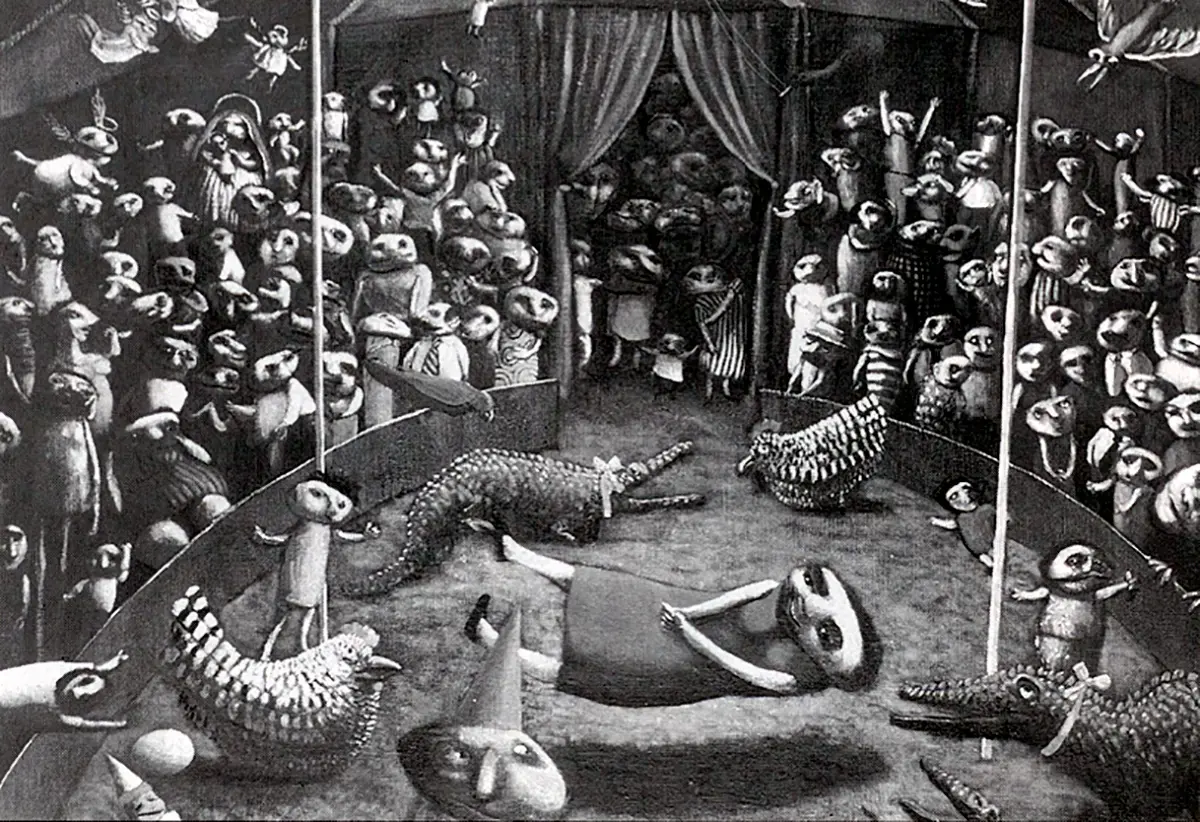
According to the artist, during the period of his figurative paintings, he also painted works inspired by his Sunday excursions. Eventually, his attraction towards nature and his ecological interests led him to make landscape the central theme of his work. Unfortunately, the show did not include any of the paintings from the 1970s, a drawback which could have been rectified by requesting collaboration from certain Mexican collectors. Neither did the show include any of his prints or lithographs, which formed part of his earlier work.
The show presented a selection of landscapes from the 1980s, including Flooding in Aguas Blancas (1985), inspired by the flooding of the beaches to the east of Flavana in 1982, Clouds from the Mountain (1987), and Shore (1989). The first work was presented, along with three others, at the São Paulo Biennial in 1985, and was the starting point for a series on the theme of flooding. The two other pictures in the show, which were painted when Tomás Sánchez lived in Mexico, included new elements, such as the mountain, the clouds, the river bank, or the lake, and were also the point of departure for new series inspired by these themes.
Shore (1995) was precisely the title of the work placed at the entrance to the exhibition. It is a recent version of the series of white canvases characterized by vegetable "mirages," and was specially done for the show. Sánchez creates a horizontal kind of mirage by placing a fringe of green, very even vegetation across the canvas that becomes a picture inspired by the tendencies of color field painting or minimalist art rather than a realistic landscape. More traditional landscapes in the show included Shore (1993) and Laguna (1995), works full of handsome color that confirm the artist’s ecological interests.
The show also presented, as part of the landscape series, a work entitled Meditator and Laguna Hidden in the Wood (1995), in which the artist clearly expresses his interest in the relationship between man and nature. The message is made even clearer with the presence of a little meditating figure, which can be seen as an autobiographical reference. The composition of the picture is based on two different perspectives: the first places the spectator in the position of someone walking, the other allows him to "fly" over the landscape.
Different Worlds also included a representative selection of works from the "garbage" series. Most of these pictures are characterized by the same sense of realism and technical perfection as the landscapes. The details, although not consciously sought after by the artist, reveal considerable skill, both in form and in the handling of color. The format of most of the works is also indicative of the skill in composition.
There were no early examples of this theme in the exhibition, i.e., those pictures done in the mid-1980s, which suggested that this theme appeared in Sánchez's work only from the 1990s. In fact, the garbage dumps of Mexico City, where Sánchez briefly lived at the beginning of 1990, inspired him to take up again a theme which he had already explored in Cuba. Subsequent versions included in the exhibition, such as Mirage (1991) and Island (1991), combine both garbage and landscape, while in Garbage Dump (1991), Colored Garbage in the Storm (1991), and The Blue Door (1993) (which appeared on a recent cover of ArtNexus), Tambos (1993), and Agony of True Blues (1995), the garbage dumps question the relationship between man and the environment and criticize its destruction.
There was also the controversial Crucified Man (1992), in which Sánchez shows a young crucified figure on a garbage dump, seen from the perspective of the famous Christ by Andrea Mantegna (1446), and Time for Nesting (1995), which depicts the typical Cuban "tomeguin" bird perched on an oil barrel, in an allusion to the extinction of this species in Cuba.
Different Worlds was the first presentation of a retrospective selection of work by Tomás Sánchez in a United States museum and drew many visitors. However, it is important to note certain unfortunate technical flaws in the show, in particular the lack of frames for some pictures and the mint-green background of the walls in the adjacent show, which clashed with the coloring in the "garbage” pictures.
According to Sánchez, this exhibition marks the end of one stage in his artistic career, and he now hopes to develop his ecological themes and explore the relationship between man and nature through more figurative work.
NOTE
* Interview with the artist, April 1996.
FRANCINE BIRBRAGHER