
One of the most vexing problems faced by anyone who enters the field of Latin American Art (of any period) is the difficulty of obtaining information. One of the hallmarks of Latin American art is the compartmentalization of research; scholars generally tend to deal with the art of their own country and often treat it in a vacuum, often establishing few critical links and relationships with art in other regions. This has created various difficulties. One of these has to do with synthesis, literally "putting the pieces together" to be able to form a coherent picture of the totality of Latin American art in the modern era. Another problem facing scholars of Latin American art has to do with the difficulties of book and periodical distribution. Scholars throughout Latin America have produced rich bodies of written material, but much of it remains within the borders of the individual nation. Books are often printed in small editions (making it necessary for researchers to buy virtually every publication they see whenever they are fortunate enough to travel) and, due to the vagaries of import-export laws, are often not available abroad.
Arte en Colombia/ArtNexus has been, for twenty years, a beacon of information and a key element in the support of artistic creation in Latin America. For many years it was the only major art magazine that reached beyond the borders of the country in which it is published and it continues to be the most significant Latin American art magazine. It has been instrumental in establishing a truly international dialogue between the Spanish, Portuguese, and English-speaking countries of the Americas. Despite the fact that there are now several other publications that focus on Latin American topics of artistic interest, none has the breadth nor the depth of this pioneer publication.
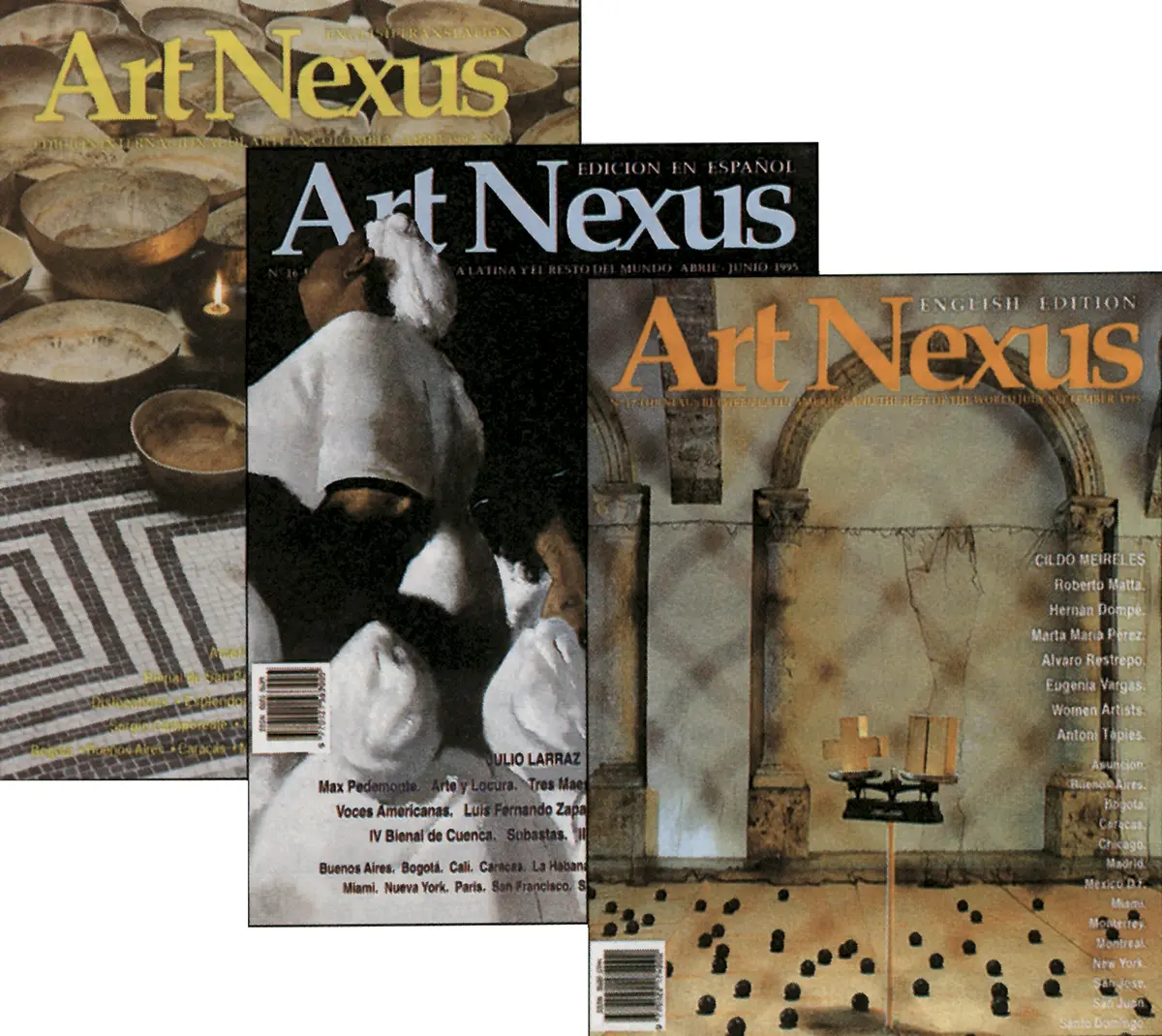
Arte en Colombia has served many audiences in many countries. I have seen copies in bookstores and museum shops from Puerto Rico and Paraguay to Paris and beyond. It is a model of fairness and broadmindedness. It does not have a specific political agenda (as is so often the case with many of the most tendentious publications of today), yet this is by no means to say that it has no point of view. Arte en Colombia has always been conscious of giving serious coverage to an enormous variety of events in countries that would receive no mention whatsoever in the major magazines of Europe or North America. It is decidedly liberal without espousing any specific political policy. Nonetheless, its readers know that they will be able to find as much information about the latest Cuban avant-garde or historical articles on the revolutionary or protest mural movements in Nicaragua or Chile as they would on, for example, the most recent exhibitions of Fernando Botero's monumental sculptures on the streets of New York, Paris, Mexico City or Washington.
Publishing a serious, consistently well-produced magazine is, ultimately, the responsibility of the editor-in-chief. In the case of Arte en Colombia it is, of course, the efforts of Celia de Birbragher which must be recognized. Since the beginning, the persistence, dedication, and intelligence of Celia de Birbragher have represented the heart and soul of the publication. Unfortunately, as someone charged with the physical production of the magazine as well as the herculean task of seeing to its financial well-being, Celia rarely has time to contribute substantial pieces of writing of her own. Yet, in reading her interviews, for instance, such as that she conducted with Argentine painter Antonio Seguí (in the January 1991 issue), one is impressed by the way that Celia is able to go right to the point of the matter and elicit the most intelligent, information-filled and analytical responses from her subjects.
I do not believe that in any publication has there been such a richness of reviews of exhibitions both large and small in museums, galleries, and alternate spaces (not to mention the numerous biennial exhibitions held throughout Latin America and the Caribbean) While foreign magazines like Flash Art or Art News may, once in a long while, review an exhibition in Mexico City or São Paulo, Arte en Colombia makes it it's business to keep the reader abreast of virtually everything that's happening in even the smallest art centers throughout Latin America. It is also important, in this brief expression of admiration and gratitude to the magazine for keeping so many of us informed about the events in the complex world of Latin American art, to mention the notable fact that Arte en Colombia does not limit its definition of "Latin American Art" to the most well- known cities and countries. As Gerardo Mosquera mentioned in an article published on the magazine's 15th anniversary, one of its strong points is the publication's commitment to covering happenings and issues in the Caribbean, Central America, etc. One of the most significant manifestations of Arte en Colombia's interest in the smaller art centers of Latin America is the highly important series of articles written by Belgica Rodriguez (beginning in January 1991 with Guatemala) on the contemporary art of Central America which introduced many people to the rich contributions of artists in the countries of that area. I should also mention the extraordinary series of articles by Gerardo Mosquera (beginning with number 45,1990) on the multiplicity of the African elements inherent in modern Caribbean art. Not limiting himself, by any means, to his native Cuba, Mosquera, in his usual intelligent and insightful way, proceeded to analyze many under-explored aspects of the African elements in the visual expression in the New World. His contribution to this area, along with that of Robert Ferris Thompson, author of the well-known book Flash of the Spirit, has provided us with many serious insights into cultural cross-fertilization.
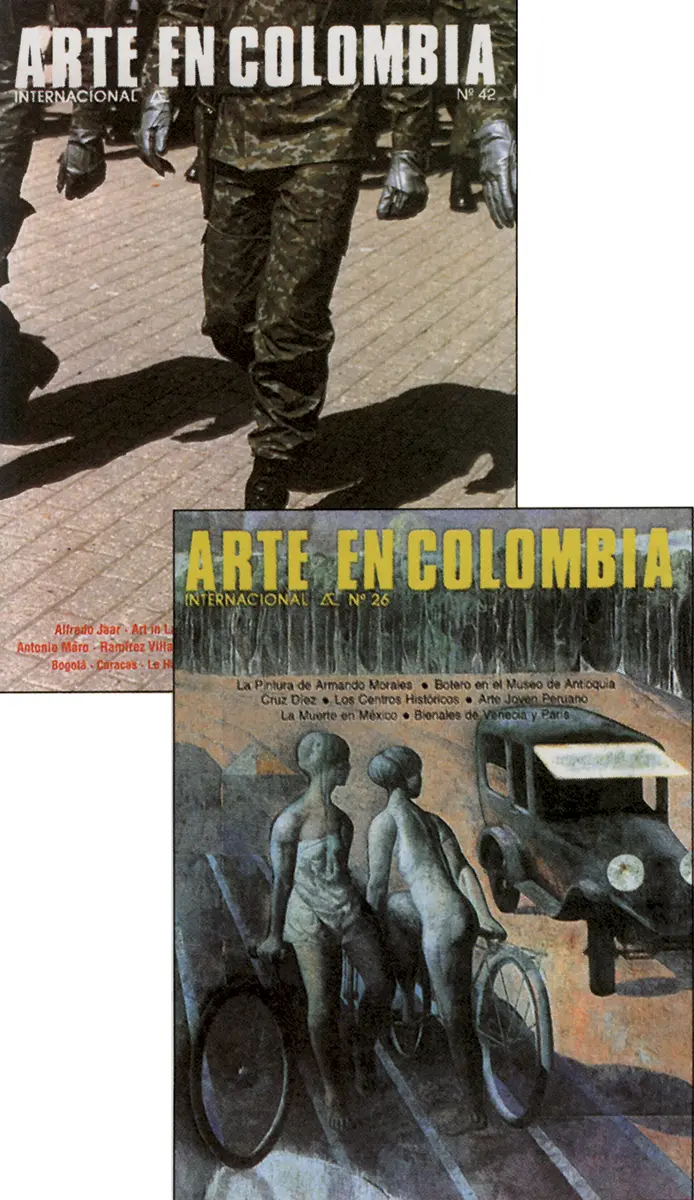
Lately, Arte en Colombia has become even more open in its scope and has covered exhibitions in Guyana as well as Haiti (see Carol Damian's article on Haitian painting in the January - March 1996 issue) It is, perhaps, in the area of the English-speaking Caribbean that the magazine could still expand. Countries such as Jamaica, Barbados, Trinidad, and others are rich in contemporary artists and art movements, Although they have been mentioned in reviews of the last two Caribbean and Central American Biennials (held in Santo Domingo, Dominican Republic), a serious consideration of some of their accomplishments would be welcome.
It is also significant, I think, to point out that Arte en Colombia is perhaps more "universal" (to use an overused word) than many people realize. I have often gained an entirely different perspective on exhibitions and events in the art worlds of, for example, New York, Los Angeles, Paris, Madri,d or Berlin by reading the reviews and feature articles by Latin American critics. Regarding exhibition reviews, I must state my enormous gratitude for the extensive and intelligent coverage of the Havana biennials. This biennial, along with that of São Paulo, is, obviously the most important collective event to take place in Latin America. While the São Paulo biennial routinely receives serious attention in the international press, that of Havana often does not. This is especially true in the United States where the illegal and immoral economic blockade, now decades old, prohibits not only travel and exchange with Cuba but also makes extremely difficult the transmission of information to the many people in the US who are passionately concerned with Latin American art. Luis Camnitzer's criticisms and analyses in the October-December, 1994 edition of the V Havana Biennial were exemplary.
One more word regarding the reviews of exhibitions and related artistic events (an area in which the magazine is particularly strong); I am sure that I echo the opinions of many of my colleagues when I express my appreciation of the multiplicity of critical opinions that is given a forum in Arte en Colombia. This was made especially clear in the June - August 1993 issue in which the highly controversial exhibition Latin American Artists of the Twentieth Century, organized by The Museum of Modern Art in New York, was discussed in a variety of articles. Each of the articles, by Bélgica Rodríguez, Luis Pérez Oramas and Álvaro Medina (plus an interview with the show's curator Waldo Rasmussen by Berta Sichel) presented a distinctly different critical approach to the phenomenon of the exhibition. It was a mark of success, I think, that some of the views enraged readers while others made them nod in assent. This deliberate lack of a dogmatic stance and the willingness to open up the magazine to a multiplicity of critical views is certainly one of the many aspects of Arte en Colombia for which thousands of readers are sincerely grateful. We all hope, of course, for this salubrious art writing to continue for many years to come.
EDWARD J. SULLIVAN
Professor of Art History and Chairman of the Department of Fine Arts at New York University.