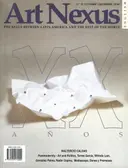
Since I have not been a member of the Editorial Council of the journal since the beginning of 1993, I believe that I am now in a more objective position to speak with enthusiasm about the twenty years of Arte en Colombia/ArtNexus, which has now published without interruption 68 issues. This is an extraordinary achievement and a difficult one to overcome. In Colombia, no other specialized art journal has had such a long existence. I suspect that the same might be said of Latin America as a whole.
The reasons for the long existence of Arte en Colombia/ArtNexus are varied, although they can be reduced to two main ones: financial backing (I remember just after the founding of the journal, I said to the director that her offices were more spacious and better equipped than those of Studio International in London, which I visited in 1968 when the journal celebrated its 75th anniversary), and above all the exceptional determination of Celia de Birbragher, who has dedicated all her time, as many know, to ensuring the success of an enterprise which, despite a number of difficulties, is striving higher and harder.
As Rosa Olivares wrote in the Madrid publication Lápiz in February-March 1995: "The advantage of producing catalogs and journals, as compared with other kinds of publishing, is the speed with which projects can be carried out; you reach a large public and have a direct influence on the sector, on artists, critics, commissaries, museums, public and private institutions... Another major advantage is that since the subject with which art journals deal is in constant evolution, the journals themselves must constantly adapt, and this guarantees a frenetic and, we hope, enriching kind of continuity. We are always attentive to the latest thing, the latest artist, the latest exhibition, and the latest text, but without forgetting all that has gone before. The process is endless." Without any doubt, these characteristics can be seen in Arte en Colombia/ArtNexus, both in the speed of the information and its divulgation and repercussion in all sectors dealing with the plastic arts whoever is interested in the subject does not know the Colombian journal from New York to Buenos Aires, passing by Mexico City, Havana, Caracas, Santiago, Montevideo, etc— as well as its constant renovation, sometimes perhaps a little heteroclite, but always of a very enlighting nature.
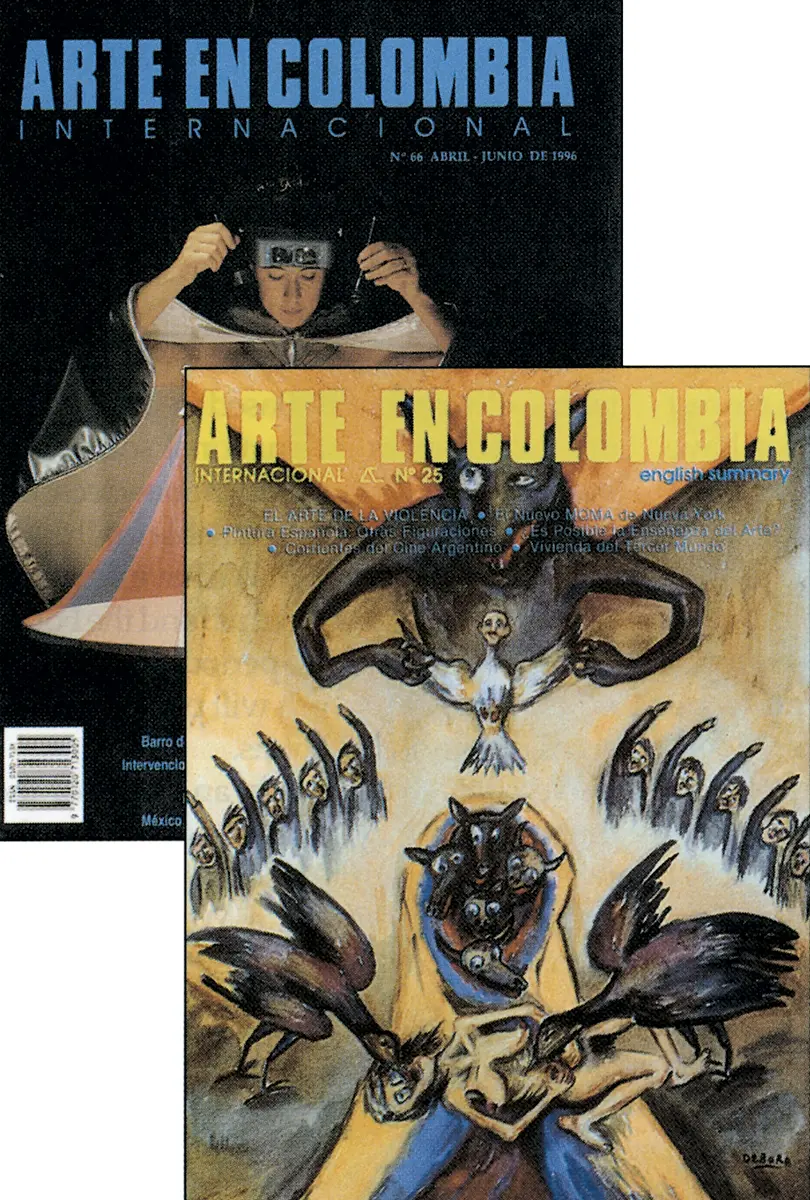
From being a mainly national journal, Arte en Colombia gradually became an international publication specializing in the art of Latin America, and since 1991 (issue No. 47), it has circulated outside Colombia under the name of ArtNexus. While the early issues of the journal included many articles on Colombian artists, now the emphasis is on artists from throughout the continent. In the last issue which I have seen (No. 67), there are texts on the Brazilian artist Senise, on Teran (Venezuela), Nelbia Romero (Uruguay), Aguirre (Ecuador), and Duclos (Chile), as well as others on art in Panama and an exhibition of Cuban art of the twentieth century in Tenerife. There is only one article on Colombia, dealing with the most recent edition of the National Salon, and an informative text on the Colombo-Mexican exhibition entitled My Spirit Will Speak for My Race. There is no other publication in Latin America that offers so many texts on art and artistic events in the various regions of the continent—and in this respect, we should remember that the journal includes two sections entitled Cronic and Publications, in which there are numerous notes on exhibitions, books, catalogs, from many countries.
But the journal does not forget the rest of the world. On the contrary, there are constant references to international art and activities in many places outside Latin America. In issue No. 67, for example, Camnitzer wrote about Mondrian (Camnitzer, a Uruguayan critic of German origin and resident in New York, is one of the most regular contributors of Arte en Colombia/ArtNexus and has written extensively on major one-man exhibitions of contemporary artists in Europe and North America, as well as on major group shows, such as the Biennials of Venice and Havana). The journal has a number of other contributors who also cover international exhibitions or write on such varied subjects as life of the museums, competitions, auctions, collections, etc.
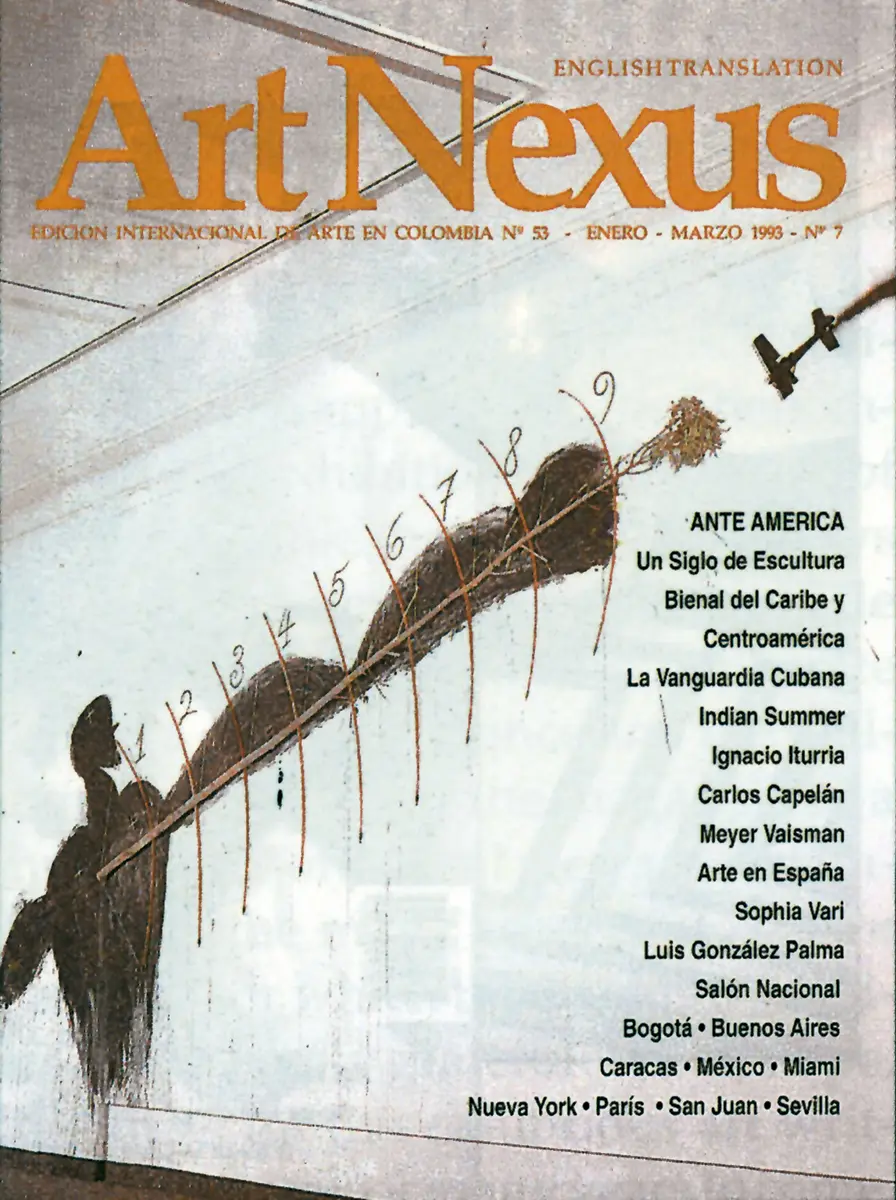
That being said, Arte en Colombia/ArtNexus does of course give special attention to the enormous region to the south of the Rio Grande—although art in the United States is not forgotten, including Chicano art and the Latin American art done in the United States. For this purpose it has a number of contributors of various nationalities and with differing interests. Although many articles have been published from the countries that are leaders in the field of the plastic arts, two of them merit special mention: Venezuela and Mexico. The first is because of fraternal ties and geographical proximity, and Mexico, without doubt, because of the importance of its artistic manifestations. In the case of Venezuela, studies have been published on artists ranging from Reveron down to the great figures of kinetic art: Otero, Cruz-Diez, and Soto, as well as Becerra, Vaisman, and others, without ignoring important group exhibits like the entitled The Emergent Plastic and The Narcissistic Decade. As regards Mexico, there have been articles on Alfaro Siqueiros, Tamayo, and Kahlo, as well as from those well-known masters down to Colunga, Marin, and Galan, and the work of outstanding photographers, the great architect Luis Barragán, and such shows as Splendors of Thirty Centuries. Cuba has also been showcased, particularly through the work of the ever-lucid critic Gerardo Mosquera. Other countries have not been ignored—Uruguay, Brazil, Argentina, Chile, the art of Central America, and the Caribbean. It would not be an exaggeration to say that a careful study of these articles would provide a very useful vision of contemporary art and a thorough grounding in its most important manifestations considered by well-known critics.
In addition to the information on each country, the journal also publishes a large number of reviews of group exhibits: the Biennials of São Paulo, Havana (both with a large Latin American presence), Cuenca, the Graphic Arts Biennial of Puerto Rico, the Biennial of Painting of the Caribbean and Central America, as well as guest-curated exhibitions, such as Art of the Fantastic, Figuration Fabulation, Latin American Art, America Bride of the Sun, Latin American Artists of the Twentieth Century—fully covered by Álvaro Medina, Luis Pérez Oramas, Bélgica Rodréguez, and Berta Sichel, as well as Voices from Overseas, Before America, Change of Focus and Cartographies, to mention just a few of the most important. Then we must mention the texts that come from the United States, often signed by such critics as Shifra Goldman, Edward Sullivan, and, once again, Luis Camnitzer, who always make acute reflections on the art of the well-established Latin American communities in North America or the Latin American art produced or presented in the United States.
As is to be expected, Colombia's presence has been very marked in Arte en Colombia/ArtNexus, particularly during the early years. The list of artists showcased in the journal is very long, from Gonzalez Camargo down to María Fernanda Cardoso, including Barba, Wiedemann, Débora Arango, Gómez Jaramillo, Correa, Ariza, Negret, Obregón, Grau, Roda, Ramírez Villamizar, Hernández, Góngora, Botero, Olga de Amaral, Carlos Rojas, Guerrero, Margarita Lozano, Santiago Cárdenas, Beatriz González, Fanny Sanín, Juan Cárdenas, Alcántara, Caballero, Morales, M.A. Rojas, Germán Botero, Maripaz Jaramillo, Óscar Muñoz, Lorenzo Jaramillo, and Laignelet, among many others. There have been articles—at times very generous—on the National Salons and the biennials, from the now-extinct Medellín Biennial to the continuing Biennial of the Museum of Modern Art of Bogotá, on public collections, life in the museums, ceramic art, print-making, etc. The journal has also published very complete research on such topics as Politics and Art, Testimonial Graphic Art, and the Art of Violence. Even so, I believe personally (as I have said to the director) that greater coverage should be given to Colombia like in the case of other countries where cultural journals are issued. I also believe that there should be more articles on architecture and photography, video and film (in two earlier issues there was a sector called Cameras), even if not exclusively on such activities in Colombia.
In its recent issues, Arte en Colombia/ArtNexus announces a list with more than eighty contributions, many of them of foreign nationality. This is a really surprising figure. The list of courses includes some new names from Colombia, although there are not many. Although several critics and historians who have already begun to write in other publications are missing, it is clear that the number of writers—whether mere commentators or real researchers —is not increasing very much in the country, in contrast to the proliferation of plastic artists. When I read the work of these new collaborators in Arte en Colombia/ ArtNexus, I found that although serious, their opinions are not very veteran or passionate. I miss the kind of enthusiastic texts that Marta Traba used to write, or the almost always polemical style of Galaor Carbonell—just to mention two of the late critics whose names still appear in the credits of the journal.
Looking back over the twenty years of Arte en Colombia/Art Nexus, with its 68 issues, I may believe that the publication has provided a showcase for the art of Colombia and the Latin American continent, which constantly reflects changes, sometimes abrupt, sometimes less marked, but always in relation to the development of our unstable and turbulent social evolution as we approach the end of the twentieth century.
GERMÁN RUBIANO CABALLERO
Professor Emeritus. National University of Colombia.