
Carlos Zerpa is a collector. His performances, showcases, sculptures, installations and painting are features of a growing collection of vignettes and objects characteristic of the world of childhood, re-situated in a single collage, within the space of evocation, fortuitous encounters and artistic celebration.
This apparently disparate gathering together of things, images, meanings, and artistic contexts distinguishes his recent exhibition, where the rooms are filled with artistic objects, intervened busts, chairs, skulls, plates, trophies, furniture, drawings, tablecloths, installations, and boxes. It was an enormous production of uneven resonance. Possibly the gallery felt overburdened, but Zerpa’s work is like that, oscillating from the baroque to the bombastic, from splendor to fine printing, from kitsch to cultural citations.
A new element or feature in his work appeared in this exhibition: his iron sculptures with limpid forms, unadorned, and occasionally of utilitarian use. These sculptures merited a separate presentation in a more appropriate setting.
The sculptures are of large format, open and transparent, with the iron in a raw state. They depicted hearts (like bird cages), chairs and stars, with benches and swords and they looked like garden pieces.
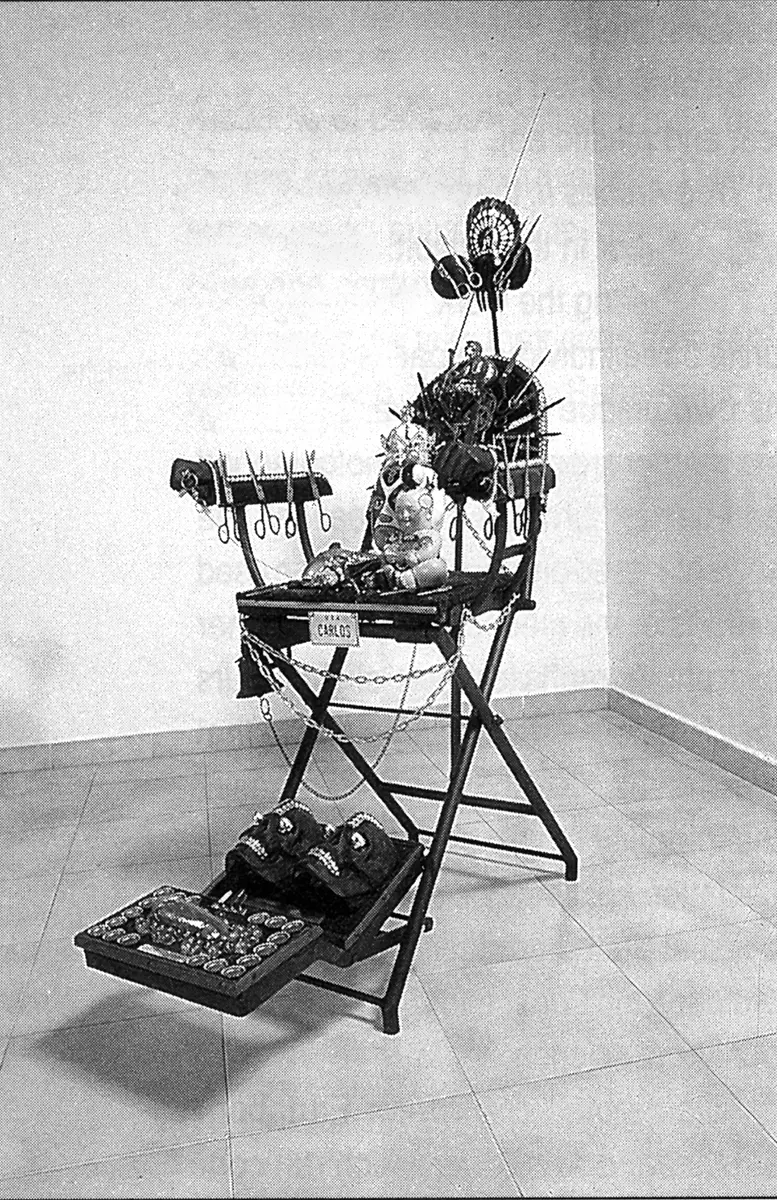
In the first room, Zerpa presented some collage-sculpture-chairs, which condensed a good part of his phraseology. Altar-chair, fetish-chair, objects intervened to the point of delirium. The arms of the two ended in human fists. His barber’s chair in particular was memorable, with countless scissors and shaving blades in its back, a burning Sacred Heart and a redundant clock mechanism, a large Spanish comb at the top, and a porcelain fish on the seat, along with a Buddha and the bust of a masked wrestler. The legs ended with a penis and a champion’s plaque dated 9-12-79.
From the ceiling of the room hang arms, hands, and legs. A mass of extremities, but without any dramatic connotation. Instead, it was rather like a room designed to frighten children.
Of all the paths which lead through Zerpa’s work, it is two-dimensional collage, his "showcases," where we can surely find his most elaborate production (followed in my opinion by his installations, ceramic pieces, and then his paintings).
These showcases with all kinds of things and colors evoke a sense of irony, violence, the fervor of the figurative, and the infinite association of images and stories. In these Zerpean boxes, we find the echo of a festive, popular world, the world of childhood, things uncontaminated by the tribulations of life.
Indeed, his boxes are always far from the turmoil of politics and systematically recreate a Latin American kind of time, the characteristic features of which are a sense of irreverence, the use of film—with its myths and idols, children’s notebooks, things pleasantly sacred, useless collectables, Disney, cultured things through painting and popular genres.
Through these showcases we see the gramophone records of Rafael de Paz’s orchestra, with María Victoria singing the bolero Como no, the figures of Dr. José Gregorio Hernández, dice, coins, knives, keys, Frida Kahlo, medals, the Beatles, teeth, bloodied nails, little mermaids, cocks, watermelons, devils, Adam and Eve, Italian flags, Batman, measuring tapes, Les Demoiselles d’Avignon, scissors, The Three Crazies, soda caps, packs of cards...Everything is a dream, everything is imbued with a positive spirit, evoking a common culture which is Latin American and urban, the world of childhood, the 1970s. A chimera of what we are and an illusion of what defines us. In one of the showcases, the central image is Henri Rousseau’s La Bohémienne Endormie (1897), in which a wandering woman has fallen asleep in the middle of an infinite landscape: she is holding a mandolin and a jug, and a lion passes by, sniffs her, but does not attack. Zerpa surrounds the Rousseau model with lots of small, old keys: the key, dream, the staircase, and the cards make up the vortex of the oniric world, with an open-ended grouping of images, strong colors, and a persistence of humor heterogeneous elements converging around an Arcadia in the Caribbean.
JUAN CARLOS PALENZUELA