
The spiritual, a component of artmaking from time immemorial, continues to inform artistic modes in multiple ways. Whether in the form of abstraction or figuration, the search for and expression of spirituality is as compelling today as it was in the radical visionary work of the earlier modernists.
Ceremony of Spirit: Nature and Memory in Contemporary Latino Art investigates spirituality in nature and memory in the works of sixteen artists of Chicano, Latino, and Caribbean backgrounds who live in the United States. The show reflects the long-held concerns of its curator, Amalia Mesa-Bains, who has closely examined questions of spirituality from within her own Chicano community. In her multiple roles as artist, curator, writer, and cultural critic, Mesa-Bains has contributed a new body of critical and curatorial work on artistic practices of contemporary Chicanos to recent scholarship.
The well-considered selection of paintings, installations, and multimedia works expands her view by presenting a broader group of Latino artists. They include Santa Barraza, David Zamora Casas, Josely Carvalho, George Crespo, Ismael Frigerio, Álvaro García, Jonas dos Santos, Ester Hernández, Arturo Lindsay, Frank López-Montnyk, Aida M. Mancillas, César A. Martínez, Pepón Osorio, Marcos Raya, Patssi Valdez, and Regina Vater. The show is organized around three themes: “Memory and the Ancestral Imperative,” “Voices of Life: The Popular Arts and Acts of Faith,” and “The Cosmological Terrain.”
Remembrances of the past are powerful forces in the imaginative expressions of Latino artists. For Chicanos, memory connects a divided ancestry (the annexation of northern Mexico to the United States in 1848). The ancestral imperative explored by several artists refers to both a personal lineage and a collective heritage. In, for example, César Martínez’s painting, Reinvented Icon for This, the artist features ancestral mother, Tonantzin (Náhuatl for mother), otherwise known as the Virgin of Guadalupe. In the Chicano world view, her presence emblematizes struggle and identity.
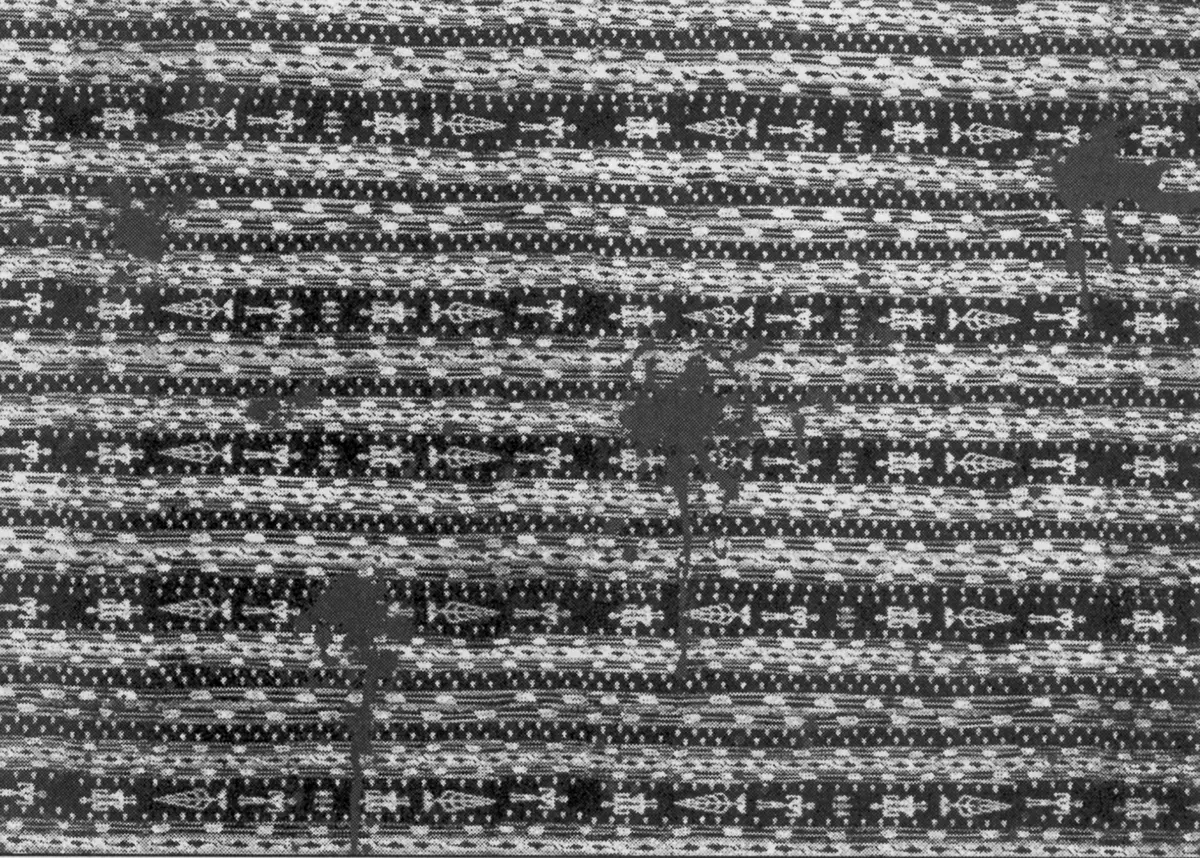
Regarding exploration of “The Cosmological Terrain,” Ester Hernández’s Tejido de dos (Weaving of the Disappeared) is a beautiful work which draws upon the textile patterns of a rebozo, a shawl-like garment worn by Central American women to cover their shoulders or heads. The black and white geometric design (silkscreen on canvas) is interspersed with rows of small images of helicopters, skeletons, and trees. Red stains dot the narrative landscape, recalling the recent wars in Central America where suffering and death were everyday occurrences.
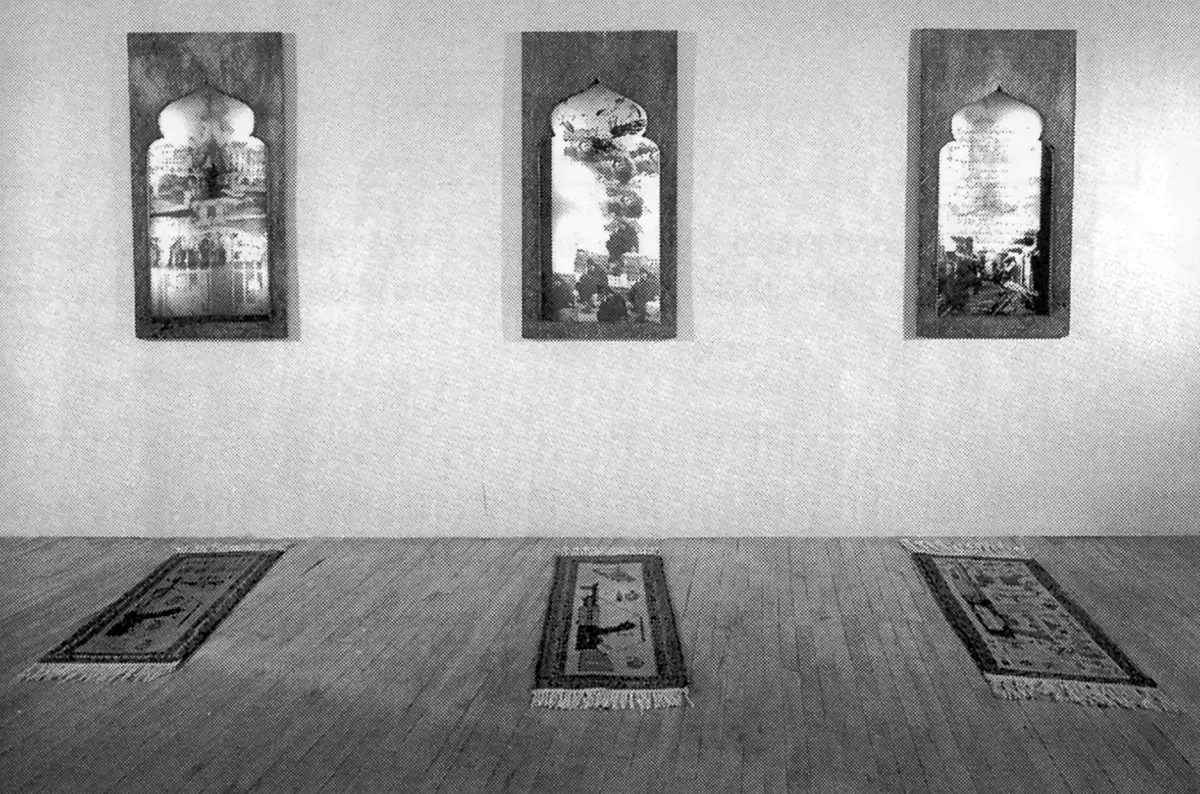
The subject of human struggle and spiritual survival is also addressed in Josely Carvalho’s It’s Still Time to Mourn: Dia Mater I Series. The installation consists of three windows in the form of mihrabs (prayer niches in mosques). Each contains images of the wars in Yugoslavia and Iraq. There, land and life are destroyed, and the survivors are left to mourn.
Ismael Frigerio’s early memories of the Atacama desert (in northern Chile) motivated his return there to incorporate elements-of nature in his installation Nature as Never- rending Witness. In the great salt desert, history lives on in the fossilized memory of nature, where the dead are buried in the landscape.
Several artists’ work centers around the theme of “Voices of Life: The Popular Arts and Acts of Faith.” Their subjects are drawn from everyday life, in which details of affiliation, social practice, and ordinary ceremony occur. Santa Barraza, El milagro de mi hermana (My Sister’s Miracle), embraces the ex-voto tradition of painting. Her narrative, linking past and present events, records a miraculous intervention. The image of the maguey plant functions as an allegory of rebirth, affirming the defiant spirit of a people twice colonized.
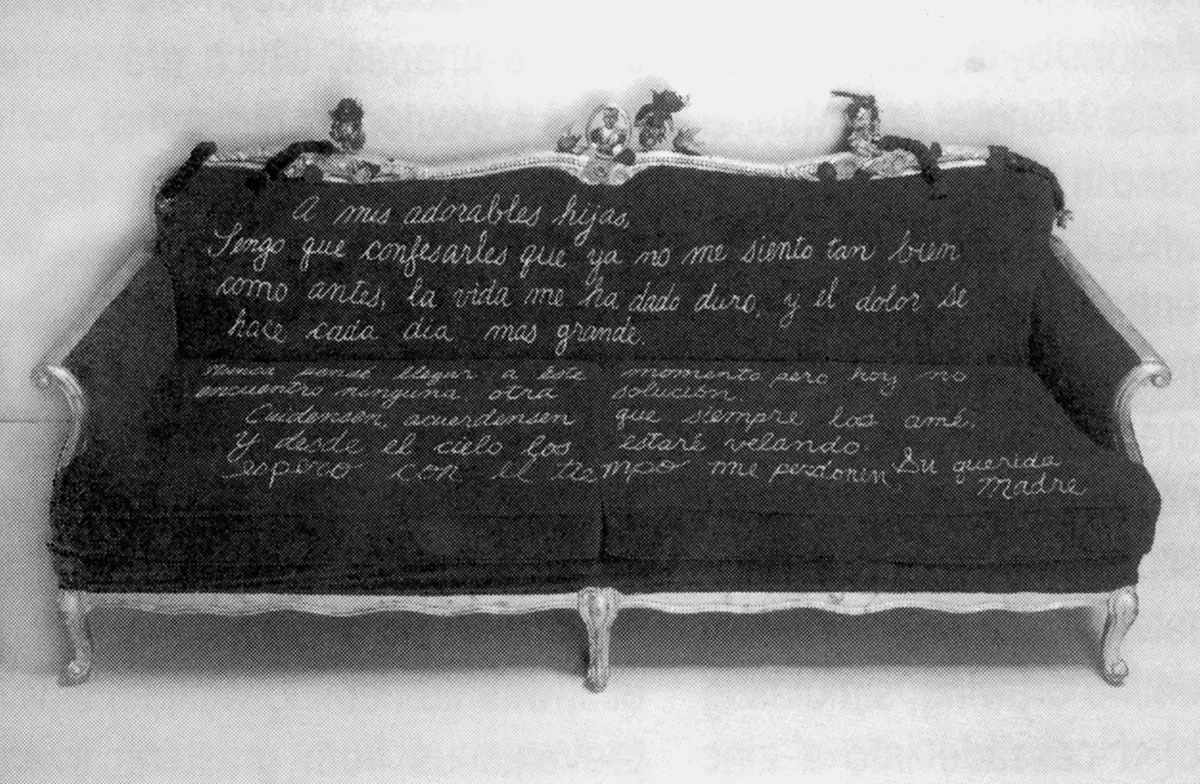
Pepón Osorio’s powerfully moving story of a mother’s final message to her daughters is handwritten on a sofa. A mis adorables hijas (To My Darling Daughters) reveals the intimate thoughts of a woman whose life is about to end. The sofa is one of Osorio’s many elaborate objects created to communicate aspects of larger histories of people and their experiences in his Puerto Rican community.
Spirituality is embedded in George Crespo’s installation, La vida ficticia muy ordinaria de José Luis Labrador (The Fictitious and Very Ordinary Life of José Luis Labrador). The artist attempts to create a primordial space through his use of organic materials, including seashells, fossils, and stones. Each of the twelve stations features hanging masks and offerings suggesting the traces of a liturgical story.
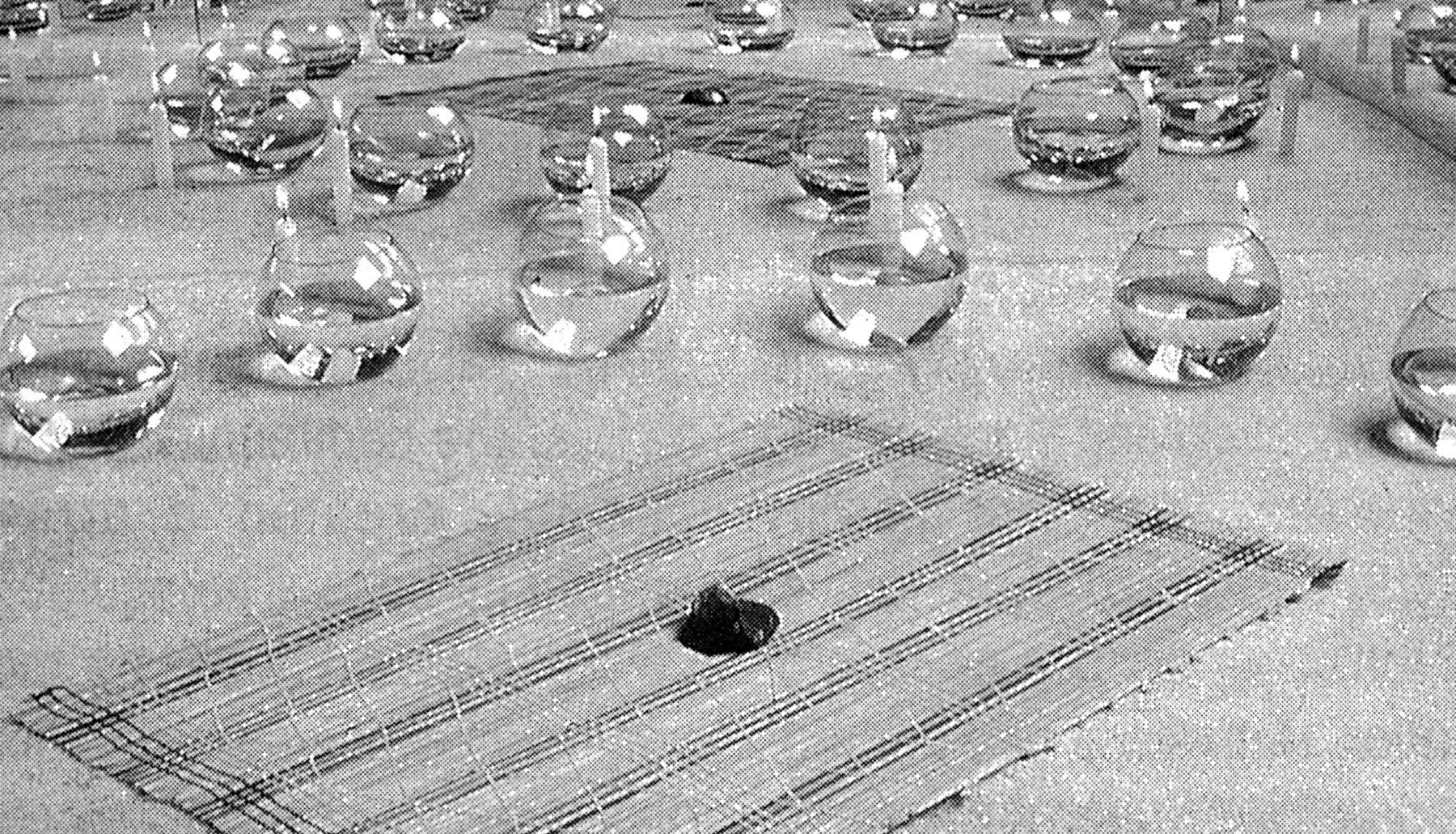
Arturo Lindsay investigates African aesthetic retentions in Latino communities. His Homenaje a Obatalá is a tribute to the Yoruba-Cuban deity of creativity. His rich blending of varied elements is paradigmatic of the layering of sources found in the cross-cultural beliefs of Latinos. Regina Vater’s Itá-Olá is a most delicate installation of glass flasks, candles, and sand. Its starting point comes from old beliefs of the Brazilian Tupí-Guaraní and the Yoruba of Brazil regarding the sacred nature of stones.
This show provided a welcome opportunity to ponder over the ways in which Latino artists, from diverse geographic and cultural communities, reaffirm issues of spirituality in relation to memory and nature. Organized by the Mexican Museum in San Francisco, the show is presently at The Studio Museum in Harlem in New York. The catalogue’s three fine essays are by Amalia Mesa-Bains, Víctor Zamudio Taylor, and Arturo Lindsay.
JULIA HERZBERG