
Consuelo Castañeda and Quisqueya Henríquez belong to the generation of Cuban artists who left the island in the latter part of the I980s and settled temporarily in Mexico City. For a couple of years, the Mexican artistic scene was enriched by the energy and effervescence of a new community of artists who gathered around the Nina Menocal Gallery. In addition to Castañeda and Henríquez, the group included José Bedia, Arturo Cuenca, Rubén Torres Llorca, and Ibrahim Miranda. Eventually, for political and economic reasons, most of these artists went their own ways. Some, like Ibrahim Miranda, went back to Cuba; others emigrated to New York, and yet others, including Bedia, Torres Llorca, Consuelo Castaned, and Quisqueya Henríquez, decided to move to Miami and settle permanently in the United States.
Of this group of artists who resided in Mexico—almost all were painters—Castañeda and Henríquez produced works which examined the meaning of style in the history of Western art. Between 1986 and 1992, Castañeda did a series of paintings that appropriated well-known styles and incorporated quotations from the works of Frank Stella and Roy Lichtenstein, Peruggino, and Boticelli. The sculptural composition a Léger Frame for Romanesque Mosaic (1992) is a work with a lot of humor which emphasizes violently the materiality of what we call "style" as it juxtaposes two completely different artistic modes: a fragment of romanesque mosaic in black and white, and the thick, coiled monochromatic frame in the style of Léger.
During this Mexican period, Quisqueya Henríquez also explored the relationship between style and form in the history of art. Her sculptural pieces —woven with the most varied and baroque kinds of fabric, patterns, and colors— were three-dimensional letters which formed key words in the history of aesthetics, such as “middle ages,” “harmony,” “return.” They were works with a lot of humor that tried to imagine the materialization—body, form, texture—of the theoretical and abstract concepts so frequent in aesthetic discourse.
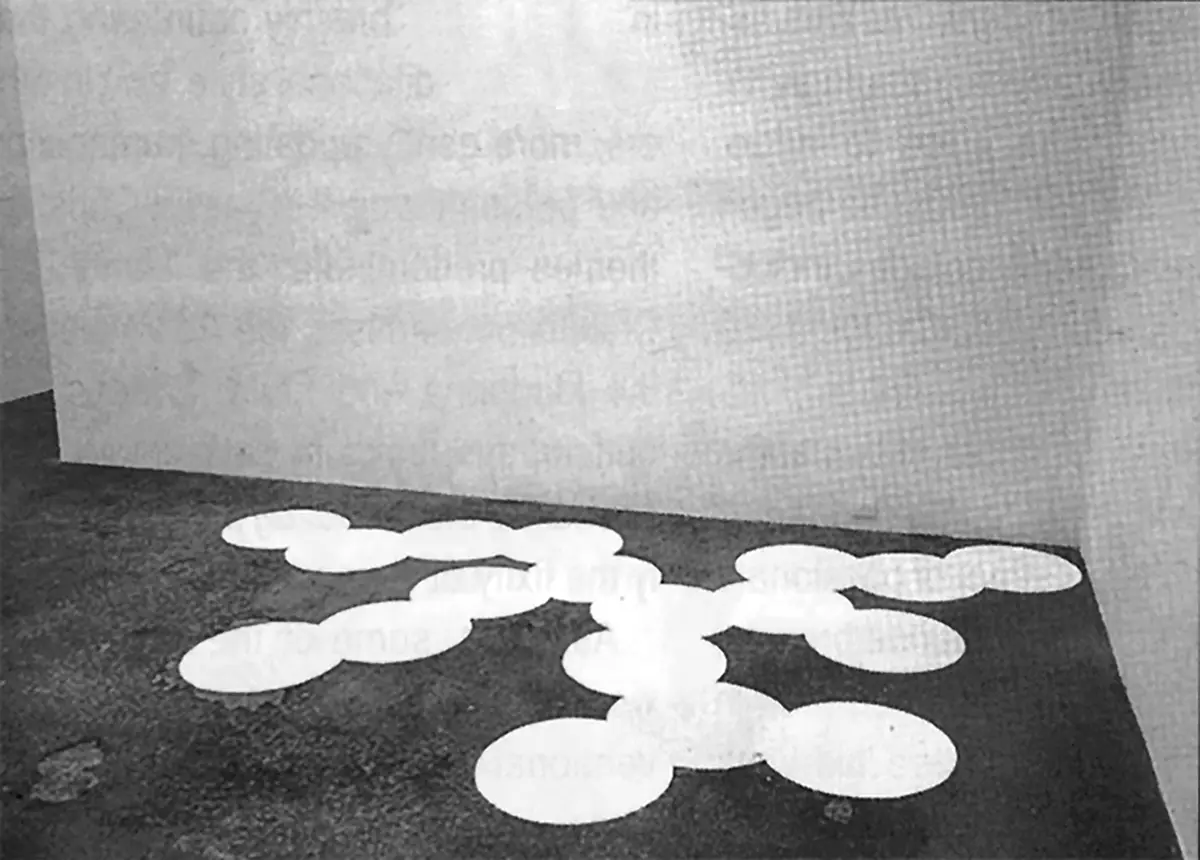
At first sight, the collective installation in the Morris Healey Gallery seemed to mark a radical change in the style and themes that these two Cuban artists used during their residence in Cuba and Mexico City. The work—whose minimalist use of laboratory materials recalls the severe conceptual aesthetics of the 1970s, consists of two complementary parts. On the floor, a series of white circles appear linked together, which on closer inspection reveal themselves as being composed of white powder; only on reading the accompanying fiche do we realize that each circumference contains a different substance—sugar, salt, plaster, flour, sodium bicarbonate, detergent, boric acid. The second part of the installation, mounted on the surrounding walls, consists of eight pairs of receptacles placed on steel shelves. Each pair presents a variety in the form of the vessel (straight or round), the level of liquid it contains, and the type of liquid (which may be water or oil, but as in the case of the powder, it is undistinguishable at first sight).
Despite the apparent break between this project and the pieces that these artists had previously created in Cuba and then in Mexico City, the main theme of the installation—the perception of difference—has been a constant feature in the work of both. The parodies and quotations from well-known works by Consuelo Castañeda are an exploration of the perception of stylistic differences in the history of art. And a recent installation by Quisqueya Henríquez—presented simultaneously at the Joan Lehman Museum of Contemporary Art in the Fredric Snitzer Gallery and in the artist’s studio, examined the enormous differences (imperceptible at first glance) in terms of prestige and commercial possibilities offered by three spaces (the museum, the gallery and the studio), which are almost identitical physically and architecturally.
RUBÉN GALLO