One can only imagine the extreme precariousness and the social instability of the years that followed the near-total destruction of Mexico-Tenochtitlan, or the severe and lengthy process that gradually led to the opulent facades of New Spain. When the viceregal elites began their enterprise of raising cathedrals, monasteries and public works, as well as commissioning the production of painters and sculptors, it was done with the aim of outwardly manifesting a loyalty to the faith and of displaying an (often tentative) abundance of material wealth, largely in order to consolidate that new order over which they would prevail. In the words of one subsequent observer, Alexander von Humboldt, "Nowhere does there exist such a fearful difference in the distribution of fortune, civilization, cultivation of soil, and population." Yet for all its appearances and discrepancies, colonial society was also wrought with its share of specific natural calamities—epidemics and eventual flooding in Mexico City, for example, or the grim reality of seismic disasters—in addition to more general human misfortunes and illnesses that must have been an ominous presence within viceregal everyday life.
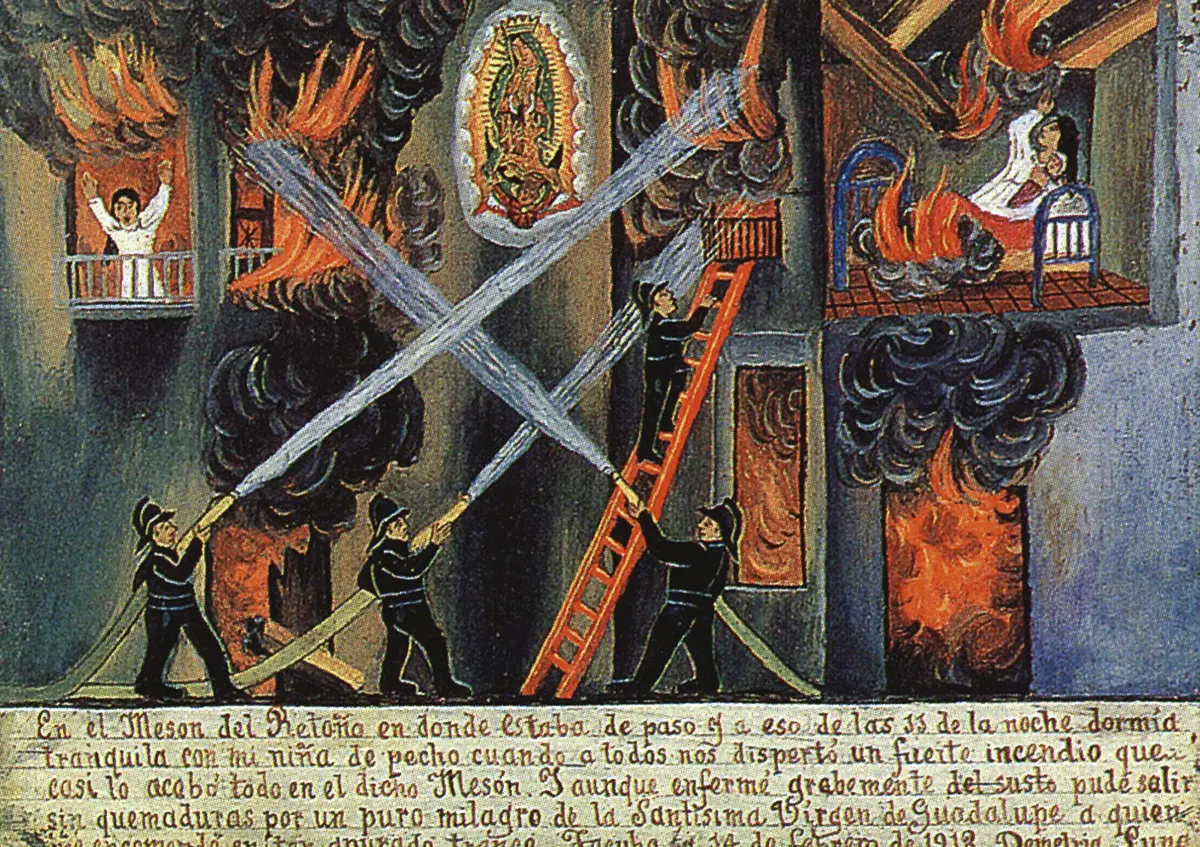
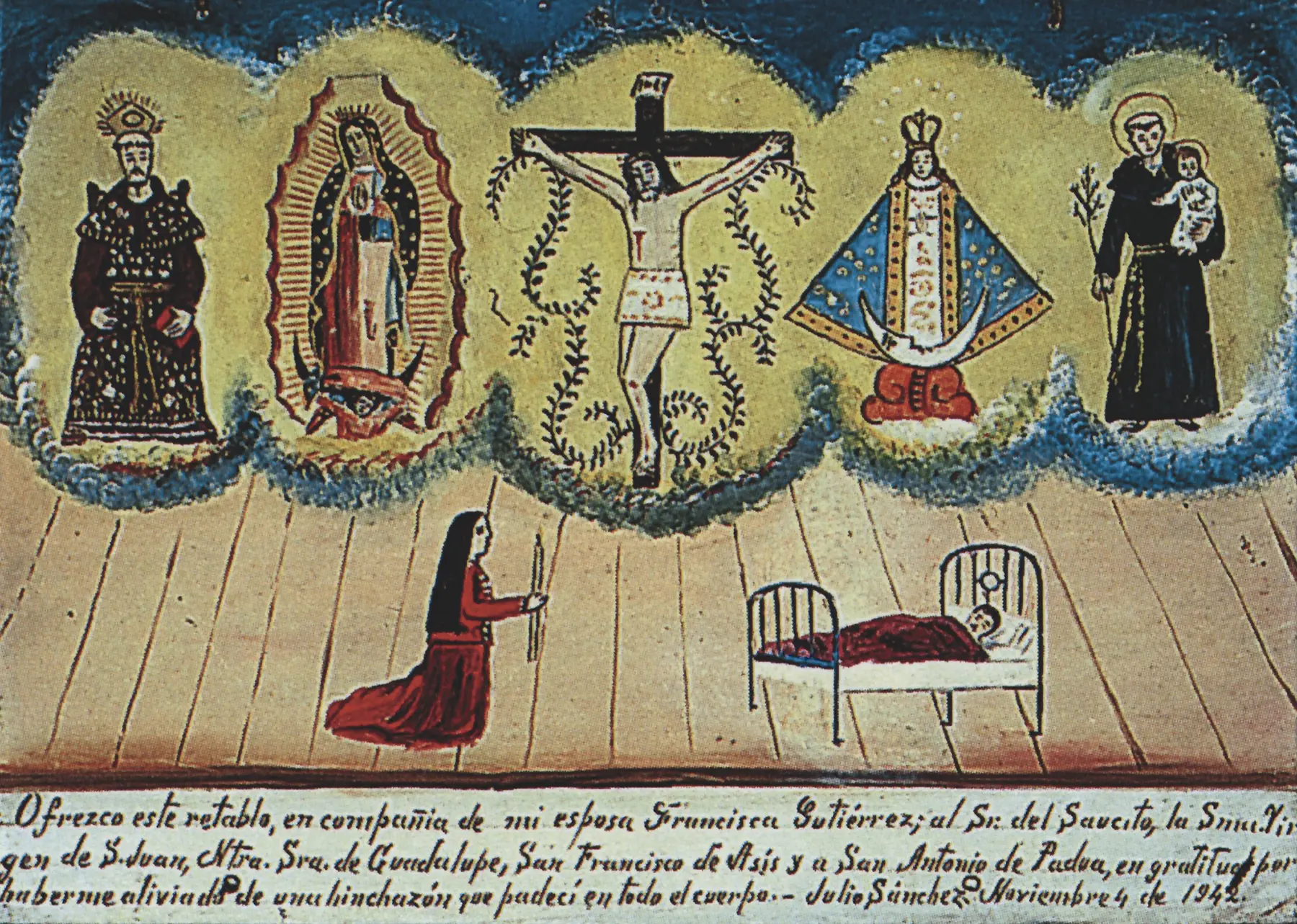
A parallel and increasing preoccupation with the phenomena of the physical world in painting of the time, a direct legacy of Europe's High Renaissance, would give way to a form that came to be known as the exvoto. This genre, not unlike pintura de castas—or painted depictions of New Spain's racial mixing—is certainly unique to the Americas. In its more-or-less canonical smaller formats, the exvoto consists of a scene that renders, in varied visual terms, the manifestation of a miracle, with a legend inscribed below commemorating either a particular saint or any one of the different apparitions of the Virgin Mary, in gratitude for having intervened on behalf of a petitioner's plea, and sometimes carrying with it an implicit commitment to life-long devotion thereafter.
Although first expressions were undoubtedly rendered in the realm of colonial "high" art, it soon became more widespread and was eventually appropriated by Mexico's vernacular imagination. There, it developed into innumerable variations on a theme, expressing marvel and thanksgiving when the will of God irrupts into the ordinary, albeit erratic, course of nature. Parallel to certain depictions of the crucified Christ, the exvoto naturally lent itself to myriad renderings of the body in pain. Despite its miniature format, it managed to include a wide range of narrative and painterly devices to convey the drama of healing, the aura of transfiguration, and the celebration of prodigy, claiming the triumph of faith and divine intervention over disease, accident, and catastrophe. In its most touching examples, the exvoto poignantly explores the visuality of mediation in what might be considered a public, spiritual, and physical manifestation of debt.
With over three hundred examples from fifteen states in the Mexican Republic, Dones y promesas: 500 años de arte ofrenda is an exhaustive gathering that offers certain speculation as to the rise of this devotional art and its impressive formal diversity. The exhibition makes an effort to trace a possible genealogy, beginning with a series of pre-Hispanic burial offerings. Conceptually it is difficult to discern how these pieces are to be read in immediate juxtaposition to early colonial engravings of the Virgin, or the monumental Procesion franciscana de Tlatelolco al Tepeyac implorando la intercesion de la Virgen de Guadalupe para aplacar la peste (cocolixtli), a nearly mural-sized canvas in reference to the 1544 plague that decimated much of Mexico City.
Without providing sufficient historical context, this colossal curatorial leap and bit of forced continuity obviously fails to account for the religious upheaval of Mexico's conversion to Catholicism. In fact, one of the gallery notes posits an extremely debatable idea using a quote by Anita Brenner: "The notion of the miracle was one of the few ideas that the medieval Spaniard and his Mexican contemporary could have discussed without major misunderstandings." [La noción de milagro fue una de las pocas ideas que el espanol medieval y su contemporáneo mexicano pudieron haber discutido sin mayores malentendidos.] Nevertheless, most of the didactic material accompanying the show is to the point, especially in terms of certain formal aspects. One text intelligently addresses how a typical composition in the genre may be divided into planes of the human and the divine, as discursively and formally upheld by the cartela or legend that serves as the lower edge.
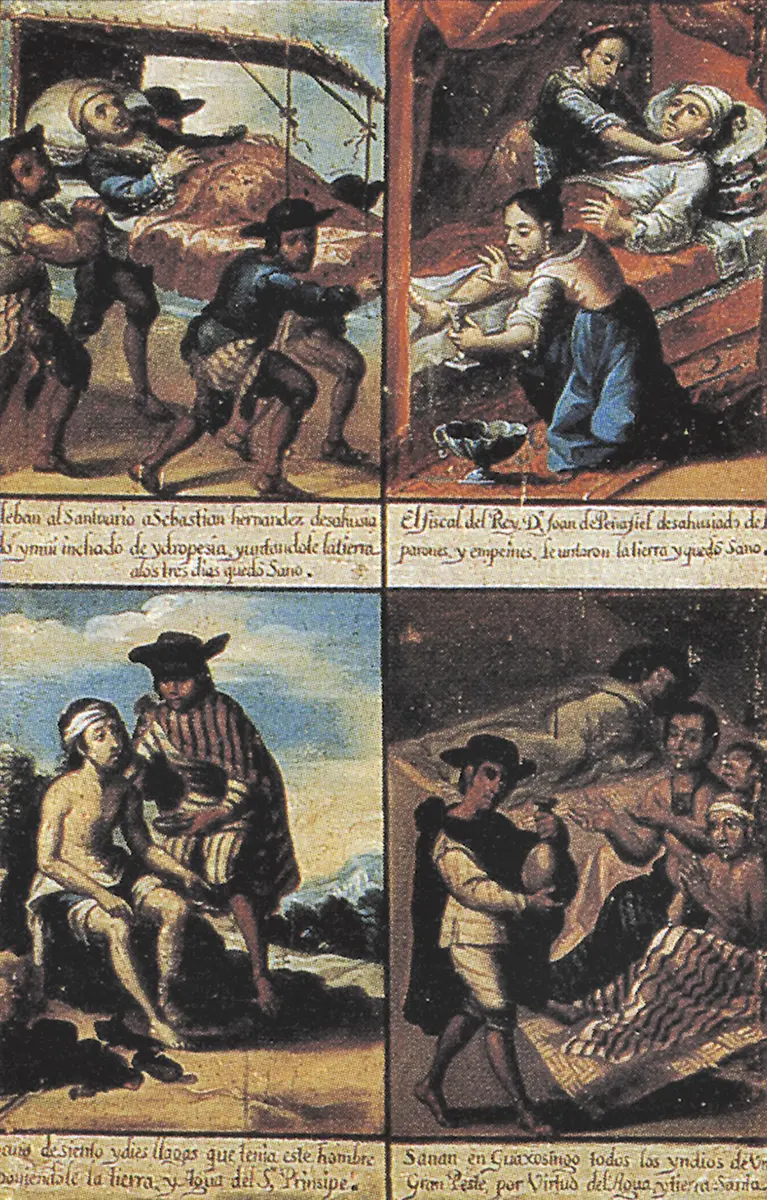
Some of the other "antecedents" to the genre are of particular interest, especially an anonymous painting that stands as a reminder of the ever-prevailing threat of shipwreck that plagued the Manila Galeón on its route between the Philippines and Acapulco. In one anonymous exvoto from the eighteenth century, as in others, the pictorial plane may be divided into several compartments, recounting a series of prodigies, as if to constitute a veritable book of days. Not only do many of these small works chronicle the architecture, attire and other exterior effects of New Spain—as well as, to a lesser degree, its racial miscegenation and class divisions—but also the pathology to which viceregal life could be victim: from leprosy, inflammation, mange, smallpox and epilepsy to "acute melancholy morbu deliriosa" [fuerte melancolía morbu deliriosa] and "cholera morbus, spewing charred liquid humours without eating or sleeping" [coléra morbus, echando el humor líquido requemado sin comer ni dormir]. They also serve as a catalogue of the accidental, from fires and raging bulls to the casualties of war. It is in this sense that they can be read in a more profane light as responses to the awe-inspiring nature of the body's extraordinary capacity to convalesce— and, more importantly, to the body's often inexplicable capacity to resist its inevitable end.
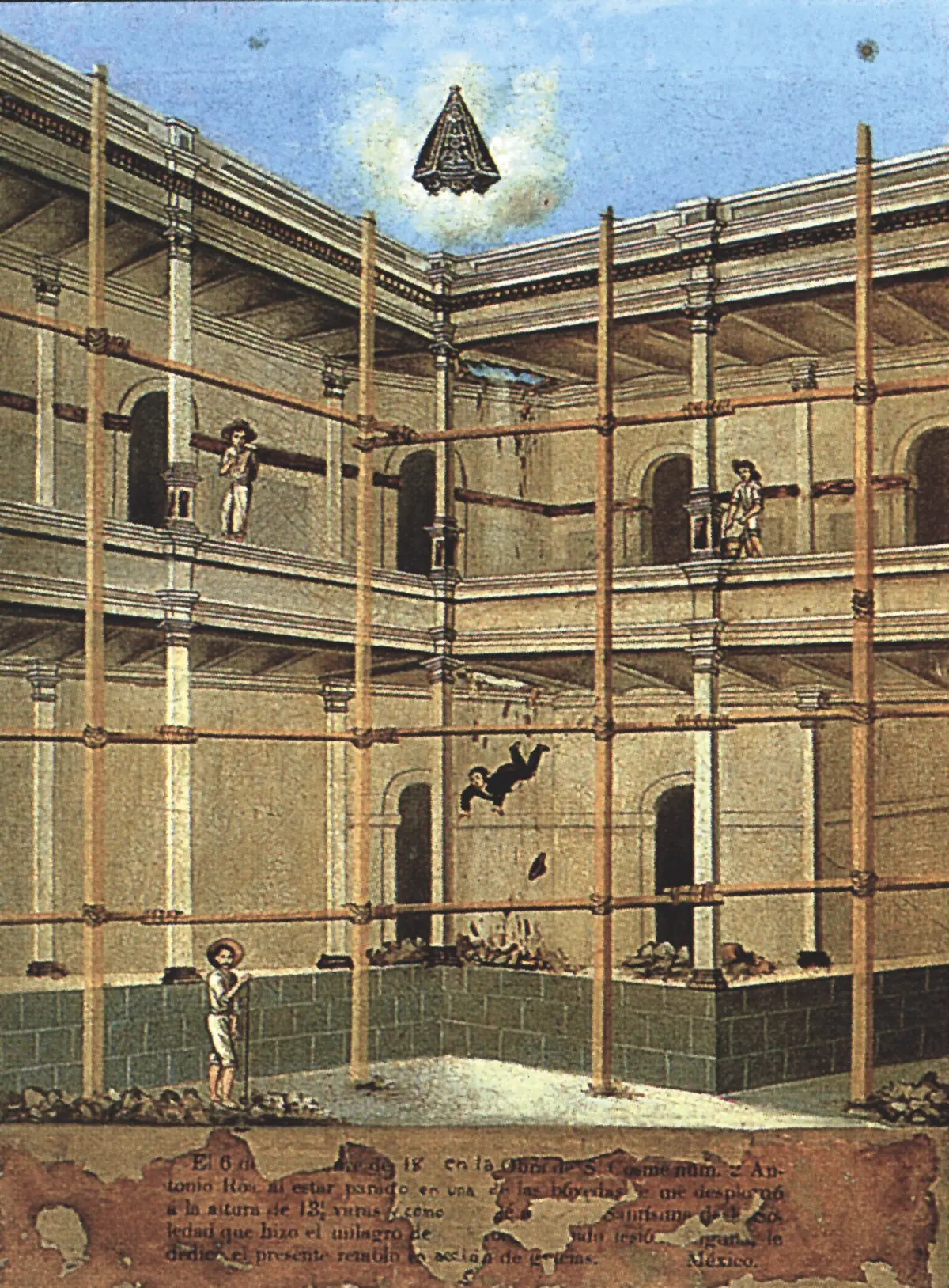
The flourishing of the exvoto as a vernacular art in the nineteenth century is represented here by various provincial schools that emerged in Jalisco, Zacatecas, and San Luis Potosí. Now painted primarily on metal plates,1 none surpasses the deft psychological insight of Hermenegildo Bustos, who worked in the state of Guanajuato. One of the most enjoyable aspects of the exhibition is a series of galleries in which exvotos have been divided thematically—prisons, violence, thanksgiving, and war (including a certain José Luis Palafox "wounded in combat in Vietnam"), as well as rural dilemmas and failed harvests.
The re-appropriation of the genre into "high art" during the twentieth century is represented by modern masters such as Ángel Zárraga, Manuel Rodríguez Lozano, Gabriel Fernández Ledesma, Fridha Kahlo and María Izquierdo— all of whom, to greater or lesser degrees, either included a depiction of an exvoto within the frame or employed aspects of the generic structure itself. A final inclusion of contemporary artists would have greatly benefited from the precept that "less is more," featuring only that work which manages to critique or reinvent the exvoto as an endemic legacy—that of Francisco Toledo, Nahum B. Zenil, Germán Venegas, Magali Lara, and Sergio Hernández.
In one sense, Dones y promesas [literally "gifts and promises"] makes the unfounded claim that, despite the historical displacements of the "encounter," modern Mexico is founded on a commonality which is essentially devout. It becomes impossible to ignore, however, that it is also an art that arose out of the anxiety instilled by the less amiable sides of Catholic dogma. While showing the unabashed opulence of those privileged by colonial society—and later its humbler underside—the exvoto is a genuinely moving genre about the tributes paid to the miraculous turns of fortune; about a world in which nothing is arbitrary; about blessings returned and transformed into the diminutive testaments of gratitude facing the overwhelming and often unaccountable world of events.
NOTE
1. There is an argument to be made, in fact, that this change from canvas to metal led the format away from the full, sinuous, and contrasted work before it, to the flattened color and conceptual space of the typical frontal composition and its domestic scale.
Photographs are courtesy of the Centro Cultural/Arte Contemporáneo A.C., Fundación Cultural Televisa A.C.
ROBERTO TEJADA
He lives and works in Mexico City, where he currently edits Mandorla, a yearly journal in English and Spanish of advanced poetry and poetics from the Americas.