
Eduardo Pradilla and Frangois Bucher organized an unusual exhibition at the Santa Fe Gallery in Bogota during the months of June and July, entitled The Players, which consisted of 25 large format photogrammes in full color, scanned copies of original photographs by Julio César Flórez, arranged together in groups of five on strips stuck on the wall. Between and above each block of photographs, there was a narrow wall clock, in a black painted metal case, with black hands, and below, four placards with some disturbing words: "Indication," "Crime," "Conjecture," and "Evidence" The spectator was invited to use these images and indications to create a kind of serie noire film gyrating around the dazzling world of the casinos. Pradilla and Bucher did everything possible to ensure that this could be achieved. First, they went to a well-known casino in Bogota, full of mirrors, lights and fantasy, where they were photographed by Flórez, along with a woman friend, a familiar face from Colombian television, in the roles of three unlikely characters: John Coltrane, Hakim Mery and Edda Manrique, playing black jack at a table run by three enigmatic women croupiers. Except that their roles were acted out without words or movements, just as when we are in front of a photographic camera. The action, the drama, the crime in which they were probably involved could be detected only through indications, alterations in positions, gestures, or even in the clothes worn by the unusual actors. Any photograph is a luminous trace of something or someone, but it is also an indication that, as was clearly demonstrated in Antonioni’s film Blow Up, it can actually become evidence. Of course, with the indispensable help of conjecture, a mental construction which gives shape and substance to suspicion.
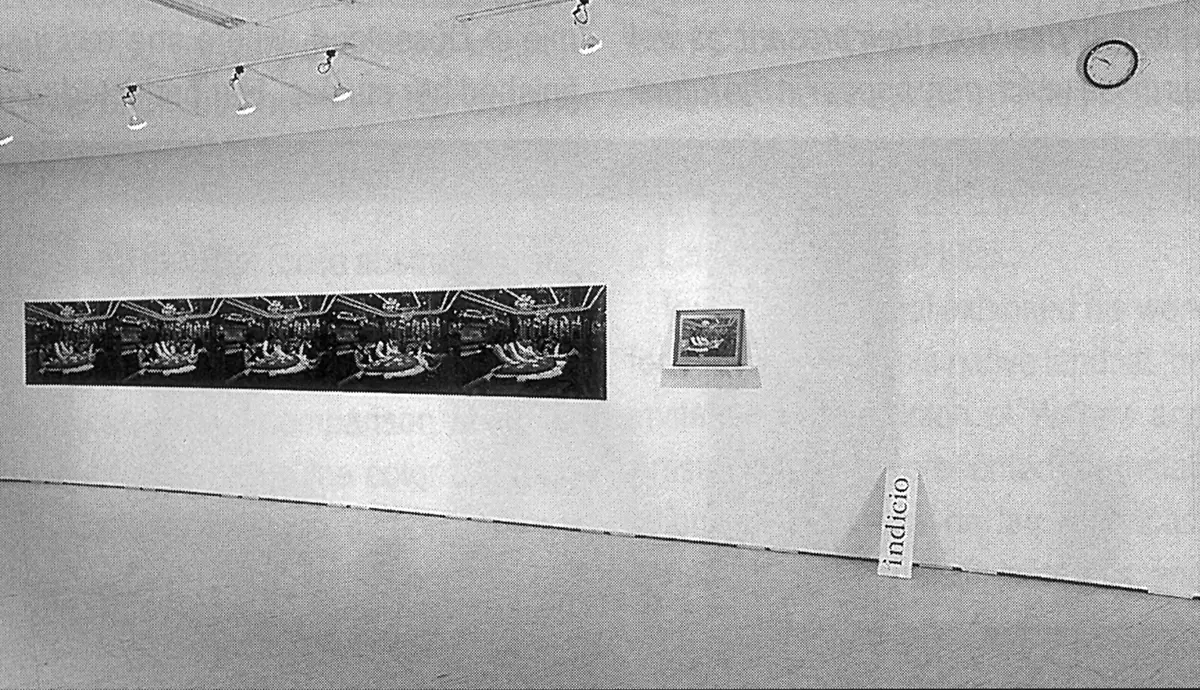
However, Pradilla and Bucher were not simply revealing the hidden aspects of photography, whose display would have attracted the attention of Umberto Eco, the philosopher of traces, signs, and indications. This exhibition was in fact an installation, in which both Pradilla and Bucher managed to activate a much wider field of meanings and interpretations. The closest and most immediate concerned the associations between this casino and these players and the social reality of a country like Colombia in which human life has acquired a completely hazardous nature, swinging arbitrarily between bullets and buffoonery, ambushes and kidnappings, irreparable squalor and the mortal roulette on which those involved in some illegal shipment of cocaine place their bets. Not to mention such impressive sociological phenomena as the so-called «airplane game», which recently turned the city of Cali into one multitudinous, chaotic, and frenzied casino.
But other interpretations are possible. For example, the one which emphasizes that Pradilla and Bucher associated to their work the clock, photography and roulette, instruments of the privileged ones, no longer of a country like Colombia, but of a whole civilization —our own— asking for the due permission from those who are its integrants and who consider themselves the owners of its origin.
The clock is a means and instrument for measuring time, which is mechanical, linear, and causally ordered. The roulette functions at the opposite extreme, a means and instrument of chance and the calculation of probabilities. And in between the two, there is photography, which destroys linear time, to give way to the freedom of chance and hazard. The only freedom left to us.
CARLOS JIMÉNEZ