As Ernesto Pujol himself has said, the conceptual basis of his work is the archaeology of memory. A constant search, obsessive almost to the point of becoming pathological, for his lost cultural identity, first when he was taken by his parents from Cuba to Puerto Rico, at the age of four, and then, on finding himself part of a minority in New York, where he has been struggling to establish himself as a Latino artist, since 1985.
In April 1995, Pujol exhibited his work for the first time in his native land, at the invitation of the Union of Writers and Artists of Cuba. He presented five installations at the Casa de las Americas, done with local domestic materials, and grouped together under the title Children of Peter Pan. The work was a tribute to Ana Mendieta, the first Cuban-American artist, who presented her work in Cuba twelve years before Pujol, and to those who, like her, emigrated as children in the Peter Pan Plan. Most of the children who participated in this plan were placed in North American schools, orphanages, and families, in wait until their parents could join them. This process went on for many years, and many of the children developed psychological traumas or had to confront identity crises in various degrees of intensity, racial problems, adaptation difficulties, a sense of not knowing where they belonged, nostalgia for their native land, home, and family.
In July 1995, Pujol once again exhibited his work in Havana, along with Manuel Alcaide, in a show organized by Sandra Ceballos and Ezequiel González, at the Espacio Aglutinador. In this show, Pujol again emphasized the world of children and the themes of displacement, memories, the domestic environment, and castration, using found objects. The exhibition was entitled Cold War Trophies.
In June 1996, Pujol was back in Havana. Under the auspices of the Ludwig Foundation, he presented in the Center for the Development of the Visual Arts an installation entitled Saturn’s Table. It should be noted here that Pujol is risking his career by presenting his work in Cuba, since it could result in hostility from some artists, collectors and galleries in Miami and a resulting loss in promotion possibilities in the United States.
At the inauguration, which was attended by a large public, the gallery was closed and almost dark. The artist sent groups of twelve people at a time inside, in a deliberate attempt to create an intimate atmosphere and to emphasize the message of his work. Our perception of the work would thus be conditioned by the state of mind created by the orchestrated atmosphere: an effect of surprise and apprehension, a sense of theatricality and drama.
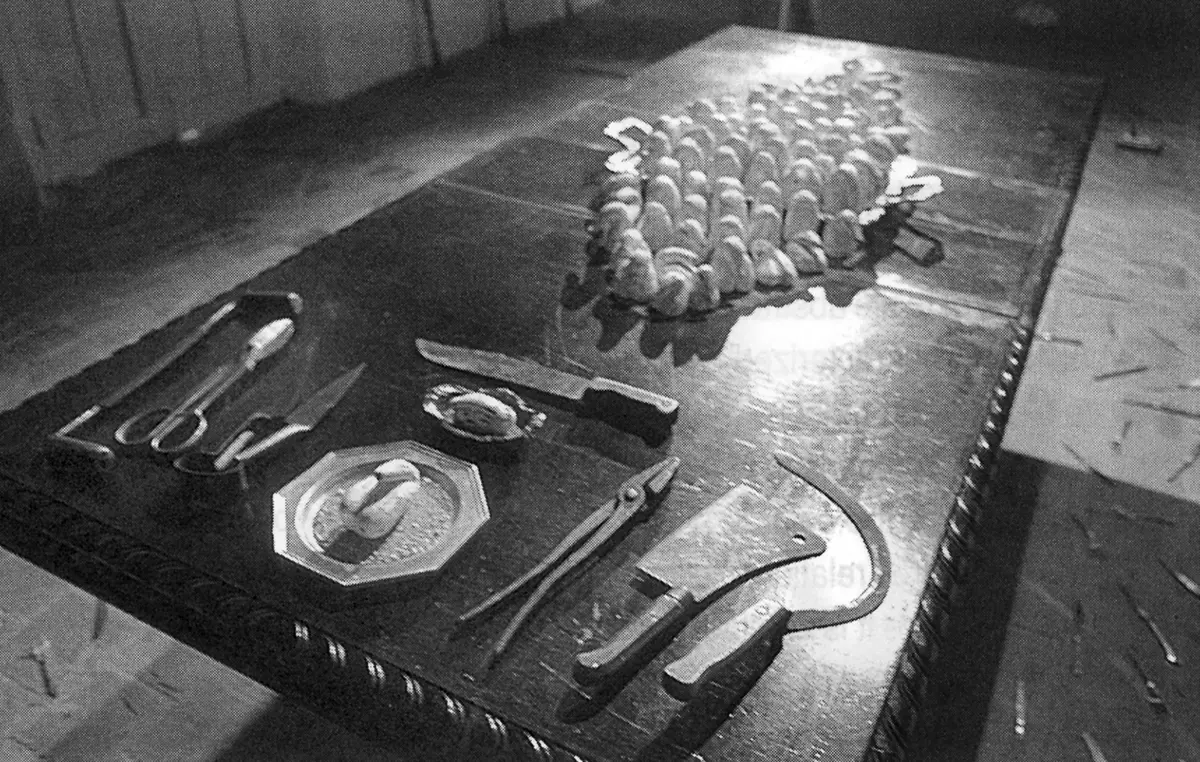
In the penumbra created by the meager lighting, a solid high-backed chair could be seen in a room. Although empty, the chair was imposing, a kind of throne, suggesting that it belonged to some patriarchal figure, absent for the moment. A place of power. In front of the chair, there was an enormous table, with a tray bearing male genital organs in plaster, and instruments for cutting: knives, scissors, a scythe...all of very large size. On the floor, in front of the table, there were more genitals, one of which was caught in a cord, suggesting strangulation. There were more knives and forks on the floor, ready to devour the castrated sex.
In Greek mythology, the god Saturn devours the fruit of his creation, i.e. his own children. The question here is whether Pujol was referring to political power, which can be castrating for a person, in the general sense, the power of the father in a machistic and patriarchal society, where authority leads to the alienation of the children, or the relationship between the artist and his work—or all three at the same time.
The ambiguity is somewhat attenuated when we recall the personal history of Pujol, the fact that he is a homosexual, and is proud of the fact. As in the Aglutinador show, there is once again here an ironic recurrence to the concern, as it were, of the male sex about castration, the loss of the outward sign of virility, especially when the person in question is at the age of self-affirmation.
While in the earlier exhibitions Pujol insists on autobiographical elements, in cultural and emotive terms, now his reference seems to be towards an aspect which, although derived from his own history, must be set in a wider, less personalized framework. It is no longer a question of Ernesto Pujol, but of individuals, of male persons who might belong to any social, ethnic, or religious group. His concerns now extend from the individual to the human group, to the self, generically speaking, within a dimension which includes the psychological.
There is no doubt about the artistic excellence of Pujol’s work, his mastery of his medium, his fine sense of taste, the purity of the design of each element in this work, with its effective and efficient use of space. Nothing was lacking or redundant in this installation. But what might be questioned is the reiteration of this element in his discourse.
If until now he has successfully avoided the pamphleteering, banal and trite aspects of the cheap melodrama, and has presented his moving story with an admirable sense of constraint and sobriety, perhaps he could now move on to another aspect, and hopefully give a rest, at least for a while, to the subject of small penises.
The repeated recourse to infantile genitals, which have been castrated or simply placed apart in some kind of parenthesis, requires some kind of solution or resolution. Otherwise, the theme might well become permanently identified with the artist: Ernesto Pujol = male genitals, becoming a kind of trivial emblem which would detract from his proposal, viewed in the context of innovation. He himself could become a kind of Saturn, consciously or unconsciously, exhausting the resources of his own work. The degree of seriousness that he has shown in all his research up until now suggests that he can do something else if he can turn his obsessions towards new objectives.
ERENA HERNÁNDEZ