
I am as often amused as amazed by the lengths to which some art critics will go in their abracadabra and moonshine prattle over an artist’s work. "What you see," said Frank Stella, in one of the most oft-quoted statements on modernism, "is what you see." It is perhaps not always the case, of course, but at the same time, it is always part of the case.
The work of Fabián Marcaccio is a prime example. The 33-year-old New York-based Argentinian is one of the most prominent abstractionists on the scene these days, generally considered a member of a group that includes Jonathan Lasker and Lydia Dona, among others. Despite his roots, Marcaccio’s works do not fit into the Latin American genre; it is decidedly New York, and beyond that, decidedly American. Not for him are the issues of political correctness, but also not for him are the matters of spirituality and history that typify European painting. Marcaccio rather busies himself, in the American tradition, with the elements —visual elements, it should be emphasized— of painting and painting making: brushstroke, surface, plane, medium, canvas, stretcher, image, subject, and so on. The paintings on view at Barbara Farber Gallery were virtual assemblages of these components, bringing to bear the element of composition while making an oblique reference—maybe— to collage. Photographs silkscreened onto canvas interacted with both actual and silkscreened images of brushstrokes (one could not help but think of Roy Lichtenstein). What is actually depicted in these photographs is basically irrelevant; what matters is the pattern the images make, so as to create a kind of brushstroke of a pattern or a form composed of patterns, or perhaps the suggestion of printed fabric. Occasionally, the artist adds in a bit —a line, or an image, or a scrawl. Here, too, is a reference to medium, and one in which something is removed (the wax) in order to create. It is a kind of game the artist plays with possibility.
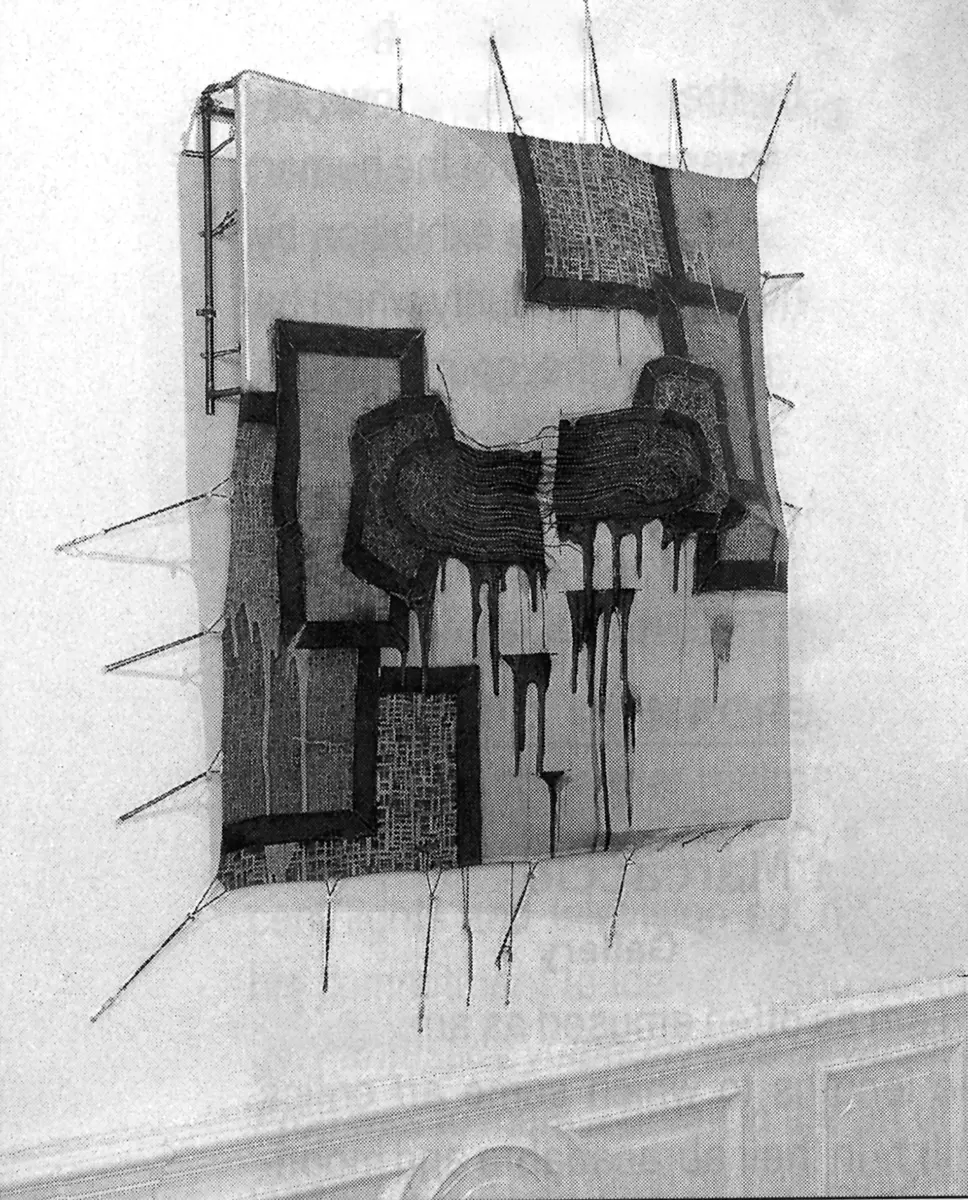
And, speaking of fabric, Marcaccio performs his amusing antics with this too: beyond the use of batik, a method specific to textiles, Marcaccio plays with his canvases themselves. Often they are not canvas at all, but burlap or even the wall itself. Enter the explorations into yet another element: texture. Some works incorporate burlap and wood, or stretch beyond the actual canvas to incorporate the wall, making possible a study of textures while articulating the issue of boundaries. (And what is the boundary of a painting? An exhibition?) At Farber, the paintings’ stretchers, made of copper pipes, often extended beyond the conventional rectangle, bending, twisting, and protruding sculpturally from the wall.
Similarly, Marcaccio’s gallery installations are carefully composed, each painting an element in a whole, so that the boundaries of the individual paintings extend, in effect, to one another, and then to the gallery space itself.
Compelling stuff, this. So why do writers on Marcaccio’s work insist on speaking of "cyber paint" and "derealization" and "the dilemma of painting" (what dilemma?)
Marcaccio’s constructions are not just explorations of and into the elements of painting: they are reminders of what painting —what art— is all about: a certain physicality, a commingling of ingredients, that together produce both the actual work of art and its effect: our contemplations of or on it.
If needs no abracadabra. This is, alone, enough.
ABIGAIL R. ESMAN