
Francisco Mariotti is an artist closely associated with the experience of rupture, which affected the country in the 1970s. A man of rigorous discipline, who studied in Switzerland and at the Academy of Fine Arts of Hamburg, Mariotti was one of the main protagonists of the currents that transformed the concept of art in Peru during that turbulent decade. His presence left an impresión in the memory of those who lived those years of uncertainty and optimism, through his experiences in the desert.
There, he worked with milk cans to create images recuperated from popular iconography (Beata Sarita Colonia, patron figure of those excluded from society); he was the leader of one of the most lucid groups of the period, Huayco, and he left his mark in the memory of all those who lived through those years of uncertainty and optimism.
At the beginning of the 1980s, exhausted by his revolutionary ardor, Mariotti decided to move to Europe, where he began to study technological applications coupled with ecological expressions which in Lima had been reflected in his enormous penetrable dome, The Circular Movement of Light (1968) and in his paradigmatic poster for Contacta in which he showed two insects copulating. Contacta was the most ambitious Peruvian project of the 1970s, in which artists worked on the myth of Inkari, travelling throughout the country as cultural promoters and attempting to reproduce at a popular level the effervescence of an art without obstacles or censorship.
Eight years after his departure, and after a period of intense activity in Europe, the former leader returned with a show in which his sensors, PC, fluorescent lights, and television set reflected his commitment to ideology and ecology. Fantastic Symphony for a Bewitched Frog was to mark a break in the art of a country which had been overwhelmed by the excesses of violence, which found in the variants of neo-expressionism the most appropriate language to capture its reality.
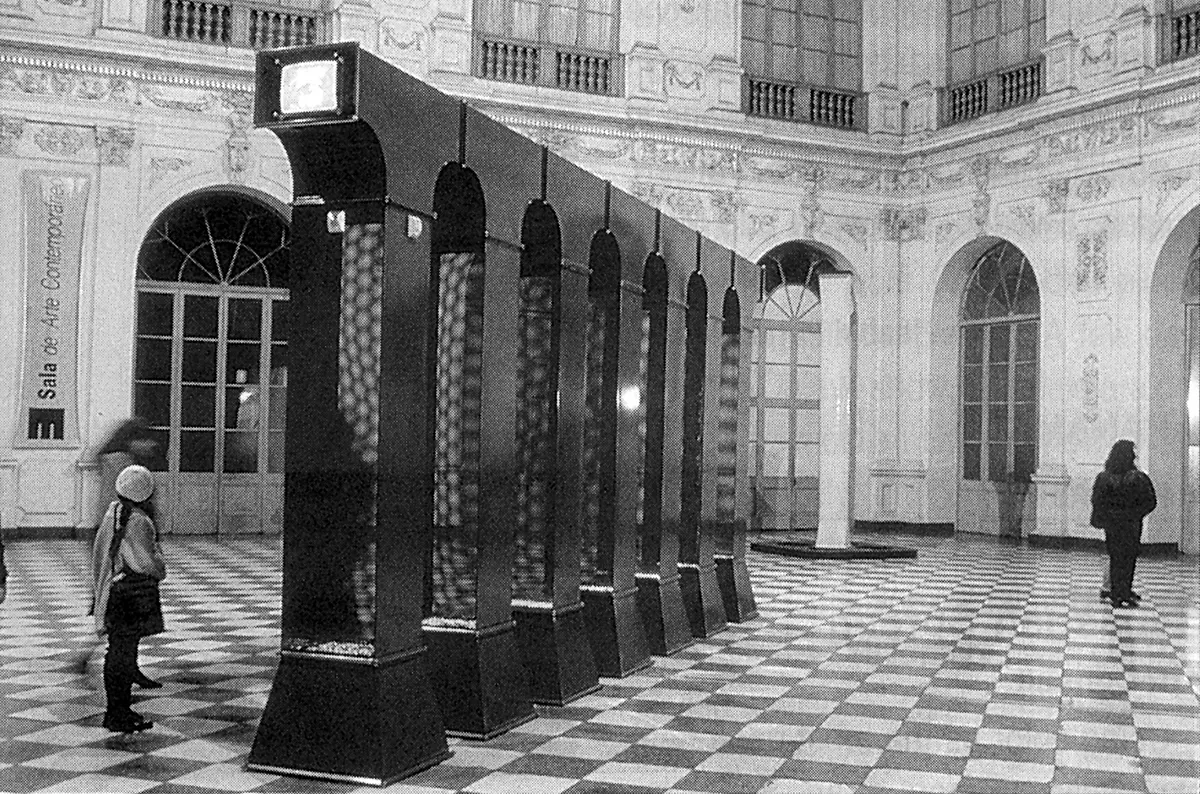
This year, Mariotti returned to Peru to present in the main patio of the Museum of Art of Lima the most complex show that has ever been exhibited in the country. Using such varied materials as Amiga 600 computers, yoghurt jars, ventilation ducts and solar modules, Mariotti created a kind of metallic nature, a cybernetic fauna closely linked with the past of Latin America, as in The Great Pre-Columbian Macaw, which with the movement of the spectators flaps its wings and speaks in living pre-Columbian languages (Guaraní, Quechua, Aymara, Náhuatl): "Word recorded in the air. Memory of time.”
Perhaps the work which is the most impressive, by its dimensions and its diagonal arrangement in the middle of the rectangular exhibition space, is The Temple of the Fireflies. Conceived as a homage to the opposition waged by citizens to the construction of a highway bridge, the ruins of the failed project are converted into a temple dedicated to fireflies.
During the day, the song of insects rings from the temple. At nightfall, a play of light emerging from hundreds of fireflies begins inside the temple, filling the arches and making all the architecture of the patio vibrate with their brilliance.
The Cactus of the Four Winds, a metallic version of the hallucinogenic San Pedro, done this year with ventilation ducts in stainless steel, is a structure measuring 4 1/2 meters high in which Mariotti inverts the color of the cactus, making the base red and the flower green, and which on closer inspection reveals its spines with rays of water connected together inside.
Last June, the artist presented at the Museum of Fine Arts of Caracas, Canto Cuantico, and on the occasion of the exhibition, he quoted the text entitled "Firefly" by the Cuban anthropologist Lydia Cabrera: “Fortunately, many fireflies are captured and placed in a bottle which is submerged in the river. He who does this will capture many fish over five days. On the fifth or sixth day, a voice will say: ‘You are going to capture all the fish in this river…’”
Childhood games in which cruelty is given legitimacy through innocence: Many of us have at some point in our lives experimented with captured insects. Mariotti too, used to do so during the time he spent in the Peruvian jungle. Today, in his adult life, the fireflies are electronic, powered by the sun and activated by photo-sensitive cells, but they have the same enchantment as the playful participants of so many years ago.
A version of Canto Cuántico was also presented in Lima. It was perhaps the most radical of all the pieces on show here. The big yellow tube measuring four meters high, which answers our presence with the chirping sounds of its imaginary insects, makes us answer, as does Cabrera’s text, by saying: "What I wanted was to speak with you....” And we cannot help throwing our heads backwards, as the anthropologist says, because Mariotti has endowed the metal with life through form and color.
Mariotti’s career in our country has been atypical. With a work which is foreign to any kind of populism, he has gradually moved towards those aspects which are familiar at all levels of our daily life, but which are so different from what we see in the work of many other artists. Most of the elements he uses are a far cry from high-tech rhetoric and belong to the materials found and sold by many street vendors in our popular neighborhoods. It is these encounters and appearances that become the stuff of art in his case. And Mariotti knows it. These electronic fireflies, which sing in the air, and these cacti and macaws, which surround the central temple, allow us to discover a poetics of enchantment, woven—and literally constructed—with the most forceful elements of everyday life. And this is one of the main reasons for their seductiveness.
LUIS LAMA