
The posthumous retrospective exhibition of work by the painter Jaime Colson (1901-1975) presented at the UNESCO headquarters marked an important step in the international projection of art from the Dominican Republic. This exhibition was presented at the same time as another group retrospective in New York, entitled Modern and Contemporary Art of the Dominican Republic.1 Both shows were carefully organized and sponsored by the private sector. The works arrived on time, the shows were accompanied by handsome catalogs, with texts and illustrations providing complete information, and the shows were attended by a substantial public. The Jaime Colson catalog reproduced all the works in full color.
Jaime Colson, who suffered many setbacks and misunderstandings in his life, never had in Paris such an opportunity as that given to his paintings and drawings by the Bellapart Museum2 at the UNESCO headquarters in the Place de Fontenoy in Paris. Knowing the artist’s sense of self-esteem, we can conclude that he would have felt very much at home in this palace-like setting, close to Pablo Picasso and Joan Miró. But destiny is often implacable…
“A nomad,” as Colson himself said,3 and mal aimé, with its connotations of misfortune and unhappiness. He would have appreciated the admiration and reverence evident in the careful selection of works by the founder President of the Museum, Juan Jose Bellapart. The show was preceded by months of teamwork, the likes of which have never been seen in Santo Domingo.
In the Conference Hall, the immense spaces posed an enormous museological challenge, with the works having to be placed on both sides of a ramp and staircase. The mahogany and marble walls, white panels as well as a small salon thus became the supports for the 72 drawings and paintings, carefully distributed and provided by excellent lighting.
The layout facilitated the reading of the works, even for those not familiar with the artist’s production. The presentation was partially chronological, with the smaller pictures being placed on the panels (including the splendid Merengue, reproduced on the poster, along with an enlarged signature). The larger format works were presented on the marble surfaces opposite, and organized in purely aesthetic terms, without reference to criteria of style or chronology.
The exhibition allowed the visitor to reflect on the work of Jaime Colson and the great injustice that he suffered through the ignorance of his work, both before and after his death. A few catalogues, one or two texts and commentaries, the odd mention of his name, which was sometimes misspelled (and his nationality incorrectly reported)...whereas his real place was amongst the greatest representatives of contemporary Latin American art. Fortunately, there are seven major works by the painter in the Museum of Fine Arts in Havana, although they are not on show. But with this traveling exhibition in Europe and the Americas, one can but hope that the oblivion into which he has been cast will be corrected, and that this native and universal artist will finally be recognized at his true worth.
I say native and universal, because this is an undeniable feature of his art. In his successive periods, like his mentor Pablo Picasso, Colson moved with great freedom from one trend to another. There was no room for any backward movement. Like the genius from Malaga, he savored with equal relish realism and neoclassicism, as well as Cubism, as well as all their various expressions and variants.
Both artists were particularly interested in the human condition and being, within their respective sensualities, and both shunned abstraction. They were impassioned by their youth and paid full homage to the body. Colson and Picasso never abandoned their portrait work, which was never completely anonymous, since it reflected persons whom they loved or to whom they were attracted. Moreover, Pablo Picasso, who was twenty years older than Colson and at the peak of his glory, appreciated the work of the latter and referred to him in Paris as a “new Zeus.”
The selection presented in this show from an extraordinary collection of more than 350 works by Colson, carefully illustrated the various styles Cubism, neoclassicism, realism, with very individual features, alternating between paintings and drawings (Jaime Colson was the greatest drawing virtuoso in the Dominican Republic), major pictures (such as El merengue, Metaphysical Figures, On the Banks of the River Camú, Fiesta in Guachupita and Weeping in Chiaroscuro) alongside other lesser works and sketches.
In addition to this extreme agility by the artist, the small ink works—Africanist and Haitian heads, initiation to voodoo—were fascinating. Of course, curating a show like this which was selected from a single collection is an easier task than having to search out works from different collectors and institutions.
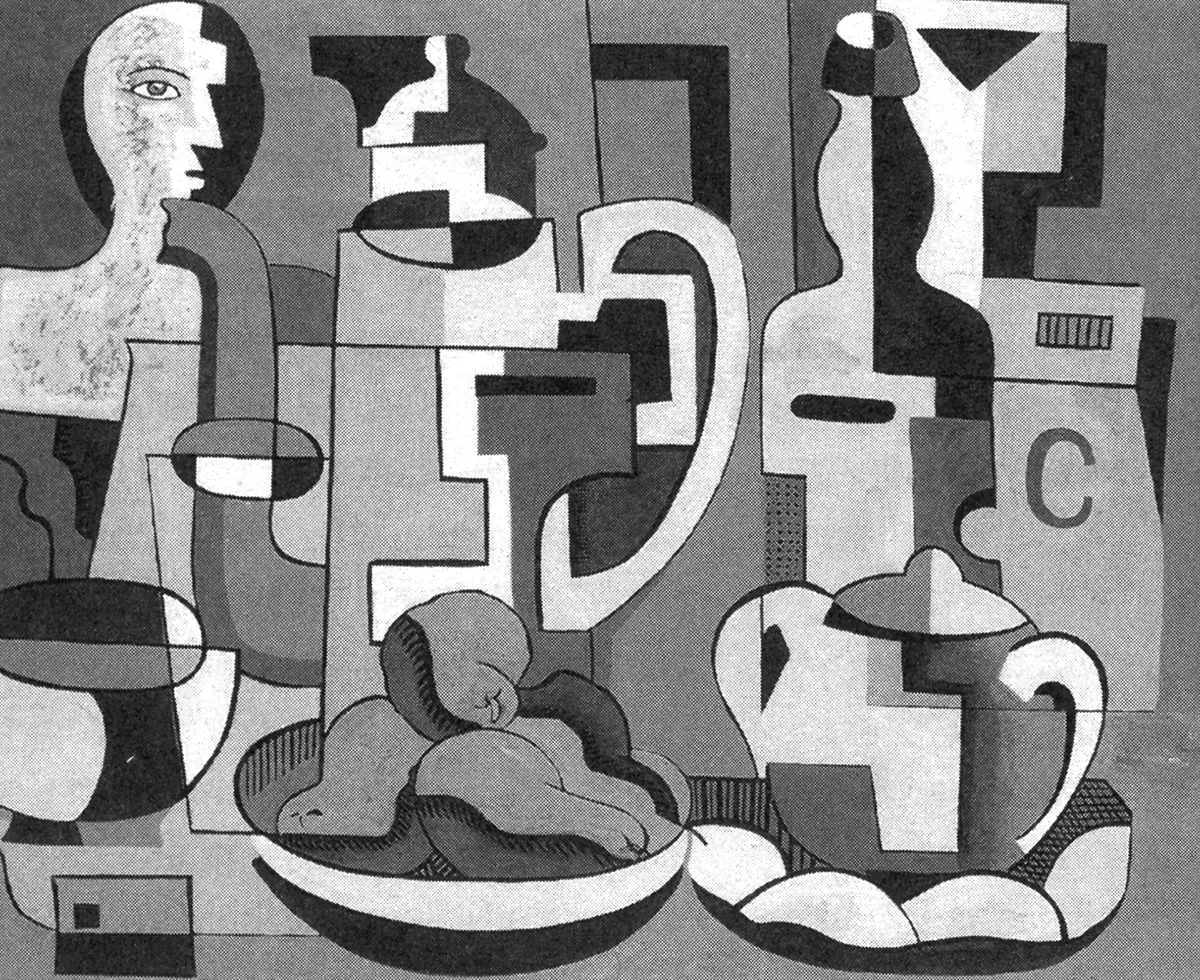
Although special importance must be attached to the special kind of neoclassicism of Jaime Colson, which reached its climax in the 1930s and 1940s, and during his final period, so unusual and disturbing when he drew close to the mise en scène of Giorgio de Chirico, or the Freudian introspection of the Catharsis series,4 the show was right to place much emphasis on Colson’s cubism. There was something exceptional here, as Colson moved from his magnificent exercises in the Juan Gris style (Nature Morte de L'Humanité and other works from 1927 and 1928) towards a simultaneous exploration of surfaces and volumes in The Woman of 40 Years, and unique versions in which he fused cubist facets and principles with ethno anthropological characteristics from the Dominican Republic and the African traditions of the Antilles. Jaime Colson, the draughtsman, was equally a colorist and a geometrician of space. Young Peasant in the City and The Merchants reflect this multifaceted character.
Colson had a deep knowledge of the cubist methods and those of other movements close in time. He could, when he wanted, nuance his images with futurist elements (as in the impressive The Cart) and experiment with Orphism and its curves and luminosity (as in Virgin of the Unprotected and in geometrical faces of some of his works). The cubist richness of Colson’s work is astonishing and clearly shows that it was possible to do cubist art ...in the 1950s, since all renovation depends on an artist’s creative capacity and aesthetic solutions. It is unfortunate that the studies and exhibitions on cubism in Latin America have ignored Colson, who was one of the great exponents of the movement on the continent.
The work of Jaime Colson also confirms that realism will never die. It will always depend on the interpreter, who makes it his own. We will never grow tired of looking at the male and female heads of his Africanist and Haitian series, which marked Colson's re-encounter with his people, with blacks and mestizos, in his two final decades, when he remained forever in his country. There is a synesthesia between the visual and the sonorous; we “listen” to his work to the rhythm of the merengue, the bodies, and the faces.
We hope that the show will be presented in Santo Domingo at the end of its travels. By then, the Bellapart Museum will have been inaugurated, and the people of the Dominican Republic, like thousands of other people outside the country, will have the opportunity to enjoy this major retrospective and realize, in the tradition of misfortune that dogged the painter, the twentieth anniversary of his death passed on 20 November 1975 had passed unnoticed.
NOTES
1. The Bellapart Museum, which bears the name of its founder President and the owner of the collection which will be exhibited there, is the first private museum in Santo Domingo. It will be inaugurated as soon as the construction work is completed and will be devoted to the art of the pioneers of modernity and of modern Dominican masters.
2. Modern and Contemporary Art of the Dominican Republic, Spanish Institute and the Americas Society, New York, and subsequently the Bass Museum in Miami.
3. Jaime Colson wrote his Memories of a Nomad Painter, which described his adventures and misfortunes between 1924 and 1968. It is an indispensable document, published by the Colson Foundation in 1978.
4. Catharsis is a series of two oilworks—part of the Bellapart collection—and 25 gouaches (all of which disappeared in Caracas). There remain only the excellent photographs. Never will it be possible to fully clarify this mysterious series, which reflected the anguish and intimate problems of the artist.
Final note: It has been recently reported that an Arab collector, fascinated by the oil work entitled Metaphysical Figures, one of the two remaining works from the Catharsis series, is willing to offer a Miró work in exchange.
MARIANNE DE TOLENTINO