Fractal realities and multidimensional space are not strange concepts to the physician-mathematician who graduated from the Autonomous University of Mexico, an institution that recently presented his exhibition entitled Genesis of Dream. Leonardo Nierman (1932) decided to devote himself to art, first as a muralist and then through painting, sculpture, and tapestry work. Belonging to a generation which distinguished itself by its exploration of form and its break with the canons of a decadent figurative nationalism, Nierman fashioned from the international abstract currents his own style from very early on.
With a language of cosmic spaces and fragmented realities, the first period in the work of Nierman, according to José Gómez Sicre, combines oil and acrylic in labyrinthine compositions of a mosaic kind. During a second period, the imaginary cities begin to detach themselves from the figures, so that his painting becomes a frank expression of a need to extract from reality those elements which the artist considers attractive in plastic terms.
The paintings of Leonardo Nierman, Julio Cortázar points out, "capture the four elements and what the artist calls the intuition of the universe, in an assault which is like an avalanche of memories, half-glimpsed visions, a cosmic thirst which strives towards expression.”
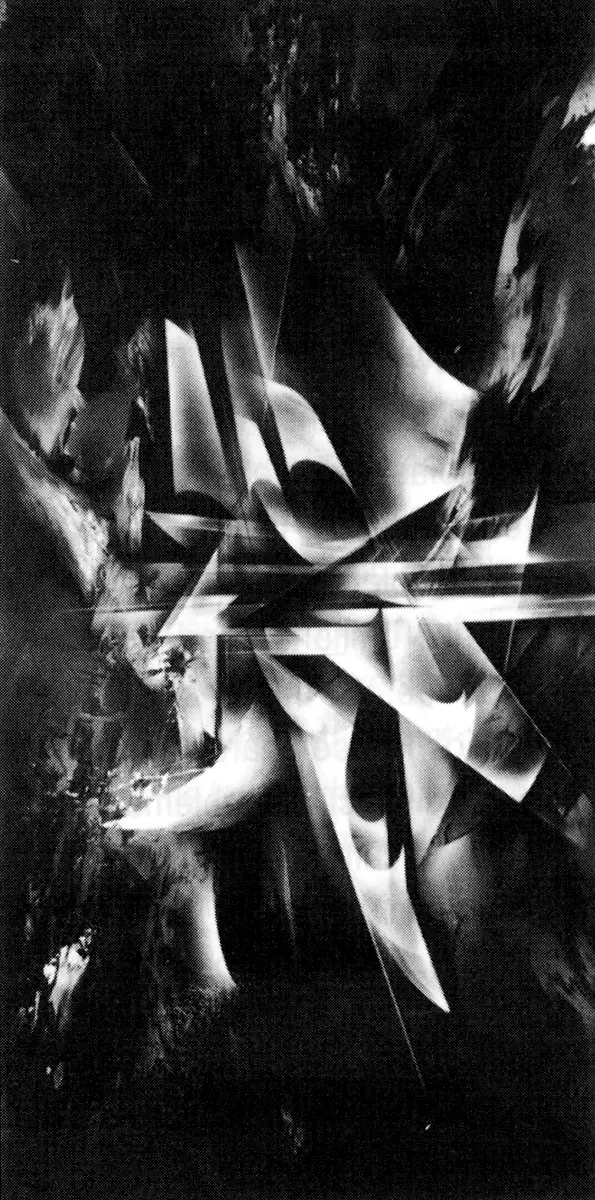
Although the show lacks a precise chronology, it does offer an anthological view of the artist’s work. Suggestive translucent spirals of marble rise up, rotating with sensuality, flying like birds which, by stretching their wings, show egoistically their proud movements. In contrast to the lustrous surfaces of the paintings, the textile works detach with their veritable chromatic combinations, with the woven wool capturing prisms, ships, cosmic storms, and fiery explosions with great definition and warmth characteristic of the material, and creating a sense of closeness which is absent from his paintings.
In addition to the ascending, prismatic sculptures in steel and bronze, there are the crystal studies, pieces from the series inspired by birds and the silhouettes of violins, an instrument which the artist played well as a young man, pictorial and volumetric reminders of his love for music and his studies at the National Conservatory of Music.
With the floor and the walls covered with false pleating, one of the rooms presents canvases in a trompe l’oeil style, like crinkled paper with a shrunken and carbonized texture, creating a ludic effect.
With their attenuated cubism, futurism bordering on science fiction, a burst of transparencies and color reminiscent of the landscape of Dr. Atl and the spontaneity of the experiments of Siqueiros, these works, according to Edward Lucie-Smith, creates an impression of solidity and fluidity at the same time, with the artist maintaining all the varied life forces in perfect balance.
Water, earth, air, and fire, the horizon, clouds, oceans, the universe, and its redimensioning through the most vital aspects of man, music, rhythm, sensuality, transcendence, and eternity. Gómez Sicre defines the work as neo-romantic: "I believe that it has the fatalistic accent of the Old Testament, the melancholy and pain of the Hebrew soul, the sorrow of the psalms, the anguish emerging from the belief in the God of the Jews... Leonardo Nierman is an important artist in Mexico whose voice of freedom has its own accent, without leaving the vortex of universal cultures."
With countless prizes in Mexico, London, Paris, Rome, New York and Chicago, Doctor honoris causa in letters at the University of Irvine, California, Nierman has exhibited his work more than one hundred times and is represented in major public and private collections in Australia, Spain, Israel, the Vatican, Austria, Sweden, Colombia and Mexico.
ANA ISABEL PÉREZ GAVILÁN