
The impact and potential future impact of electronic media on modern culture, from old-fashioned television which has permeated our homes and our lives for two generations, to the comunication potential of e-mail and the internet which has only just begun to be felt, to the future uses and amusements of three-dimensional, optical tricks of "virtual reality", and more, cannot be overstated. It is vital that museums of contemporary art take notice of the emerging media and the new art forms that they have engendered. Unfortunately, amidst the hyperbolic, utopian rhetoric of by-now-familiar pronouncements of global community, interactivity, and virtual reality, and an equally enthusiastic embrace of corporate sponsorship, Mediascape, the Guggenheim Museum Soho, New York's exhibition inaugurating its new focus on electronic media and its association with ZKM/ Center for Art and Media Karlsruhe, Germany, somehow misses the mark. Rather than truly undertaking to explore the radical transformations of space, time and subjectivity that the emerging technologies represent, the exhibition, for the most part, presents these forms simply as a new art medium which can be used "simply as convenient tools for creative expression, analagous to a painter's brush or a sculptor's chisel..." The other promised goals of the exhibition, "to investigate the properties the exhibition is Megatron (1995), the of the medium itself" or "its impact on enormous monument to the spectacle of society,” while the aim of several individual works, are scarcely felt in the end is decidedly less than the sum of its parts.
The exhibition is divided between the downstairs gallery, now permanently, and appropriately, dubded "The Deutsche Telecom Galleries" after the German telecommunications company sponsoring the museum's new multimedia focus, which displays largely computer-based work, and the upstairs gallery devoted to earlier, more established and well-known artists, using the more familiar formats of video and digital text.
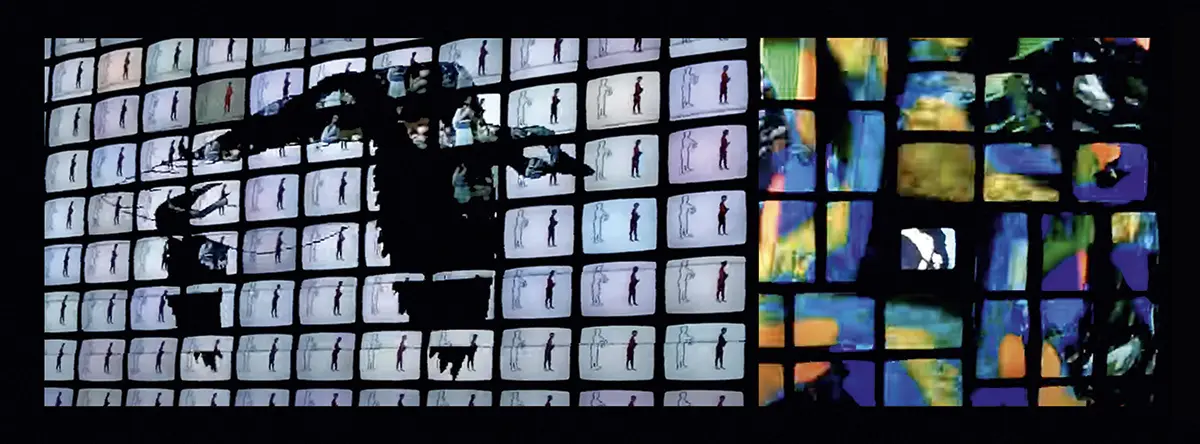
Unambiguously setting the tone for the exhibition is Megatron (1995), the enormous monument to the spectacle of televisual technology by the celebrated “father” of electronic and video art, Nam June Paik. Dominating the lobby outside the entrance to the exhibition proper, Megatron is a wall of 215 monitors programmed in sybchronization to raoidily flash a mixture of typical excepts from Eastern and Western television culture, along with filmed images of earlier projects of Paik and his Fluxus colleagues, and computer-generated animations and patterns including, periodically, the flags of different nations. Is this a critique of television’s ubiquitous infiltration of all aspects of human life worldwide, or is it a celebration of potential for global unification through shared cultural events afforded by television? It may make an attempt at both, but ultimately, it succeeds at neither, subsuming all under the umbrella of spectacularization for its own sake. Like a prettified form of channel surfing, it equalizes the lure of a naked woman in erotic poses with any other familiar television spectacles, from sporting events, to parades, to animation, and ultimately, to the simple, hypnotic brilliance of colorful flashing lights is pleasing patterns. Admittedly, it is possible to spend quite some time gazing at the sparkle of light emanating from the mosaic of monitors, marvelling at the technical splendor, or admiring the skill of the synchronized programming, but again, like channel surfing, you are left with an empty feeling of wasted time spectacle without substance.
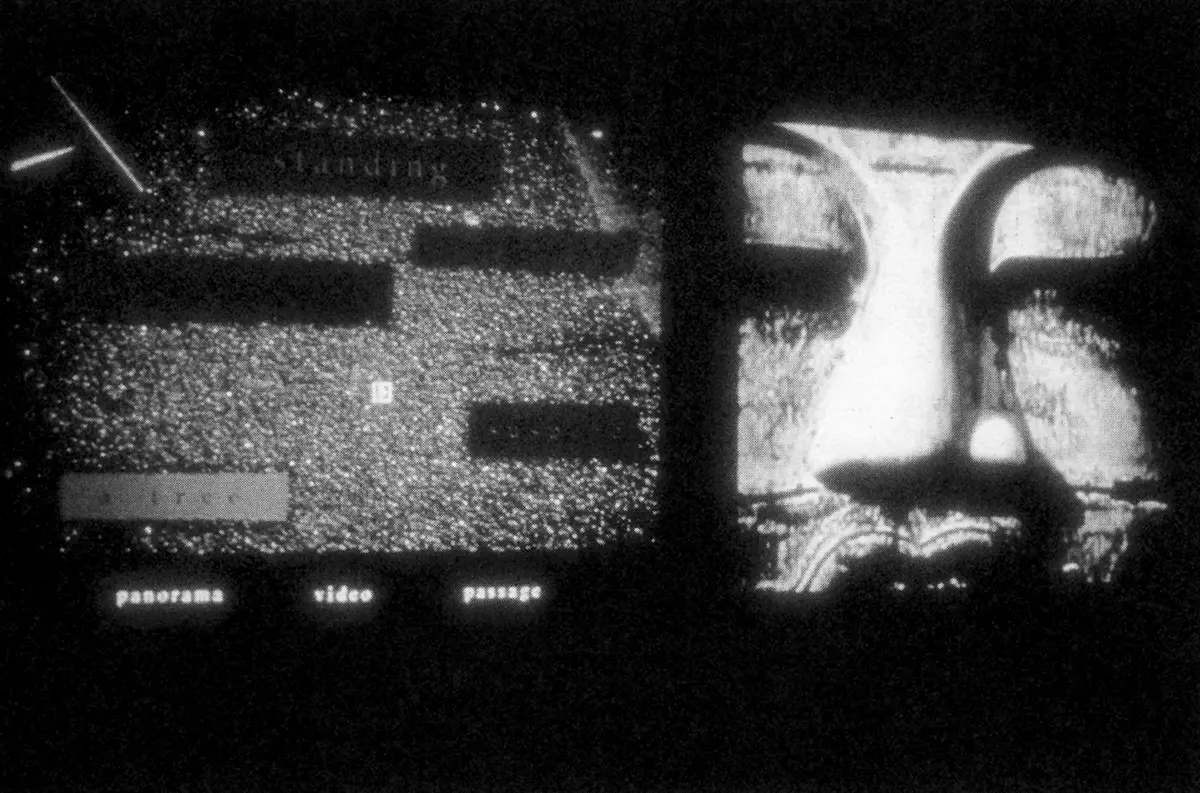
Several artists in the show attempt to explore some of the more significant implications of the new media, but even these are in danger of getting lost in the stream of electronic spectacle. Bill Seaman's Passage Sets/One Pulls Pivots at the Trip of the Tongue (1994-1995) is the most immersive, ambient room-filling projection, and it makes the strongest attempt to investigate the potential for real "interactivity" in computer-based art. This work consists of three screens of words and images that change in response to the user's indications through a point-and-click control. Unfortunately, the viewer/user is too preoccupied with the technology (how does this work? what happens when I press this?) to become immersed in the workings of the words and images or to really feel part of the creative process. Furthermore, the affected tones of the voice reading the generated "poetry" (declared "Haiku-like" in the catalogue) make one self-conscious about the parlor-game feel of the poetry. Unlike the randomly generated poetry of the surrealists, who would select words through chance methods or group contributions, here, there is a finite number of words, pre-selected to sound both high-tech and romantic, which combine to create rather forced poetic resonances. And there is no space to perceive any irony or absurdity sparked by strange new juxtapositions, nor the implications of a politics in the shared generation of meaning. On the contrary, words are saturated rather than disjointed by the continuous stream of images, the soothing background music, and the even-toned voice over.
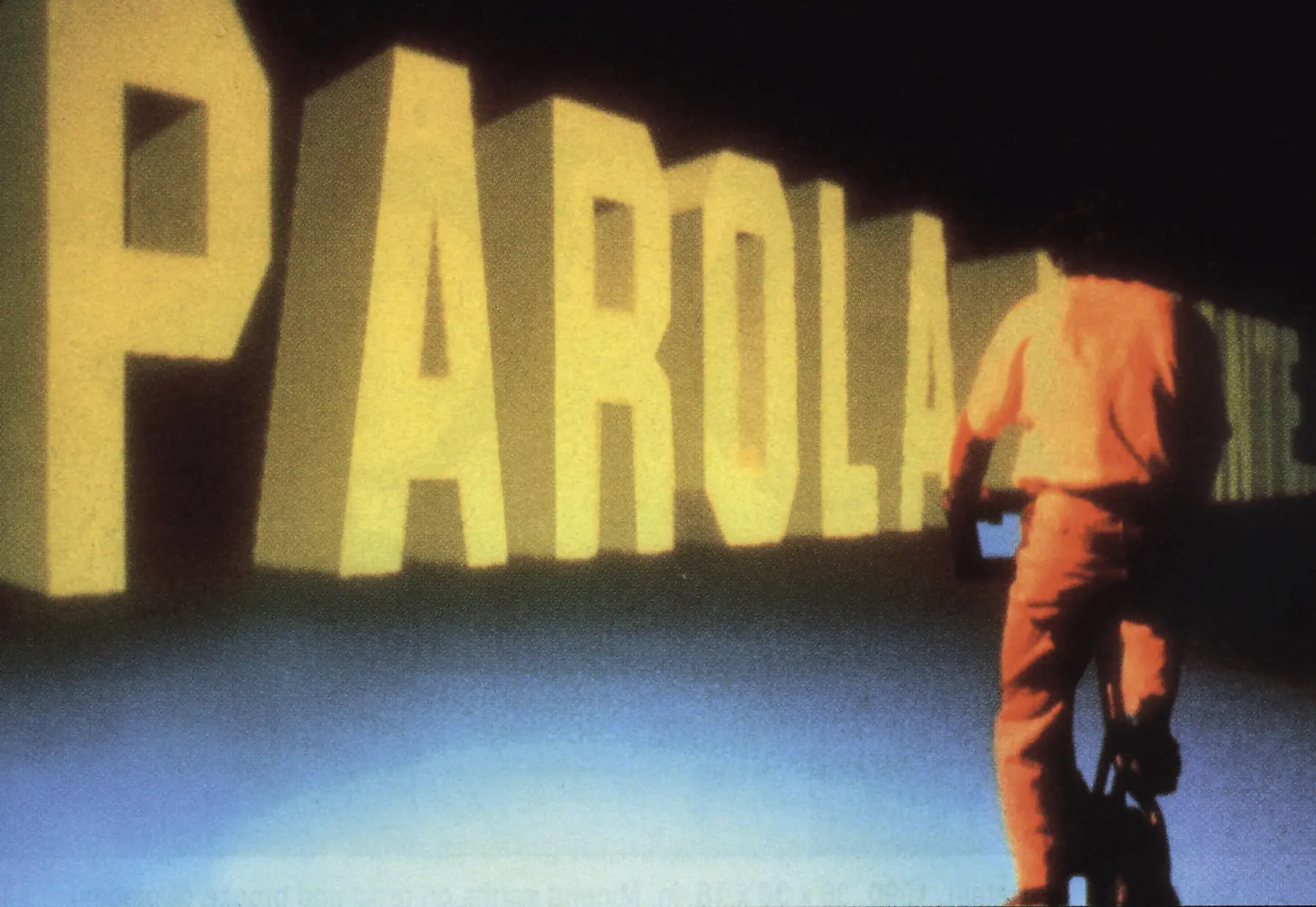
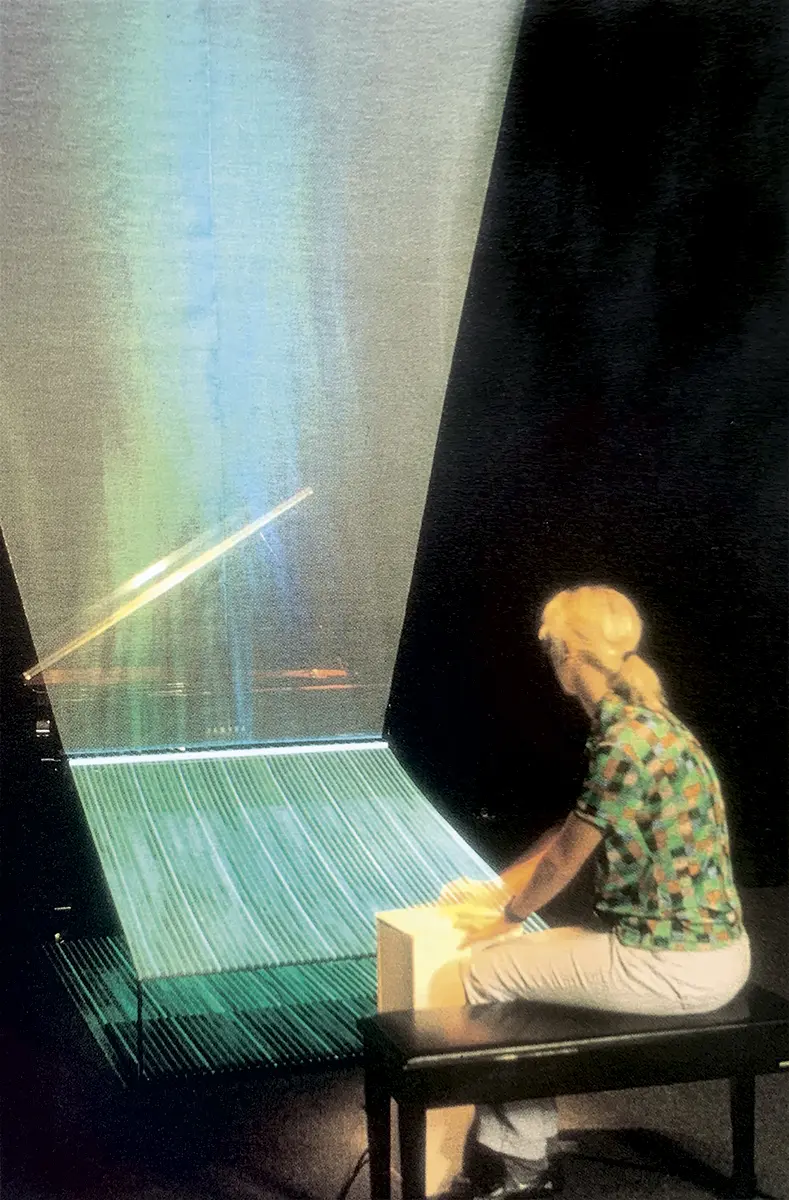
Another work of note in the downstairs gallery is Ingo Gunther's East West Wind (1991). Here, images from the end of the Cold War are projected onto blank white flags fluttering toward each other. More than Paik's extravaganza, Gunther's more technologically simple project attempts to address the effect of global television on political events. There is also the frustrating and boring The Legible City (1988-1991) by Jeffrey Shaw, in which the viewer/user is supposed to pedal a real bicycle to control a screen projection of a cityscape made of letters. And Toshio Iwai's Piano As Image Media (1995), which is not much more than a rather pretty toy on which the audience can use a simple control to play single notes with synchronized laser lights.
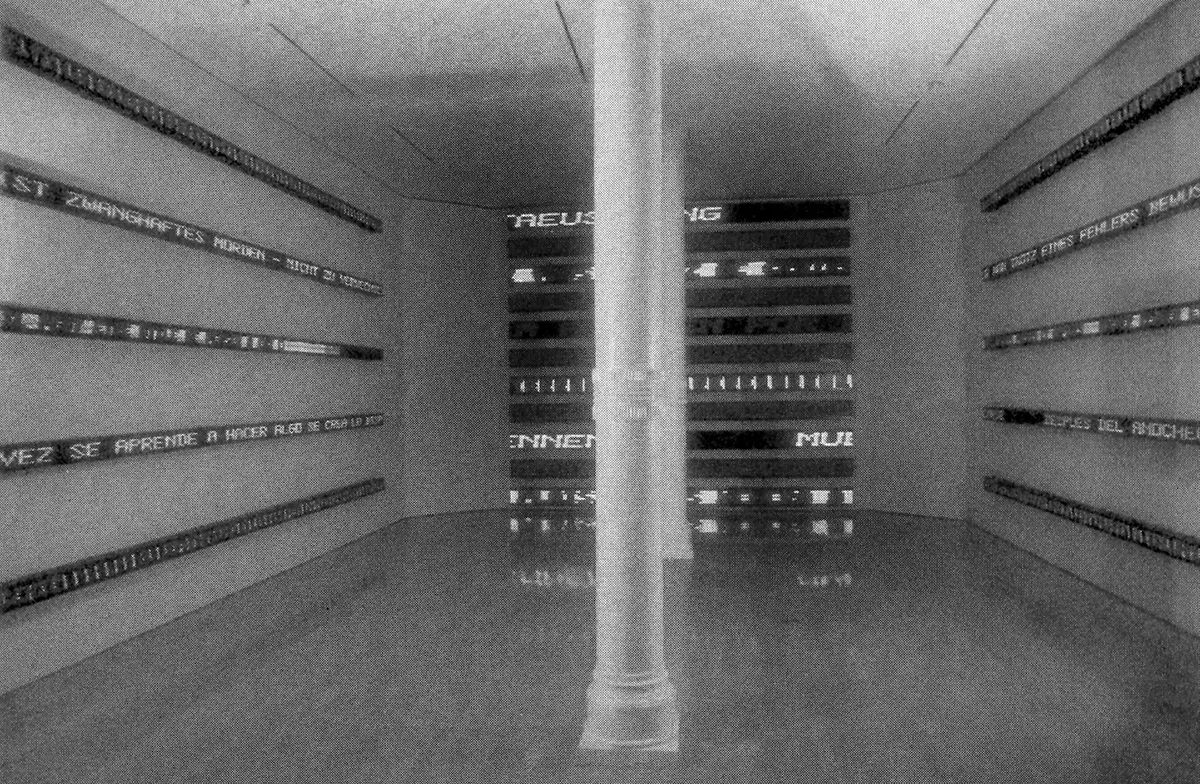
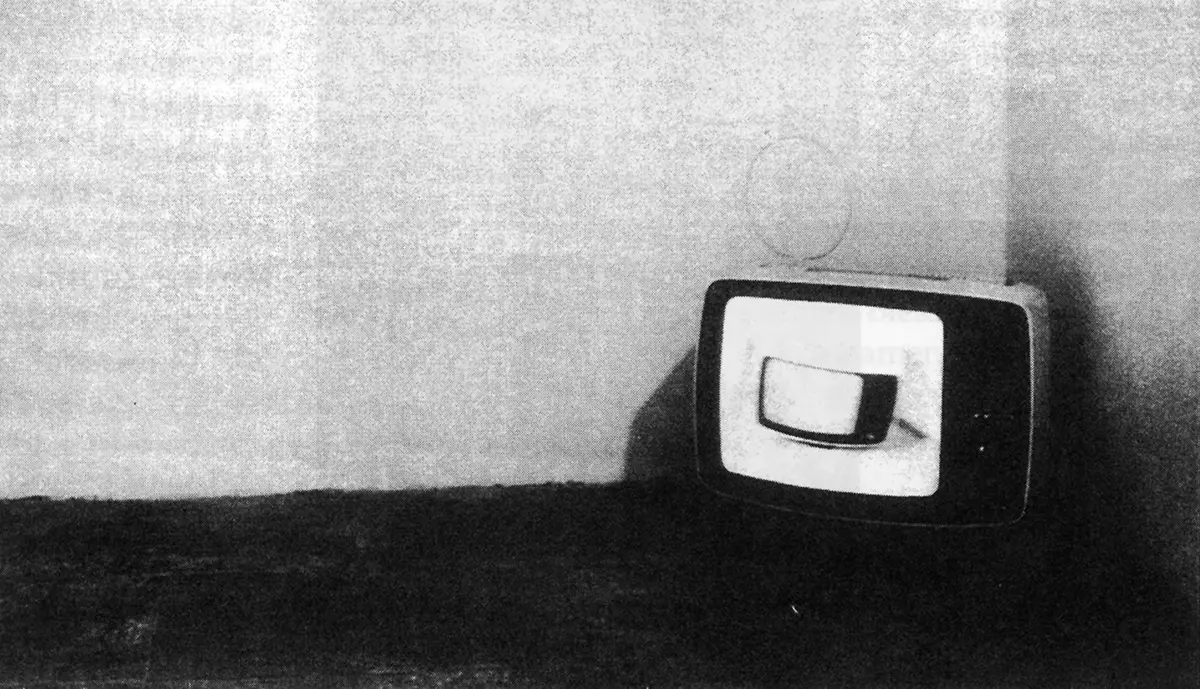
Upstairs, there are a few gems, but rather than serving as a grounding for the works downstairs, these reveal more of a disjuncture than a lineage. Where are the computer equivalents of the kinds of investigations posed by a Bruce Nauman or a Jenny Holzer? Nauman's Video Surveillance Piece (Public Room/Private Room), 1969-1970, which consists of a monitor in the "public" exhibition room showing the live feed from a cammera in the "private" room which is closed off to the pulic, while a camera sweeps the public room, presumably feeding its image to an unseen monitor in the private room, seem hopelessly out of date technologically amidst the sparkle of the rest of the show. However, computers invite, even compel, exploration of precisely those issues of surveillance, presence and absence, public and private, and the nature of time and space that Nauman's work raises. Similarly, computers focus attention on the issues of communication, mass media, and the nature of the public sphere addressed, for example, in Jenny Holzer's untitled room installation of her familiar multi-language phrases moving past on LEI) illuminated signboards.
Most disappointing were the new permanent spaces which opened in conjunction with the exhibition, the ENEL Electronic Reading Room and the ENEL Virtual Reality Gallery (also named for their corporate sponsor, the Italian electric company and computer developer), devoted to providing access to interactive computer media. On one side of the downstairs gallery, in an utterly inexplicable floor-to-ceiling architectural structure of Shiny metal parts which encloses the viewer in what reads as some mid-1980's version of a futuristic spaceship, you can view CD-ROMs on individual screens (presently a sampling of paintings from a European collection and some nice tidbits of art and cultural history of modern Italy—more is planned). Here, the Guggenheim misses the perfect opportunity to provide access to truly interactive computer sites. If an open link to the World Wide Web would be impractical for logistical or legal reasons, why not at least access to the Guggenheim's or ZKM's own websites, or that of Art View, the exhibition's online sponsor? Even a limited Mediascape electronic "bulletin board" where visitors to the exhibition could record and share reactions to the show would provide the opportunity for uninitiated visitors to experience a glimpse of life in the technosphere-maleable identity through the creation of an online persona, anonymity, interactivity, communication, and community. Instead, the dry, encyclopedic CD-ROMs, which might indeed be quite informative, offer limited appeal in the context.
Across the main gallery, in the ENEL Virtual Reality Gallery, you can try out a virtual reality program through individual headgear and a joystick in a similarly improbable futuristic architectural space. First, there is the to be expected disappointment in the huge gap between the hype of multi-sensory, immersive, quasi-halucinogenic, transportation of the bodily self into another dimension of experience, and the reality of the simple optical tricks actually available in present VR technology there is barely a difference between watching the image controlled by other users on the overhead viewscreens while waiting on line and actually wearing the headpiece yourself. Second, and quite aside from the limitations of the technology, the program available and quite aside from the limitation of the technology, the program available for the audience to try out is not even an attempt at an innovative or interesting use of VR. Practitioners in industry have applied three-dimensional technology to pilot training. And artists have been experimenting with similar formats in work ranging from abstract, organic immersions to intellectual explorations of words and images. Instead, the program at the Guggenheim is simply a basic type of video arcade game literally organized around a “quest for the holy grail” staged in imaginary historical landscapes and famous architectural sites. The “game” even includes on-screen instructions like "follow the lue line" and "the enemy is in your area" and comes complete with the dramatic chords of adventure movie musical themes playing in the background.
Exhibitions like Mediscape cannot avoid operating within certain discourses and debates that have circulated since the first reception of video and media art in the early 1960s. Marshall McLuhan, arguably the first theorist to embrace electronic media, conceived of computers and electronic media as sensory extensions of man, the logical next step in our process of evolution. Expounding visions of an electronic utopia and a global village, he declared the medium itself to be the message. Guy Debord, formulating the opposite side of the debate, described what he called the “society of the spectacle,” ensnaring us in a system of “false consciousness.” In Jean Baudrillard's later model, which came to be a defining tenet of postmodernism, there can be no lifting of the false spectacle for the true; a cyborgian relationship to machines and the simulacral nature of media are the very conditions of existence in a postmodern world.
Commerce and industry must take a functionalist approach to emerging technologies. It is with artists (and museums), in their role as outsiders to these systems, that there lies the opportunity for alternative exploration. No engagement with these debates and premises will run the risk of leaving the audience with a notion of electronic media as simply a high-tech paintbrush or a shiny new toy.
ELLEN TEPFER
She is an Art Critic based in New York and holds a Ph.D. Candidate in Art History at the Graduate Center of the City University.