One of the highlights of the New York spring season was the solo exhibitions of Miguel Calderón and Iñigo Manglano-Ovalle at Andrea Rosen Gallery. Both artists, through different media and aesthetic strategies, are engaged in issues involving language and representation that go beyond immediate cultural identity concerns.
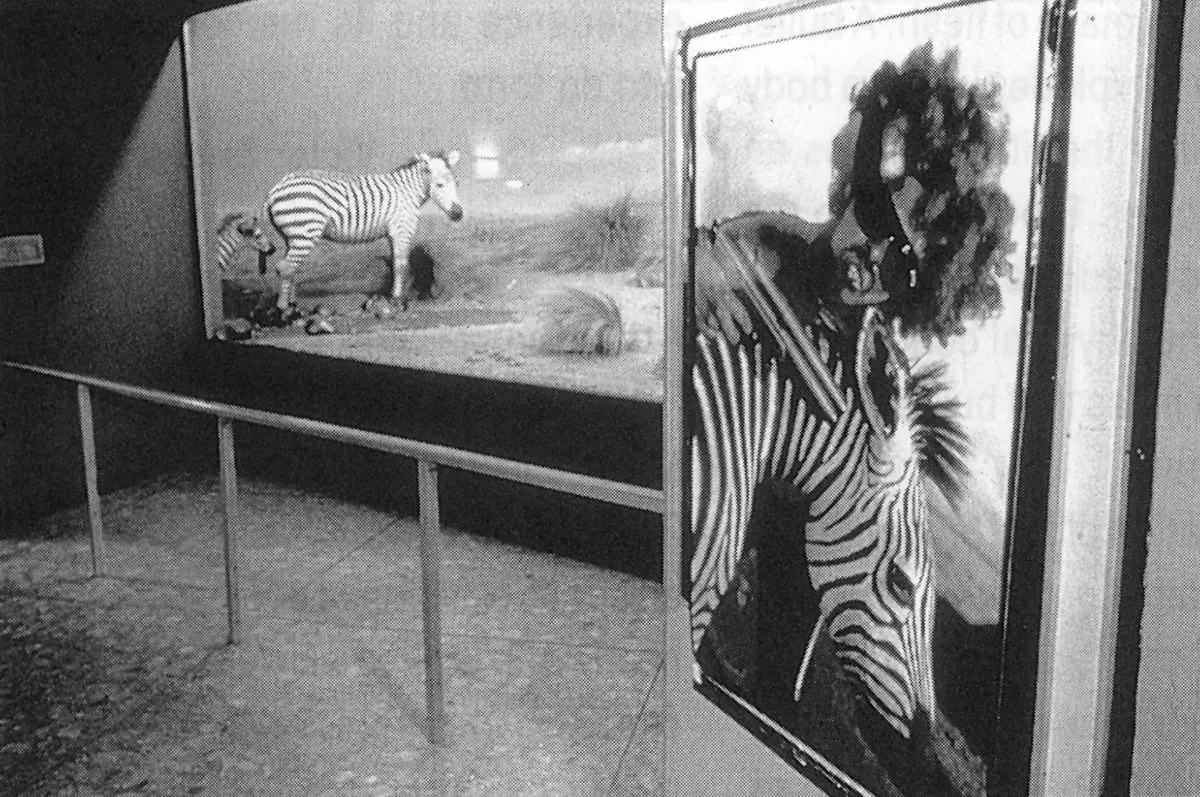
Calderón, an artist currently living and working in Mexico City, explores in his art issues involving culture and its visual display. Both his works on view, Serie Historia Artificial (Artific History Series, 1995) and Evolución del hombre (Evolution of Man, 1995) strike a critical and humorous tone regarding culture as an industry and as a machine of signification. Taking advantage of the ambivalent as well as privileged conditions surrounding museums in Mexico, Calderón managed to utilize the dioramas of the National Museum of Natural History in Mexico for his photographic tableaux viviants. In the c-prints, the artist poses as an urban "Latino" hunter wielding different weapons, ready to attack a variety of animals that have already fallen into the hands of taxidermy. The photos, shot during his guerrilla-like incursion, were first exhibited for a night at the museum next to the dioramas where he staged them. Calderón inscribes himself into the postmodern tradition of the critique of the museum within its very own practices and walls. Calderón can be linked to a chain, discontinuous and uneasy as it may be, of contemporary artists such as Sophie Calle, Louise Lawler, Fred Wilson, and to a lesser degree, Gabriel Orozco, who site and use the museum metonymically. For them, the institution is a part that reveals the whole of culture as both textuality and context of power. Calderón, however, in contrast to his predecessors and contemporaries, utilizes pulp fiction and bitter-sweet humor: his c-prints are complex and comical.
In Evolución del hombre, like the Serie Historia Artificial, Calderón also included himself as a subject of the theme. What is questioned and mocked in this polyptych of six c-prints is the telos with which cultural development is conceptualized and displayed. Beginning with a shot of himself as a nude squatting man, one step removed from being on all fours, Calderón adopts a simulated persona that traces the development of the homo erectus to homo sapiens understood and stylized as an urban homeboy. An integral part of the progression towards a "higher level” is the weapons used as attributes of "Civilization.” Evolución del hombre conjures up a web of photographic practices—medical, scientific, ethnographic, and aesthetic—involving performativity and representation. His age —Calderón was born in 1971—training in film studies and the performative dimension to his oeuvre, might account for Calderón's refreshing take on such an overwhelming conceptual endeavor and art historical lineage, contemporary as it may.
Currently living and working in Chicago, after spending formative periods of time shifting between Madrid, Bogota, and the Windy City. Iñigo Manglano-Ovalle (1961) is a conceptual artist dedicated to cross-media strategies. In a selection from the Bloom Series, his first solo New York City exhibition, Manglano-Ovalle works with a layered and complex social poetics and aesthetics that have characterized his artistic trajectory. In Manglano-Ovalle’s work, aesthetics still resonates with the implications of its philosophical origin: it involves sensual apprehension and comprehension of phenomena, which generates knowledge and power.
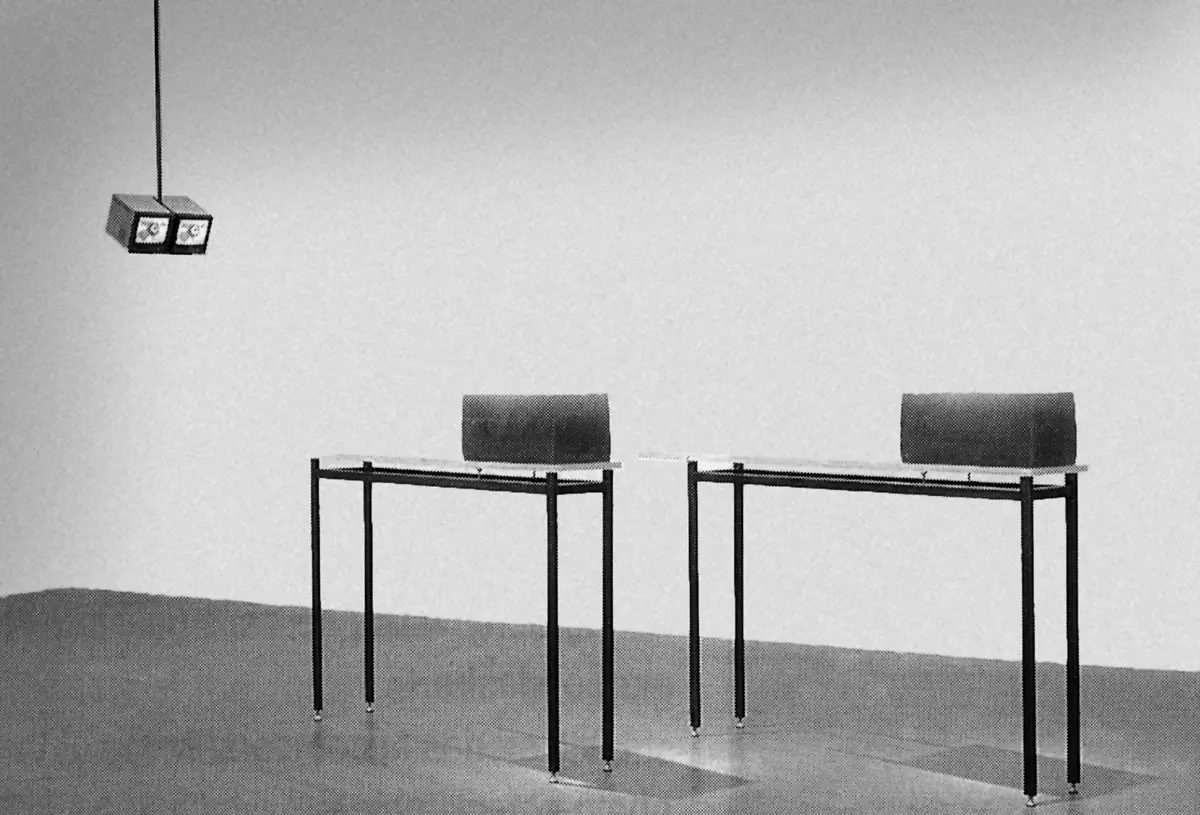
The Bloom Series, as in his most recent works such as Balsero (1994), and Televecindario, his public art work for Sculptures Chicago (1993), Manglano-Ovalle utilizes technology as an integral aspect of his art production. Manglano-Ovalle takes culture to the brink of culture by realizing technology to its poesis, to paraphrase Martin Heidegger. Technology in Manglano-Ovalle’s work is process; it is the means by which webs of relations are made palpable and diverse metaphorical schemes are unleashed, triggering rich linguistic textures and associations. Language in the Bloom Series reveals both its communicative as well as subjugating character. Stunningly installed, the Bloom Series is composed of various parts. A barely audible tract of an electrocardiogram was heard as one gazed at the two similar sculptural components in a counterpoint-like fashion. Two rectangular blocks of ballistic gel contained hollow-point bullets that had exploded in them. The gel, a surrogate for body mass, involves a process: it changes in situ, and as it dehydrates, it acquires another corporality. At a distance, a binocular surveillance camera monitor actually screened a time-lapsed video of a hibiscus flower rapidly opening and closing.
The Bloom Series deals with the parables and paradoxes triggered by language: its utterance, its social agency, and context. "To bloom” is a verb that describes the bearing of flowers, being in flowers, coming into flowers, and blossoming. The process of a flower blooming, by association, also describes any living person or thing actualizing its potential, flourishing, coming into full vigor, having beauty and glow. But "to bloom” also describes the actions in ballistic discourse, of the physical process of a bullet entering a mass of flesh. A bullet blooms when it explodes within a body in such a manner that it resembles an open petal flower. Bloom is also the nomenclature used in ballistic studies to measure the physical conditions of the body as a mass that bullets lodge in and penetrate.
The installation of the Bloom Series had a gesamtkunstwerk effect on one’s sense and location. Signs and metaphors of diverse domains, one routinely separated —nature and culture, lyric and epic; beauty and violence, formalism and critique— are transgressed, criss-cross, and shift. Manglano-Ovalle’s piece is a complex reworking of conceptual and minimal undertakings: language and forms are imbued with experience. Traces and marks of experience —personal or social— blurred in detached conceptual quests and erased from material self-referential endeavors are made evident and part of the artistic process. In this sense, passion and concept are dynamically linked to a formalism that can be social as well as political without ceasing to be personal and elegant in its production. In the Bloom Series, literally and metaphorically, experience and its memory are shot into de form.
VÍCTOR ZAMUDIO TAYLOR