
Natalia Restrepo (Bogotá, 1966) recently presented her first one-woman show in Colombia, consisting of a large multimedia installation, which reflects her interest in exposing through her work the different possibilities offered by visual technology.
The artist herself has said: "Through what might be called a technological collage, I am trying to transgress the two dimensions, make time a participant, and above all, generate a new kind of intermediate space, where memory is activated precisely by means of this relationship between time and space. To do this, I also had to take into account the space available for presenting my work. Dialogue or perhaps dialectics (with all that this involves concerning the encounter between opposites), the dialectics created between the media and figures of various origins, breaking the limits between spaces, whether theatrical, cinematographic, pictorial, or even architectural, in this case, the Museum. In this way, the visual information to which the visitor is exposed, like the bombardment we receive from the mass media, means that not only do these limits disappear, but so do those which separate their past from their present, as well as those which may appear in the future."
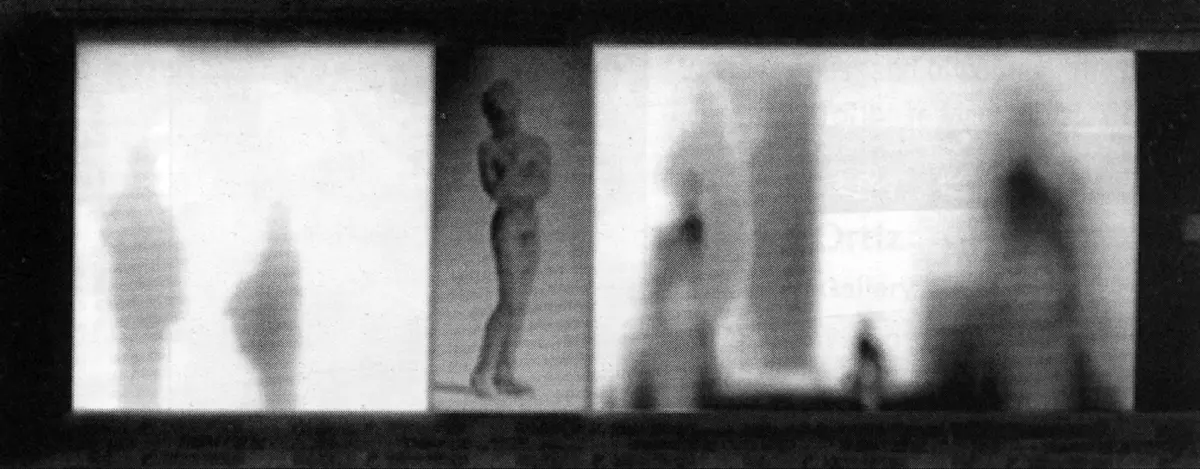
Her proposal therefore is directed towards an exploration of the perception of the image, as well as a revitalization of historical icons and their materialization through various means.
The public and the private, open spectacle and hidden feelings, collective memory and personal recollection are the themes which she uses as her allegorical argument, with the proposed images being presented through video, film, canvas and the projection of slides within a closed space which traps the spectator in different kinds of mirage experiences.
Natalia Restrepo has been exhibiting since I987, when she was a student at the Architectural Association in London. Her most recent exhibitions have been related to her work at the Kunstakademie in Düsseldorf, where she has just finished her studies. Her projected and changing work in fact exists in time and is based on physical phenomena such as the accumulative aspects of glances. Focus and lack of focus, both static and dynamic, as well as past and present, are the categories used and which exist at different levels in this work, the singularity of which reflects the artist’s own experience, which she questions in a very pertinent manner.
By transforming architectural space, Natalia Restrepo assumes that her visual message is a living element, something prosperous and changing, capable of generating poetic signs and a technological humanism which is both seductive and ambivalent. Her acute and persuasive research is also an eloquent gesture that catches our eye and reflects our own experiences. It also encourages reflection on and within Colombian art through the use of different visual media, which broadens the scope of action and intervention.
MIGUEL GONZÁLEZ