
With an exhibition entitled Allegories of Time, Pedro Caballero presented his first show in Canada with 19 paintings. His oeuvre is symbolic and decorative, based on the use of intense colors with a symbiosis of abstraction and suggestion of ancient cultures.
The influences of this Peruvian painter are traced to the textiles and pottery of the coastal cultures of Chanca y and Paracas. Most of his works have overlapping planes or frames that look like paintings within paintings. These planes can make the viewer wonder about the intentions of the artist. Caballero explains, “Each of them expresses a moment of work and satisfaction. The central plane is the force and the character, with the fusion of my emotions and the symbols of my ancestors. The others are light and ethereal, they can be the continuation and the reinforcement of my work."1
Caballero’s work can be divided into two phases, the first he calls Pre-Hispanic Reminiscences, evoking the relationship of man with the ocean, through fish, sea, and mountain images. In Paisaje Andino, the central panel has an insinuation of mountains with a textile look about them. Below this panel, the form of a fish appears and complements the top part, which is the mountain. In Mixtura, only the head of the fish is shown in red surrounded by purple. A mask is suggested below the central panel, along with a doll on the left side.
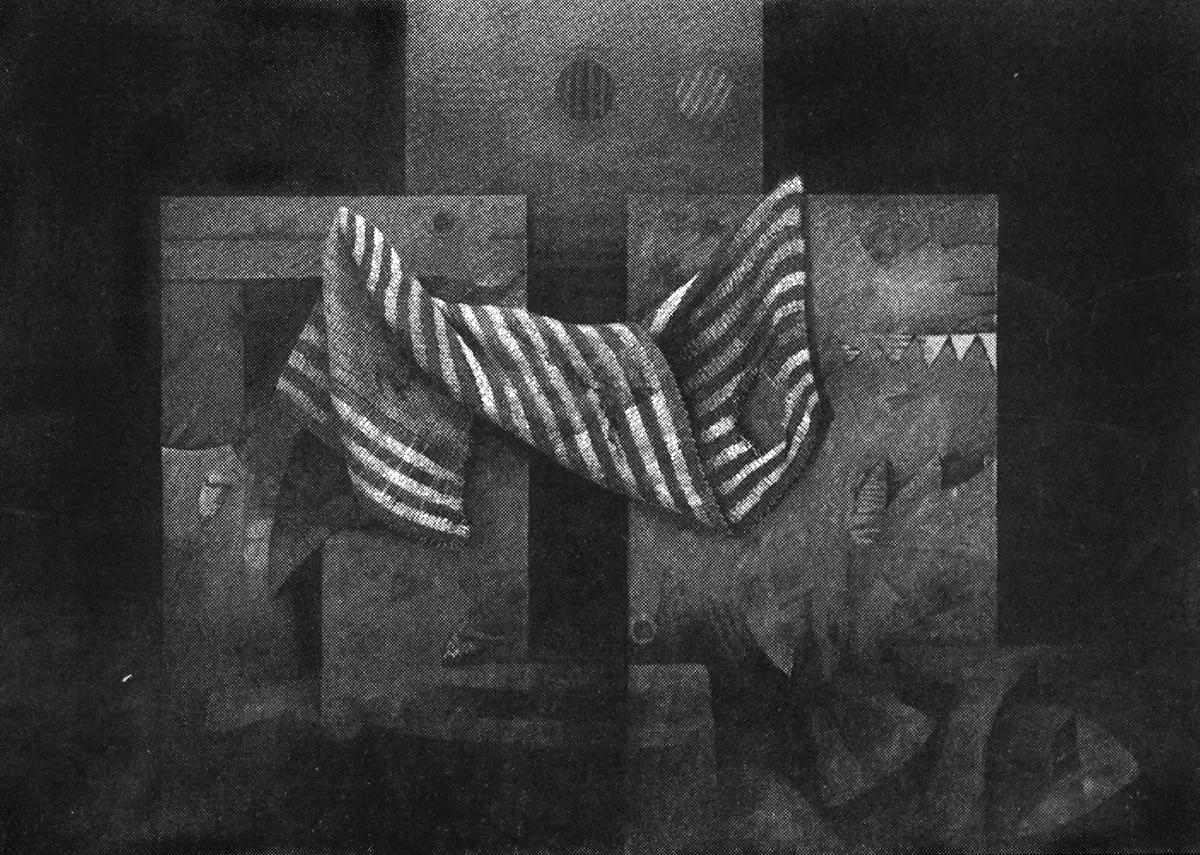
The artist calls his second phase Realism on Subjetives Spaces. In this part of his work, objects are depicted in a realist manner. In Historia de un Fragmento, a twisted pre-Columbian textile is hung from two panels that look like abstract paintings. From the piece of textile, we can see the weaving details and threads that make up the material. For this reason, seeing his work on illustrations, they do not do justice to his paintings. In Los Sobres del Tiempo, a mummy tightly bound, turns its back to the viewer and faces a panel that looks like a painting. Here again, the skillful execution can be seen in the wrinkles of the cloth, the details of the rope, and knots. The realism of this image is emphasized by the abstraction of the remainder of the work. This piece suggests the occurrence of a ritual event.
Caballero comments on the message of his work as follows: “The cultural richness has to be reinforced, and I pretend to be a painter who obeys a regional concept. These expressive forces are the fountains that feed and maintain our traditions, which in my world I transform into images and color."2
For Caballero, the most important challenge is to be compared with, or to be called a follower of Fernando de Szyszlo, because of the similarity of influences in their work. Although Caballero uses some realist images in some of his paintings, they are still within the abstract domain. They belong to the same movement of Abstract Indigenism. The likeness of their work is only at first impression, and after all has been said, it is surprising that in a country like Peru, where ancient cultures are so important, only these two artists have found the formula to blend ancient images with contemporary ideas. After this show, the exhibition will travel on to four museums in Canada until August 1997.
NOTES
1. Interview with the artist, June 1996.
2. Interview with the artist, June 1996.
AUGUSTO CHIMPEN