Soledad Salamé creates mysterious places where human rules of time and space are secondary to the dominant forces of the natural world.
The indeterminate nature of Salome’s visual world is readily apparent in Swings. The swings themselves are drawn with a realistic intensity that resembles mechanical blueprints. Although the swings are rendered in a clear, emphatic line, they tend to disappear into the playground of which they are but one part. Furthermore, by placing the swings at angles that can not be related to any of the trees within the composition, and in equally counter-intuitive trajectories. Salamé adds ambiguity to what might at first seem an ordinary landscape. Even the park’s urban setting seems tenuous. The trees and the earth that support them dominate all but a narrow strip of the composition, forcing the surrounding city into an insignificant space that runs diagonally across the painting’s upper register.
Her approach to the elements of paintings further emphasizes these incongruities. She creates spatial tensions in Chaotic House by combining drawings of rooms rendered in traditional, if slightly eccentric, perspective, and windows and doors in heavy impastos that create perceptual dimensions at odds with those of the drawing. Consequently, Chaotic House produces constantly changing viewpoints, shifts that influence even the most prosaic objects. The ghostly rocking chair, set within one of the painting’s rooms, can not remain still in this environment. Salamé painted the empty chair with sweeping lines that suggest constant, almost violent motion.
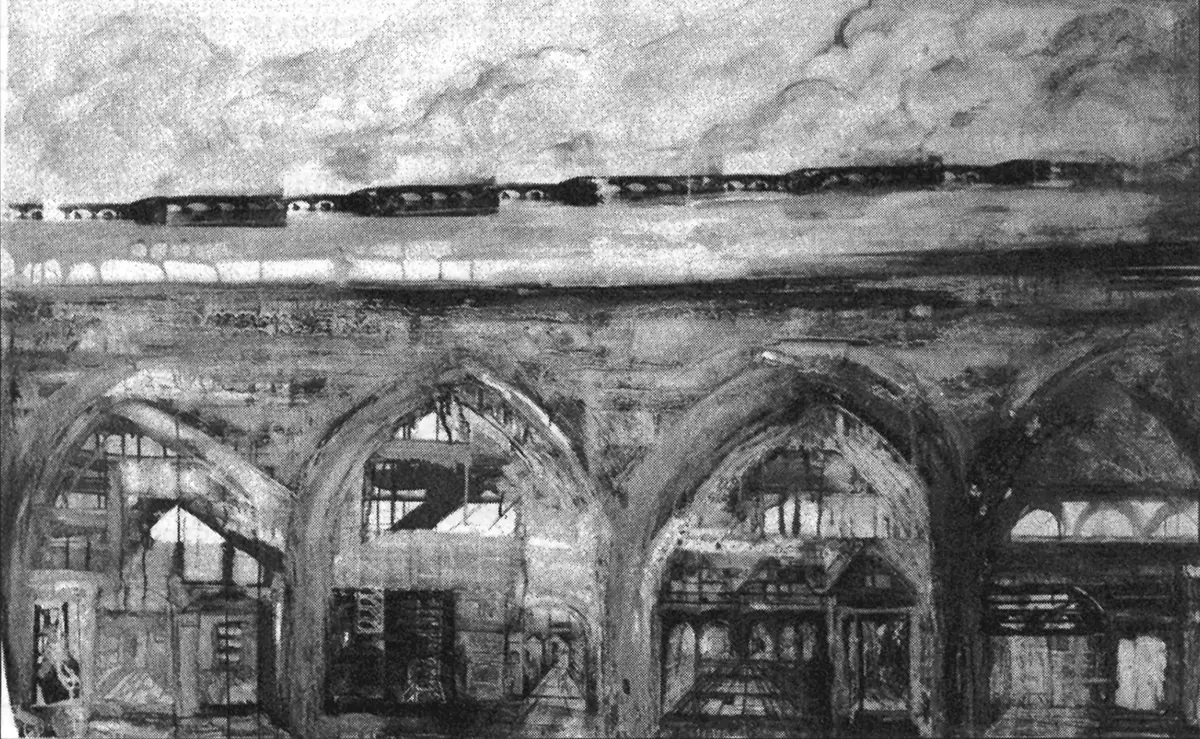
Although the constructed elements in Salamé’s paintings are invariably secondary to the world that surrounds them, they invariably echo its organic forms. Crossing the Bridge begins with arched doors set within underground arcades sheltering rooms that hold everything from alchemists’ laboratories to the distinctive gates of New York City’s subway system.
Salamé repeats the massive abutments of a bridge, spanning a wooded island, across the composition’s middle range. This repetition is not only horizontal, but also recalls the arched spaces beneath the bridge. Crossing the Bridge is completed by billowing clouds that rise above these structures, restating the architectural and natural forms beneath them.
Salamé united all of these philosophical and plastic approaches to creation in Tree Arches II, the smallest and most cogent work in the exhibit. The arches, arrayed along the work’s lower register, unite three individual spaces, each with its own unique perspective. The painting’s upper register blends photographed and painted branches and leaves. The solvent-based process that Salamé used to transfer the mechanical copies of her own photographs to paper slightly blurs their shapes, establishing a scene that is both subjective and "real." Here again, the interplay of two-dimensional representation and impasto painting creates a visual statement that transforms the ordinary and transcends the boundaries of natural science.
Salamé built Growth for Earthborn at Maryland Art Place, which ran concurrently with her solo show. This installation piece completes the ecological philosophy contained in her paintings. The work evolves gradually from two fields of living grass, sprouting from dried hay, into scrolls of handmade paper decorated with trees and Salamé’s own poetry. As in her more traditional works, the vital, unstable forces of nature in Growth provide the foundation from which all human creation derives.
K. MITCHELL SNOW