
A nameless Group Show: José Bedia, Consuelo Castañeda, Tom Downs, Teresita Fernández, Quisqueya Henríquez, Iñigo Manglano-Ovalle, and Rubén Torres Llorca.
This "nameless" exhibition was more than just another summer group show. It brought together a group of artists who wanted to define a different kind of option, rather than that of showing their works in studios, museums, or traditional commercial galleries. Without any definite curatorial direction and using a space lent specially for the occasion, the artists themselves organized an important show of contemporary art in the form of site-specific works.
The formation of the group occurred in a natural manner. There were no formal invitations, but rather a common interest in devising a strategy that would meet the concerns of the artists and offer a vision of what is currently being done at the local level. In addition to the artists resident in Miami (José Bedia, Consuelo Castañeda, Tom Downs, Teresita Fernández, Quisqueya Henríquez and Rubén Torres Llorca), the show included Iñigo Manglano-Ovalle, a Colombian who lives in Chicago, and whose participation reflected the desire for an exchange of views and the avoidance of any kind of categorization ("artists from Miami,” "Cuban artists,” etc.).
The space in which the works were presented was essential to the conception of the show. An industrial warehouse, lent by Fred Snitzer and Claude Duyon, inspired most of the artists to undertake specific projects which would have been difficult to execute in a studio or gallery, where the space is naturally more restricted, or in a museum where, in theory, there is no room for experimentation or error. In addition to creating the works, the group had to clean the placeand resolve certain technical problems, such as the lighting, in which they were assisted by Steve Morgan. In general, the artists assumed full responsibility for the project, including the publicity and financing. The objective was fully achieved, thanks to their dedication and the support of the collectors Carlos and Rosa de la Cruz.
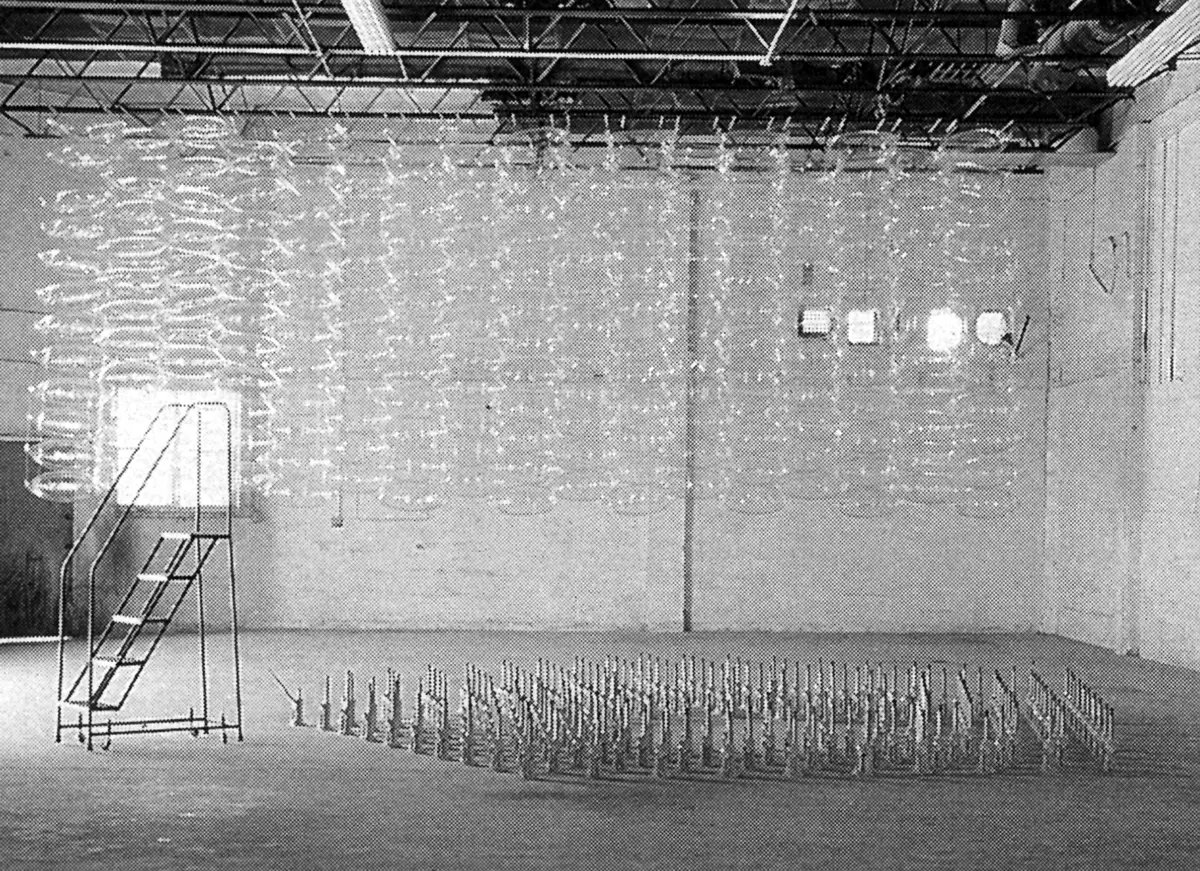
The show consisted of six works. The first, a joint installation by Consuelo Castañeda and Quisqueya Hernandez, was based on Heidegger's theory of the limit. The transparent wall measuring approximately 36 x 14 feet, made of 196 inflated plastic bags, surprised those visitors who were familiar with only the work done by these two artists individually.
However, the collaborative pieces that they have done for a number of years are part of their artistic process and reflect common concerns in the handling of techniques and themes. This time, they analyzed the idea of the limit by using a very simple and basic kind of material, air, compressed in handmade plastic bags. The installation was an attempt to eliminate the sense of limit by creating a transparent wall, which at the same time prevented the spectator from going through it. The physical conditions of the warehouse also highlighted the ephemeral character of the work, since the bags exploded with the heat. In this case, even though this was not intended, the disintegration of the work underscored the philosophical motivation of the idea and extended its resonance to the temporal level.
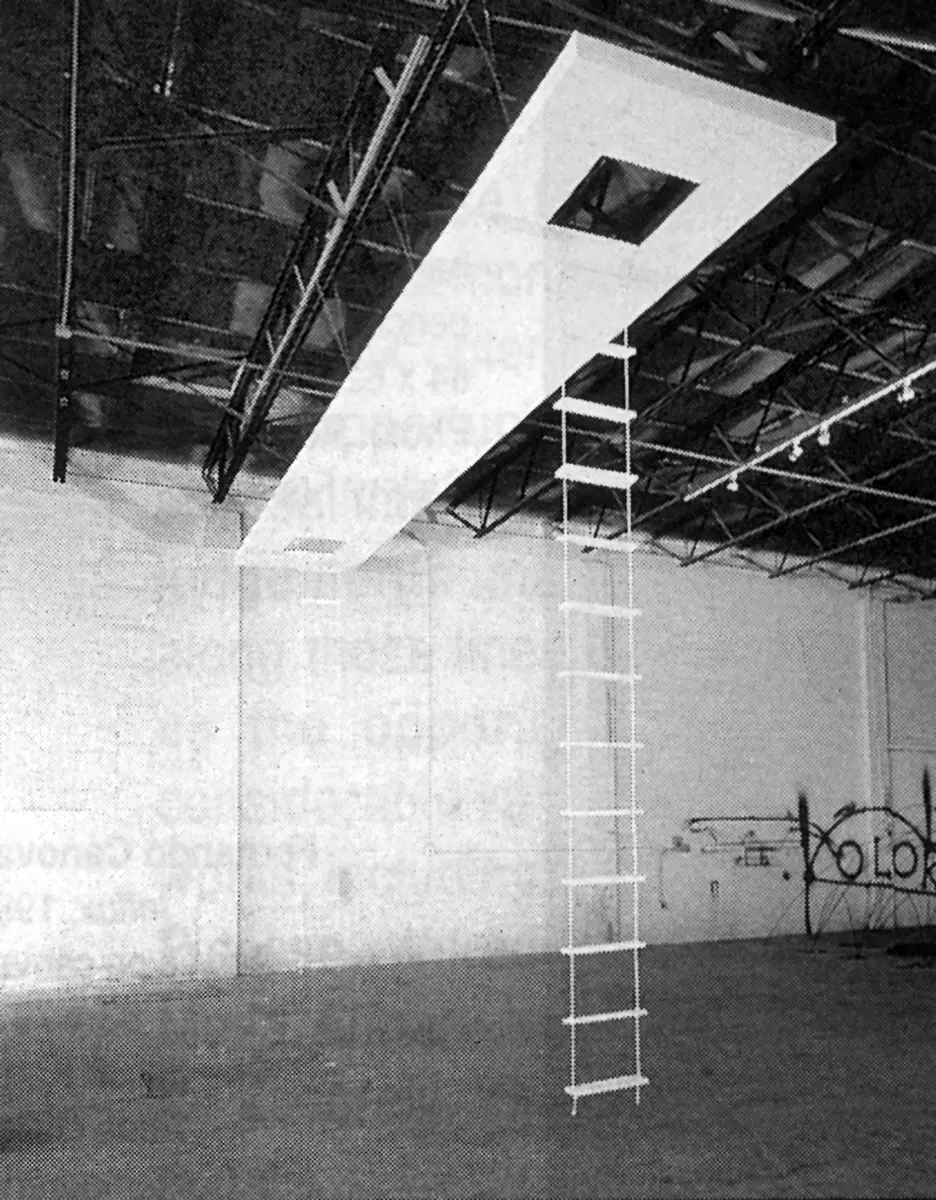
Another work, which was based on a philosophical kind of questioning in response to physical space, and in particular the height of the warehouse, was the installation by Teresita Fernández. Influenced by the architectural theory of Erau Loos, the piece consisted of a hanging platform from which two ladders led down. Visually, the idea was created that you could go up to the platform. However, it was an illusion, since, as in the case of some of Loos' own work, the platform could not be visited physically. The steps were made of plaster, and in general, the work was conceived as a non-functional object. Using physical movement as a source of provocation, the artist managed to make the spectator carry out the mental act of climbing the steps and reaching the platform, creating in the process a series of psychological and emotional reactions. Aesthetically, the white color of the work contrasted with the somber tones of the industrial setting and emphasized the non-objectual nature of the work.
Unlike this installation, the work by Iñigo Maglano-Ovalle could be visited, up to a certain point, and entered by the visitor. Notes for Levitating the Pentagon or How to Use a Car Jack consisted of an ordered series of hydraulic jacks placed on the concrete floor, which could be examined from any angle or from a red stairway placed on one side. The automobile nature of the materials coincided with the previous use of the warehouse, which was used for bodywork repairs by a luxury car agency. The minimalist intention of the artist was reflected in various ways, in particular through the exactness of the ordering of the objects and the association of the ideas related to the use of the hydraulic jack (especially the one with a red handle for its operation) for lifting a car, or any kind of volume, or even the Pentagon itself.
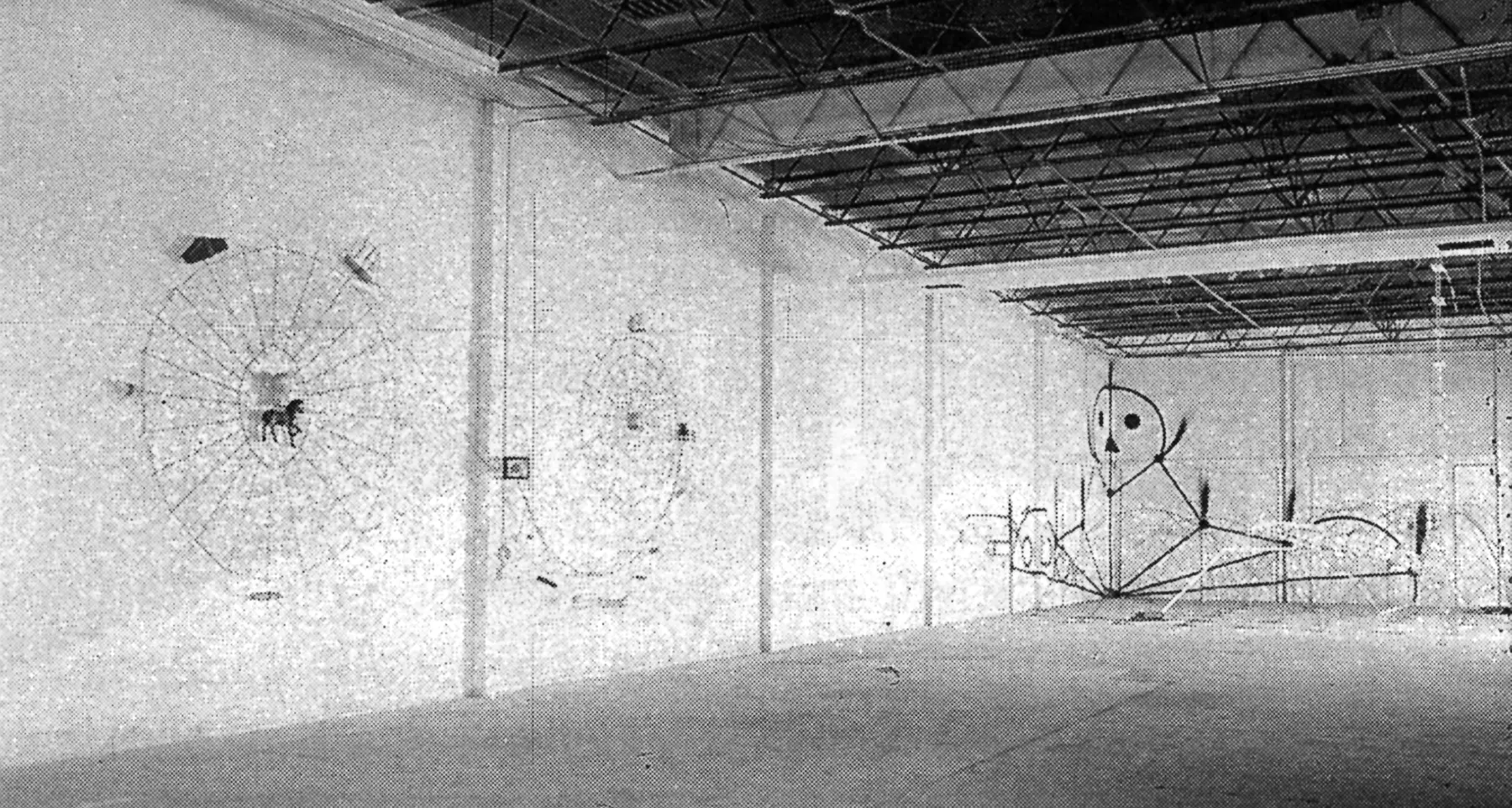
The work by José Bedia occupied a corner of the warehouse (if it had not been available, he would certainly have created it, given the religious meaning it would have in the context of his installations). On the wall, there was the figure of a torso, the shoulder of which, like a Palo Monte initiation sign, bore the name Olokun, the god of deep waters. The new feature of the work was the use of curved iron rods simulating a wall of waves on the concrete floor. Each arc emerged and terminated in little holes, which formed part of the original floor of the warehouse and in which Bedia placed little piles of earth. In the depths of this "sea,” two black toy trucks marked with white chalk carried bundles of dry sticks, like those used in Long Live the Fifth Centenary (Mexico City, 1992). In the middle of the installation, upside down in the sea, there was a woven wicker boat, which referred to the main theme of the work, the problem of the Cuban boat people, with all the associated connotations.
Another narrative work was the installation by Rubén Torres Llorca, which had a more poetic content. The only wall piece in the exhibition described a journey through a dream from the male world to the female world. The first, represented by a simple cord "cobweb" (a small circle and a larger one joined by straight lines), showed a horse’s head in the center with a boat, a house, a sheep, and a fish hanging outside the circle. The female world, represented by a more complex "cobweb" (with more circles than the first and intersecting lines) showed a woman’s head in the center and was decorated with a cot, a car, a cow, a staircase, a chair, a boat, a violin, a spoon, a pair of crutches and another chair. Both "worlds," joined by an umbilical cord, were connected to a small cage which contained a male head. The clearly autobiographical work was an "enlargement" of the works which the artist is currently producing; to some extent, it failed in that, in the context of this show, the physical intimacy required for its reading was lacking.
Finally, Tom Downs projected video in a small cubicle, especially constructed for the show. In this context, Five Histories achieved the difficult goal of creating a conceptual video that was site-specific. The artist managed to do this by projecting a series of words in black and white, which emerged from the bottom of the screen to rise and disappear at the top. The speed with which the movement occurred suggested that the words were floating in the air and rising slowly, taking up certain ideas suggested by the works of Teresita, Consuelo, and Quisqueya. In the same way, insofar as the visitor had the opportunity to construct his or her own story through the composition of various texts, the experience generated by the screen was similar to that created by the works of the artists.
In conclusion, the show was a success and established a precedent for other artists to organize and develop similar projects, which will help promote the local art movement. It also highlighted the need for finding permanent alternative spaces in a city where contemporary art is developing at a staggering pace.
FRANCINE BIRBRAGHER