To enter the workplace of Waltercio Caldas is to let the attention go towards a flow, doubly marked, by the innumerable volumes of a wide-ranging library and by the view, which precipitates from the top of one of the oldest neighborhoods in Santa Teresa. One can imagine a dimension in which the sculptures of the artist embody the silence of the contemporary atelier (just one not too random example of the current situation) and, in a reciprocal gesture, the poetry of Ponge fills with the vertigo of a magnificent view over the city of Rio de Janeiro.
Beginning with this place which embodies the ancient dichotomy between nature and culture, Caldas' parti pris is to extract gravity from a chaotic and artificial world. His process, which is deliberately slow, has given the public a series of intermediate products, whose characteristics elude the descriptive effort: between design and sculpture, between graphic gesture and installation, between logic and poetry, and above all between creation and criticism. Sometimes he manages to jolt the traditional definitions in an attempt to incorporate the context of human experience.
It must be pointed out that the artist works more with the movement of hypotheses than with the static notion of representation, thus avoiding to postulate a purity of sensibility or logic of reason, in the style of "either..or" binary machines. Thus perception is not an a priori matter. "It is a characteristic of the nature of artistic objects to preserve their destiny as hypotheses, even after they are finished".1 But against what kind of reason does such a work rebel, since non-reason has also been rejected? The objective, in a kind of endless challenge, is to combine nature with the history of thought and set the alluded work within a context of multiplicity. These are pieces that were constructed with each glance, inhabiting an imponderable distance between the "self" and the "other": thought/desire, throbbing/ machine, writing/reading, reading/re-reading.2
A sense of throbbing gives tension to space: without a privileged point of vantage, how can the meaning of sculpture be apprehended? Frontality, now an inadequate means, gives way to the continuous mobility of a horizon which is constructed in the nucleus of the relationship with things. The shell which protects the yolk of the egg is increasingly fragile.
As a recipient of this work, it supposes an active subject (meditator and not contemplator, as the poet would say), preferably someone endowed with a sophisticated awareness able to navigate through the dense mist of modernism which hides crucial aspects of tradition –like the reader of Borges, who must always be alert to the duplicity of the fiction. In this sense, it could be affirmed that the theme of recognition in Caldas' work surreptitiously appears in the quotations of tribute to the history of art (Duchamp, Matisse, Mondrian, Morandi, Picasso, Rodin, Velázquez...). Distancing himself from the jolts produced by rupture, Caldas undertakes a principle of continuity, a gesture that recalls the elegant outline of Mark Tansey, in the dance of the masters (Paul de. Man, Derrida...). There is no melancholy in the work of Waltercio Caldas, a fundamental difference with Tansey, for whom literary incest is the vital system of production both in representation and in the figures of irony.
It is worth asking now what kind of certainty can arise in the "in-between" space, the space between differences.
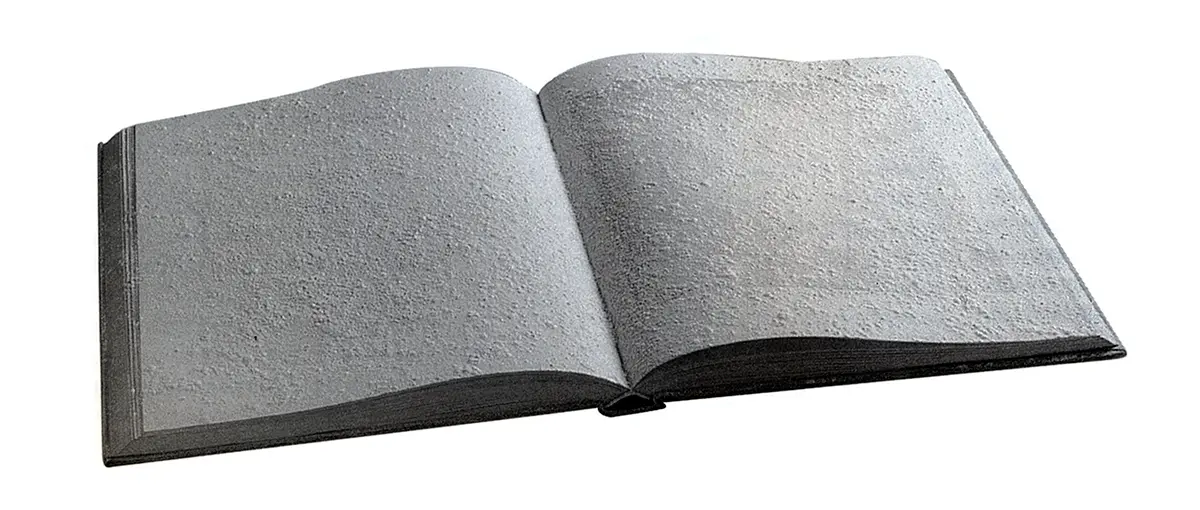
Since his exhibition entitled The Nature of Games (1975, MASP, São Paulo), the artist has been discussing the logic of reason as applied to the act of looking. On that occasion, he placed his bet on the manipulation of the other, the place of origin of the author's gesture; hypothetically, anyone could present this work (Matisse's book sprinkled with talcum powder on any page). What is an "apparatus"? he asked. Or even better, what is an "apparatus of art"? Duchamp relentlessly invoked without respite.
A pause for a historical digression: how can we interpret three painted iron bars, measuring 120 x 60 x 30 cm, placed on the wall at asymmetrical intervals? It would appear justifiable to locate the roots of this work in the constructivist movement (of the 1920s), in the battle against illusionism and subjectivity (Sol Lewitt, amongst many others, with whom Caldas shared the attention at that edition of the São Paulo Biennial). From 1978 (when the above-mentioned work was exhibited at the Museum of Modem Art in Rio), down to the present, Caldas has spared no effort in trying to correct a misunderstanding that always caused a lot of unease: the integration, in an always reductionist manner, of the language of minimalism into his work.
The fact is that, at that artistic moment, that was the nature of the artistic agenda. The discourse of the 1970s told the story of the world parting from a consciousness —whether Cartesian, Kantian, or in the best hypothesis, phenomenological. The limits between consciousness and body, subject, and object were maintained, once the glances had merely noticed the austerity and straightness of the black bars. No one looked at the space in between. "To give a name to the space between things".
What has changed: the work or our perception of it?
From the periphery, we reach the core of the problems that concern Caldas: the art of constructing a problem whose objective is to continue exploring. To resolve a problem would mean eliminating its points of tension, and combining all the possibilities (of truth and flight) into rhetoric. It is important to distinguish between the work which raises a real problem and the traps which are nothing but clumsy gagues (jokes) of the worst disciples of Duchamp.
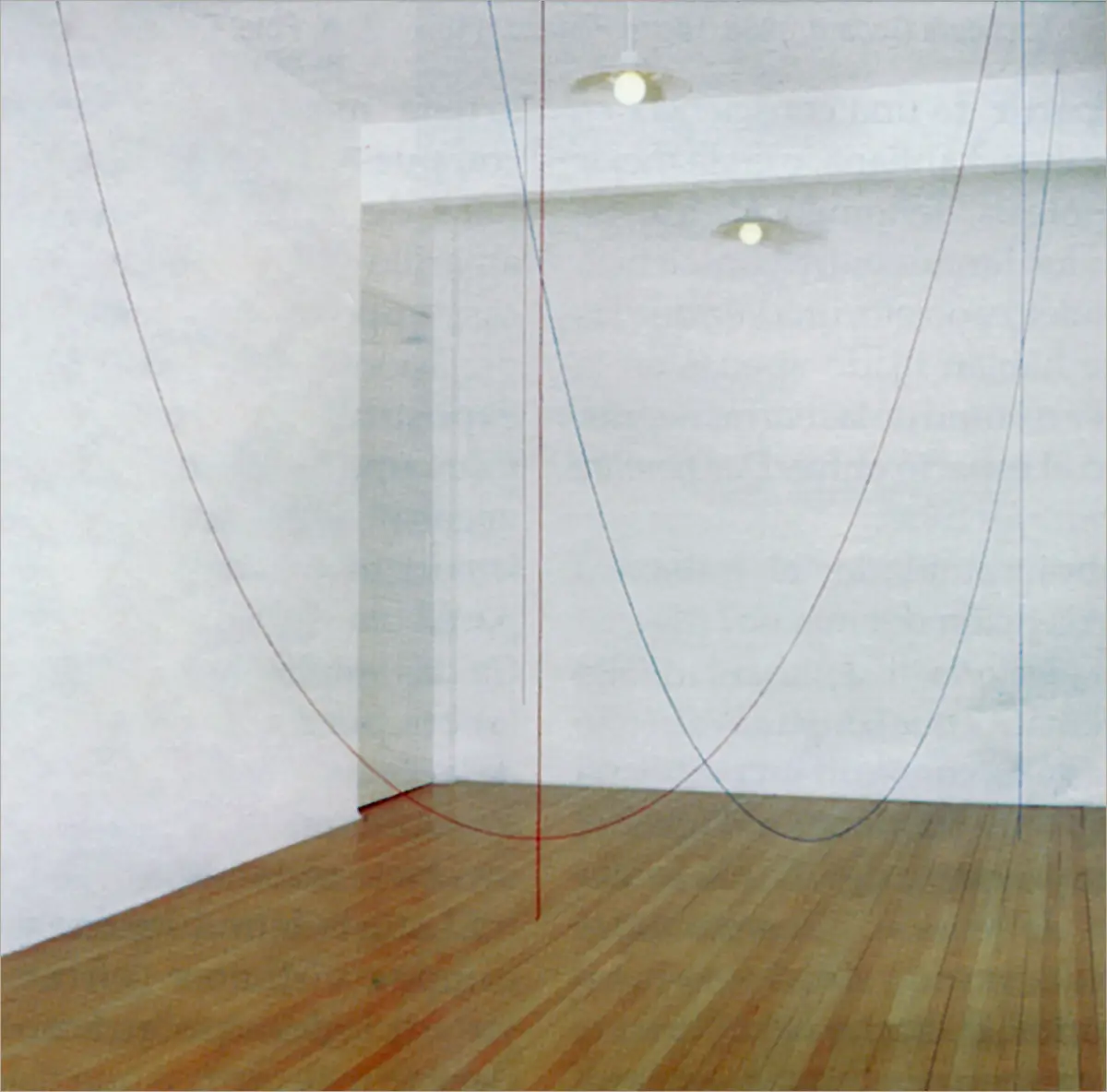
In 1993, for the first time in São Paulo, in one of those collective exhibitions that generally go unnoticed (and, it is curious to note, it would appear that the essence of Caldas generates its own procrastination), the artist mounted a single sculpture composed only of a handful of woolen threads. Four tons of yellow in the air, subtle and almost imperceptible elements, which gave precision and determination to the exhibition space. There once again were the lines which, although disengaged, did not totally negate their relationship with the irreducible two-dimensionality of the white wall. To bring them out of the surface Caldas broadened the relationship of the body with the work, and thus the sense of enjoyment with the work –something much more complex than the mechanism of recognizing a three-dimensional object.
The artist introduces virtual fields into his sculptures (virtus: power, virtue), the description of a workshop as a poetic rather than physical space. Once again, we must be careful with the perversity of words. I do not say that these words are devoid of reality. But they do have a strength which fragments the crystallization of a territory. The sculpture with woolen threads conquered the potentiality of the virtual field: this is the work (its body, its consciousness) deprived of any rigid form, suspended from a thread, almost nothing.
But then again: what does the choice of wool mean? If there were some splitting into two of the reasoning characteristics of conceptual art, it could be situated in the experience of the material which is not transformed into products (such characteristics as the origin, texture, and color of the raw materials are rigorously maintained).
Given the excellence of the descriptive definitions, we learn that this "hair that covers the body of certain animals" interprets the external prolongations of epidemical cells. Each of these stained filaments imposes itself on our perception of the transpiration of slight bodily heat. It is so slight that observation of this kind seems to belong to a realm of unimaginable subtlety. Indeed, in a period of ever-increasing speed, few remain attentive to the emergence of new ideas or hypotheses.
There is another relevant aspect of these thread sculptures: the material nature of the woolen thread is so light that it becomes virtually impossible to photograph. This is another feature of the virtual destiny of these oscillating sculptures. Although they make up an impressive set of eight pieces with sixty-two colors of interwoven wool (National Museum of Fine Arts, Rio de Janeiro),3 I am writing these lines without ever knowing whether the reader will be able to see the object in question. And this unrealizable fact —writing, reading— is intentional: the same author contrived our separation.
Caldas insists on the experience that results from the direct transmission, and a few vertically arranged woolen threads are enough for this purpose —since there is still the possibility of raising a number of (weighty) concerns about contemporary sculpture. The artist tells us that the void is as concrete as a stone and that it must be considered as a volume that breaths between the fibers. "Nothingness also claims its due, ceaselessly."
The incorporation of something impalpable concerns the reasoning of work and is a constant concern of Caldas throughout the creative process. The exactitude of a register is not achieved, but there is a living and variable record. The interest in the work itself cannot be usurped by its technical reproducibility, irrespective of the medium used (graphic or through online communication).
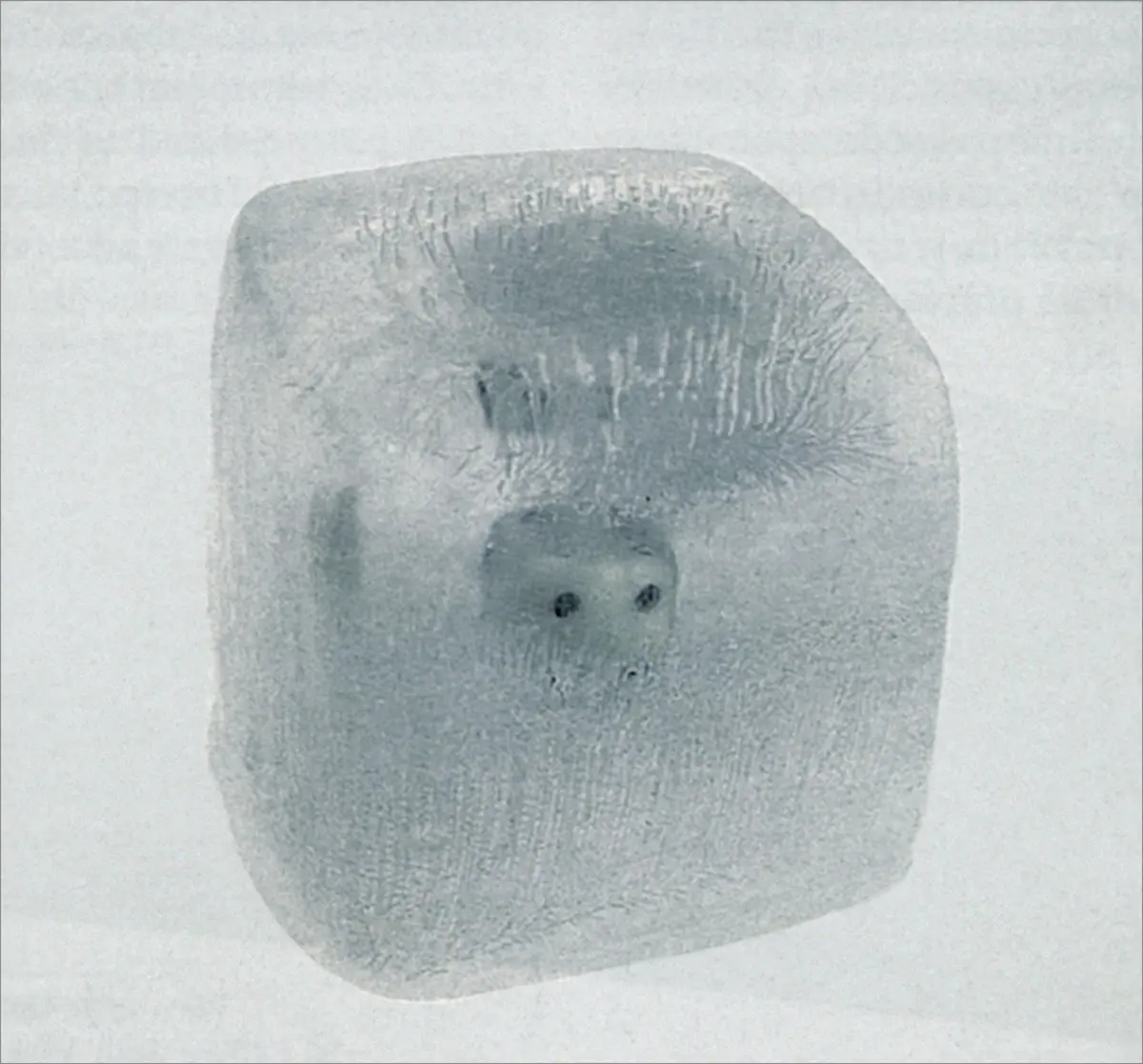
A counter-example of what has just been said and irrefutable proof that we are constantly placed in a kind of quicksand is the piece titled Ice Dice, from 1976, which is perpetuated only through its reproduction. A fragile and ephemeral construction (the ice) encompasses the place originating probabilities (the dice). There is no way of knowing the duration of the instant, not even by solidifying water. Caldas' coup de dés consists of destabilizing any kind of logical forecast, or in this case, duration.
It is expedient to remember that the artist did countless works with mirrors and dice. An element of chance and hazard par excellence, this little cube concentrates all the force of multiplicity and the unknown - perhaps the most exact nature of poetic space. As for the mirror, any comment on its reflective surface would run the risk of plunging us into a labyrinth.
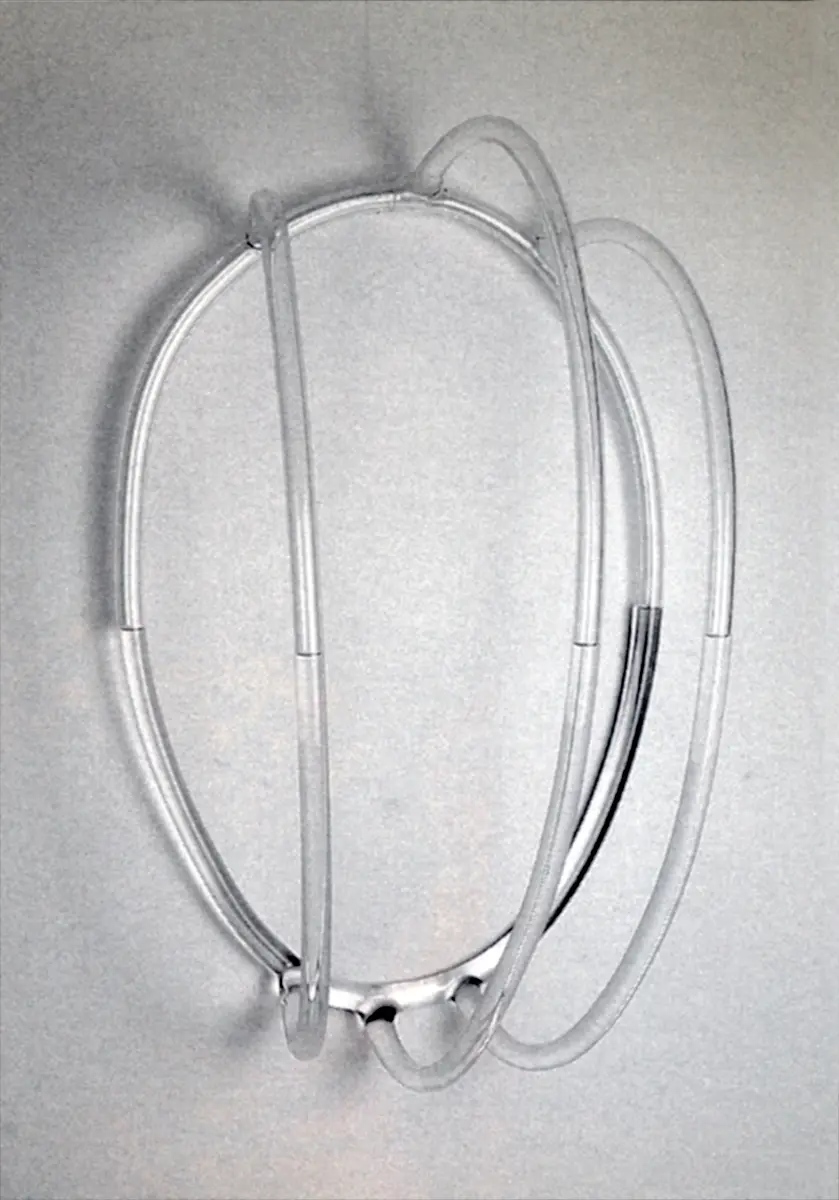
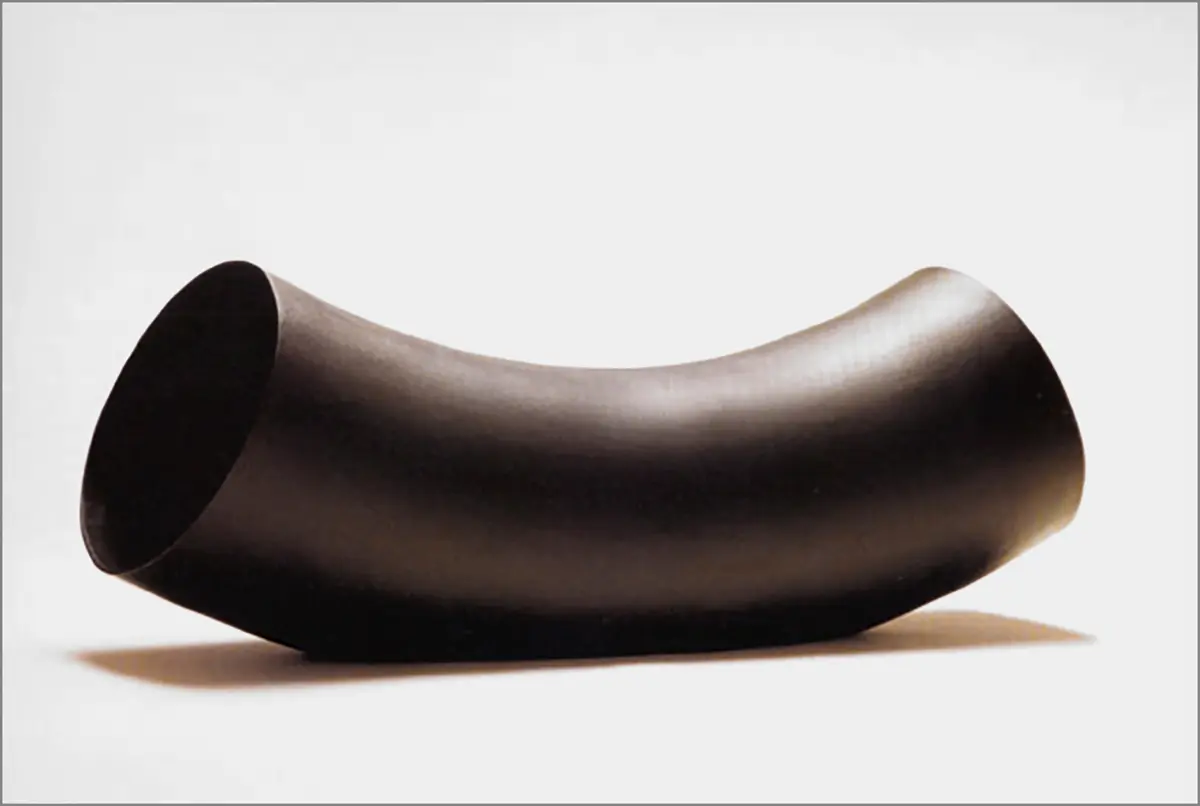
Caldas knows that things are immobile in the world only in appearance. "To observe the movement of unmoving things. To take the distracted soul by surprise." A murmur arises which prevents any absolute repose. A classic example is when we look at a cloud in a clear and windless sky. The white bob appears fixed on the horizon; however, we know that the thousands of. droplets that make it up are fluttering although we cannot see them. This is one of the implications of the piece from 1968 titled Godard Sculpture, consisting of a curved tube placed on the floor.
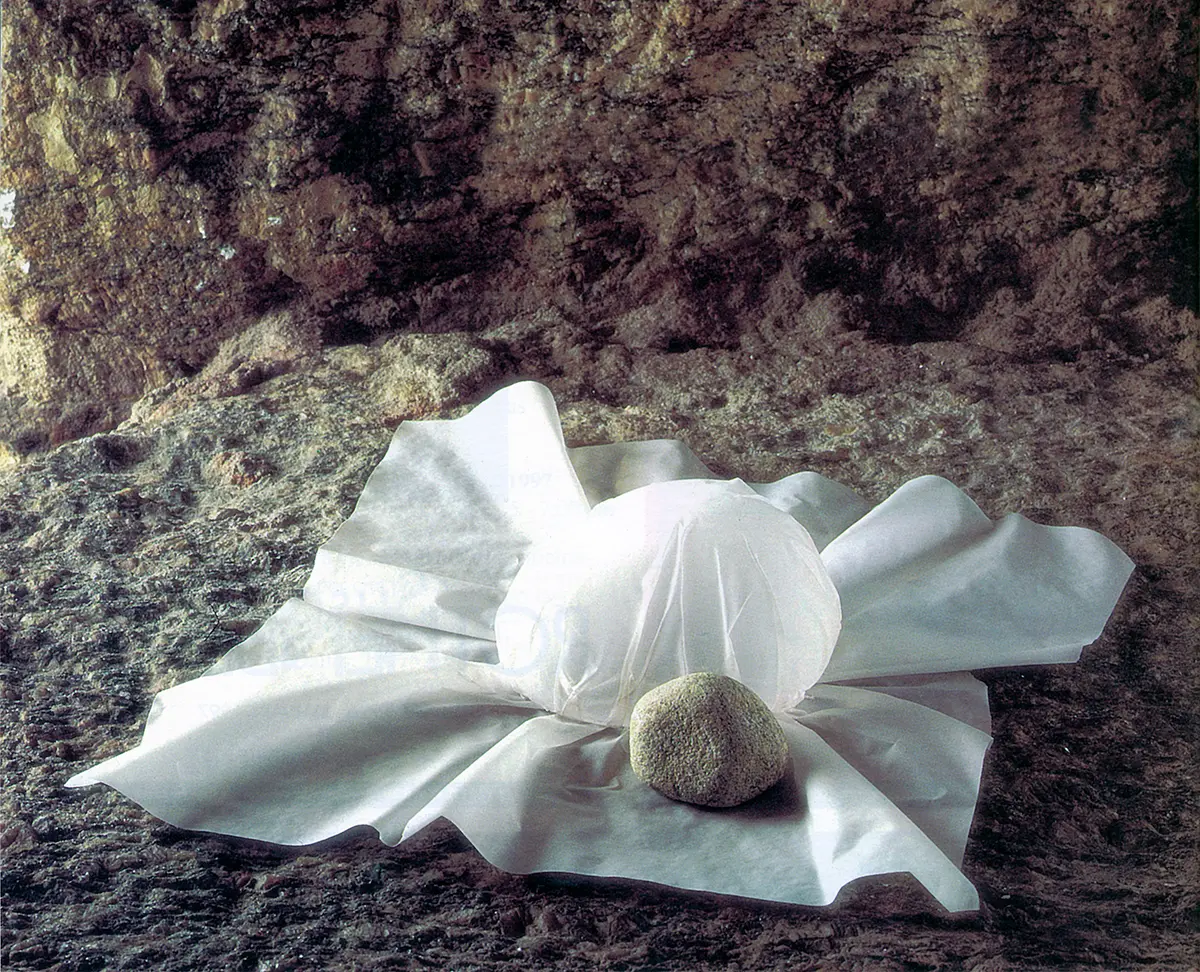
Caldas' work began with problems related to elementary optics, platonic images, and the recurrent use of two discs, volumes, stones, or recipients attempting to communicate with each other. But there is a perfectly exemplary piece (Untitled, 1994) that reflects all this discussion on the volatile nature of the spirit and matter. In communicating glass vessels, a certain quantity of alcohol remains permanently suspended, marking lines (of level) that are equalized in space. This colorless liquid would evaporate if it were not sealed inside. Without giving off its characteristic odor, the alcohol retains a mystery in the handsome branches that emerge from the wall. No one could testify to the nature of this substance, except the artist's word (once again, Duchamp).
We must therefore be very careful so as not to confine poetry to the immaterial, with the inherent evocation of a mystical spirit. If we had to recall here a category of the sublime, it would necessarily refer to the prohibited exile of passion. The mad ecstasy that fills us with emotions seems inadmissible in its tyranny. And the lightness of these works has the intelligence to exclude the realm of the indefinite. There is a desire to organize which runs against the random discoveries of irrational creative processes. Hasty readers of Italo Calvino will recall the presence of multiplicity for the next millennium, but they forget that this is preceded by a lesson of inexactness. Contrariwise, Caldas looks for equilibrium at the limits, with no contamination from sentimentalism, and even the pressed leaf is scrupulous (É, 1987). Although any cognitive process involves difficulty, in the ignorance of common sense, the result does not generate pathos.
The public could savor this enveloping serenity in a recent exhibition (Paço Imperial, Rio de Janeiro), where the artist presented a selection of 59 notebooks and objects collected over almost thirty years, in an attempt to update graphic gesture in space. "They are like parentheses without phrases or better, they are the structure of a whole resting in the parts." Indeed, to plunge into the specific time of these notebooks involved a distancing from the fine irony that permeated the artist's installation at the 17th edition of the São Paulo Biennial in 1983, a corridor of thousands of boxes of chewing gum, which the visitor eyed quickly in a gesture characteristic of all those who frequent blockbuster exhibitions.
Caldas's sculpture functions in space with all the power of the so-called Cartesian anguish. To penetrate into this universe is to believe that work is only a sensitive idea, that it is not inexorably tied to a label, and that all production is inevitably the production of a concept. Within this curved line of perception, Caldas' invitation to reasoning takes us toward a place of order, beauty, and calm. A luxury of rare voluptuousness.
NOTES
1. All the quotations are from the artist himself.
2. From 1972 auto-adhesive labels printed with bold letters on a gold background: / am you and / am not you.
3. This exhibition (1994) won the Mario Pedrosa Prize for the best exhibition of the year, awarded by the Brazilian Association of Art Critics.
LISETTE LAGNADO
Brazilian critic and curator.