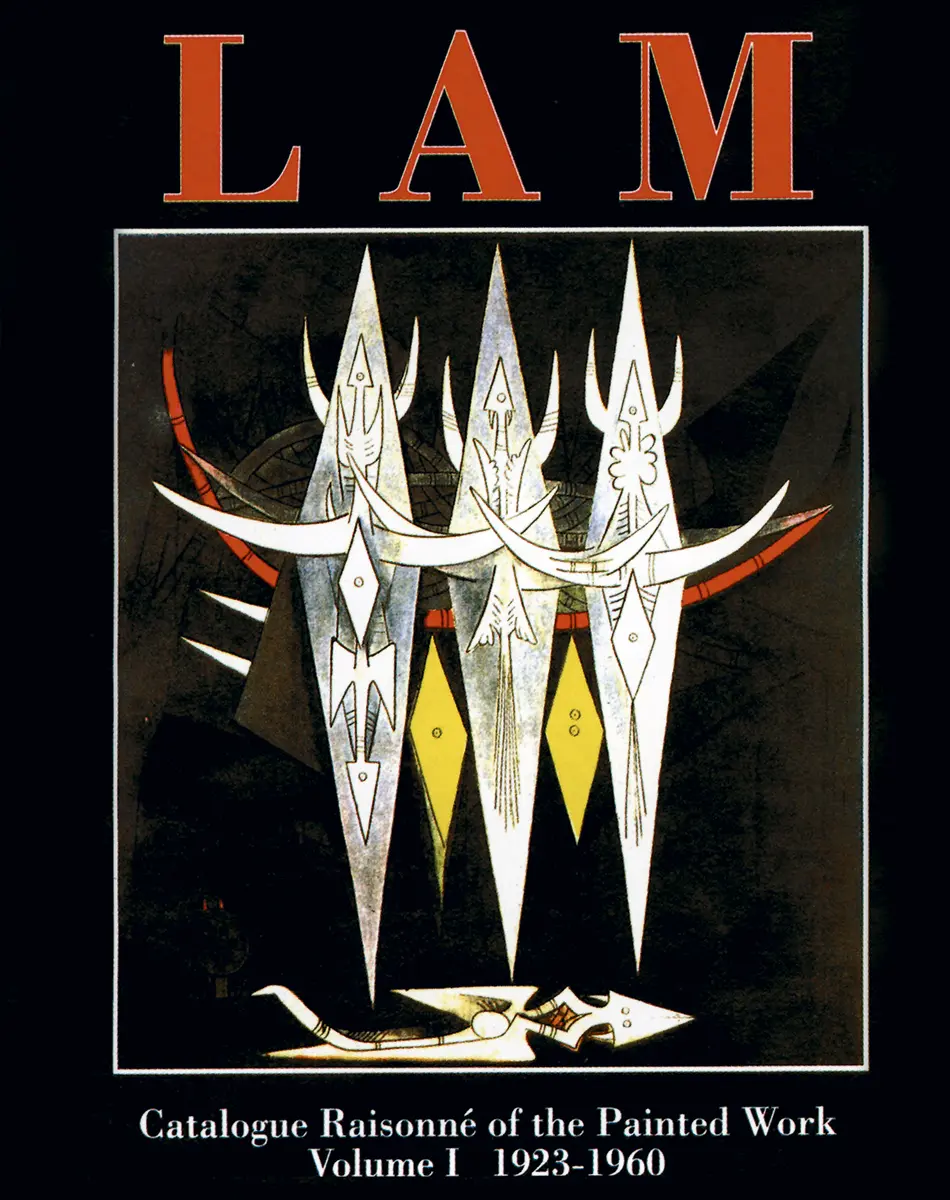
Wifredo Lam (1902-1982) is among the great modernists of the twentieth century. His paintings, sculptures, drawings, ceramics, and etchings have been exhibited extensively throughout the world. He is perhaps best known for having created a personal language in which Afro-Cuban sources assume a new importance in modernist idioms. A wide-ranging audience of students, scholars, collectors, and museums has greatly anticipated the publication of this first of two volumes of the catalog raisonné. Due to its outstanding design, clear organization, and rich body of information, the book is a major contribution to Lam's studies.
It is organized into four major sections: the analytical, which contains three essays; the historical, which is the chronology; the catalog, which documents and illustrates nearly one thousand painted works; the appendix, which exhaustively lists solo and collective exhibitions; and an extensive bibliography consisting of monographs, general references, periodicals, newspapers, dissertations, conferences, and symposiums, writings by the artists, and books illustrated by him.
The ambitious and complex project took some thirteen years to complete. Lou Laurin Lam first began to catalog the work shortly after her husband's death in 1982. With the support of many people and institutions, she tenaciously pursued this project. Four years ago, Eskil Lam, Lou, and Wifredo's oldest son, assumed the task of bringing the catalog to completion. A research grant from UNESCO facilitated this. Eskil Lam's professional involvement has been paramount to the study's conclusion.
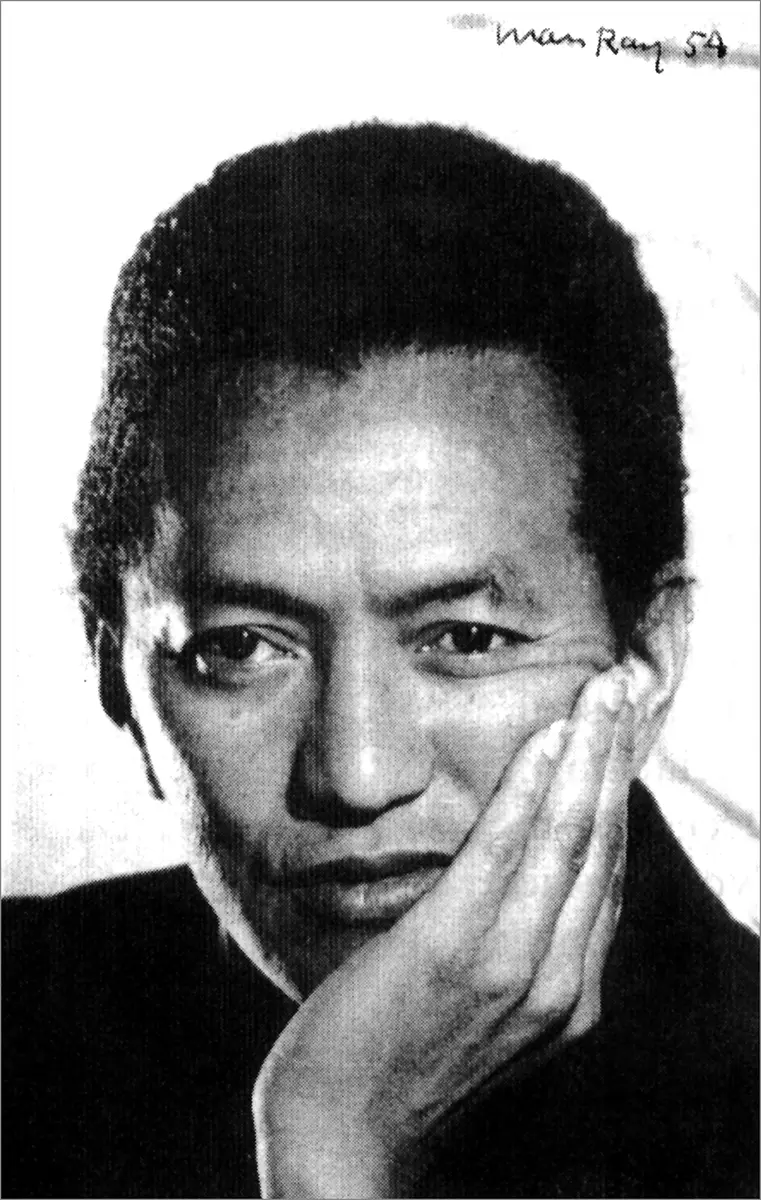
One of the endearing qualities of the catalog is the notable presence of the artist's voice. This has been captured through two short writings by Lam's friends. Aimé Césaire and Roland Dumas, translations of Lam's notes and letters, and personal photographs of the artists with his work and his friends. Perhaps it is Lou Lam's rendering of Lam's peripatetic life that best provides the reader with a sense of the artist's enormous outreach to a worldwide group of artists, intellectuals, and artistic movements. In her introduction, she poignantly sets forth the problems involved in undertaking and executing this monumental task. One of the major problems lay in discovering the whereabouts of many widely scattered works. For example, Lam was unable to recover much of the work he left in Spain and France during the war years. Another Herculean task involved the sheer ordering and documenting of Lam's papers. Although Lam kept a great many newspaper clippings, photographs, and memorabilia, he did not carefully archive his work. However, as a result of preparing the material for the catalog raisonné, the SDO Wifredo Lam (Society for the Defense of the Work of Wifredo Lam) now possesses an archive, available to researchers, with the most complete photographic record and documentation of Lam's full artistic production. The archive houses articles, art reviews, exhibition catalogs, and monographs spanning the artist's career. Recently all of the articles have been photocopied and organized chronologically.
Similar to many artists, Lam often signed his works only before exhibiting or selling them, Lou Laurin Lam authenticates the artist's work. This task has been made more difficult by a steady stream of forgeries, a problem openly referred to in several places in this book.
The section titled "Thema" (Themes) includes three broad subjects: Suffering of Spain, The Jungle, and Rumblings of the Earth. Each of these themes is elaborated upon in three essays: Maria Lluïsa Borràs' "Lam in Spain" Ulrich Krempel's "The Innate and the Foreign” and Lowery Stokes Sims' "From Concept to Style: Lam and His Geography of the Marvelous." Each provides informative insights into Lam's development and work of the period.
The Spanish art historian Maria Lluïsa Borràs' contribution is the first essay in English devoted exclusively to Lam and his artistic development in Spain from 1923 to 1938.1 For years Lam students have had very little background on the artist's life and development during his first fifteen years abroad. Borràs admirably fills this lacuna. We are presented with a well-researched account of Lam's artistic development from its academic beginnings through his modernist experimentation with Symbolist, Surrealist, Matissian, and Cubist modes. She traces his path through the towns and cities he lived in and visited from Madrid to Cuenca, León, Málaga, Valencia, Caldes de Montbui, and Barcelona. There was a generous group of Spaniards who embraced Lam in friendship and aided him financially and spiritually through years of economic, political, and social turmoil. We learn the names of his friends, companions, and patrons. Borràs successfully interweaves quotations from unpublished sources offering a close-up of the young, vulnerable artist who struggled hard before attaining artistic maturity. Lam's personal concerns regarding his aspirations and successes, his disappointments, and his failures are poignantly expressed through excerpts from his letters to his friends and to his companion Balbina Barrera.
Because of an emotional crisis caused partially by sickness, Lam painted very little in Madrid from 1933 to 1935. When the Civil War broke out in 1936, Lam joined the Republican side. He was recruited by his friend Faustino Cordón as head of personnel of a weapons factory. After some months his health deteriorated, landing him in a sanatorium in Caldes de Montbui, near Barcelona. In July 1937, after recuperating, Lam went to Barcelona where he returned to painting with renewed enthusiasm. Through introductions, Lam made contact with other artists in Barcelona which provided him with a much-needed artistic ambiance. He joined their tertulias (gatherings to discuss common interests) and the painting and sculpture section of the Ateneo Socialista, which provided him with access to the library, a cafeteria, and work sessions with a live model. His work from this period indicates that he was looking closely at Matisse and at the same time was incorporating some new Cubist spatial modes. By 1938 the war was encroaching upon Barcelona. Lam described the frightening conditions in a letter in which he recounts that Barcelona had been bombed seventeen times in thirty-six hours. By the first of May, the time had come for him to leave for Paris.
The director of the Sprengel Museum in Hannover, Ulrich Krempel, writes about Lam's work from 1938 to 1946. Krempel elaborates on Lam's distinctive ability to unite, to synthesize what was foreign and what was innate. He begins with an overview of Lam's searches in Spain. His discussion continues with Lam's years in Paris, covering the now familiar ground of his friendship with Picasso, his interest in and break from the European interest in "Primitivism." Lam's next displacement led him to Marseilles (summer 1941), where he reunited with a group of Surrealist artists also fleeing Nazi-occupied Vichy France. By the following spring, Lam was on the high seas, disembarking in Martinique before finally returning to Cuba. Krempel interprets that journey as "an emigration towards himself." The section that treats the similarities between Aimé Césaire's and Lam's creative, intellectual, and political searches is one of the highlights of the essay. Like Lam, the black poet also studied in Europe and had similar experiences there. Cesaire was drawn to the surrealist technique of automatism, using it to free his artistic voice. Both he and Lam were the progeny of colonized countries, and both used modernism's dismantling of tradition to define their own culture.
In a detailed discussion of The Jungle (1942), Krempel establishes the ways in which Lam achieved a syncretic union of figure and nature, human, plant, and deity, Nourished by Afro-Cuban rituals, the poetic vision and psychic state merge. Krempel asserts that Lam had created "a world where that which is foreign and that which is innate are not essays to recognize or to distinguish from each other."
Lowery Stokes Sims, curator in the Department of Twentieth Century Art at The Metropolitan Museum of Art, asserts that Lam's achievement, still unparalleled, marked the transformation of the "primitivist" paradigm at the turning point in 20th-century art when Third World cultures came into their own. In her enlightening discussion, she conducts the reader through Lam's subjects, their form and concept, all the while linking his developments to the Surrealists' notions of the marvelous.
Her account begins in Marseilles with a series of drawings; it proceeds to the single-figure subjects executed in the early Havana years when the artist developed his signature style, on the still lifes of the mid-late '40s, on the multi-figured works of the mid-late '40s, and finally on the horse-woman (femme-cheval) subject of the '50s.
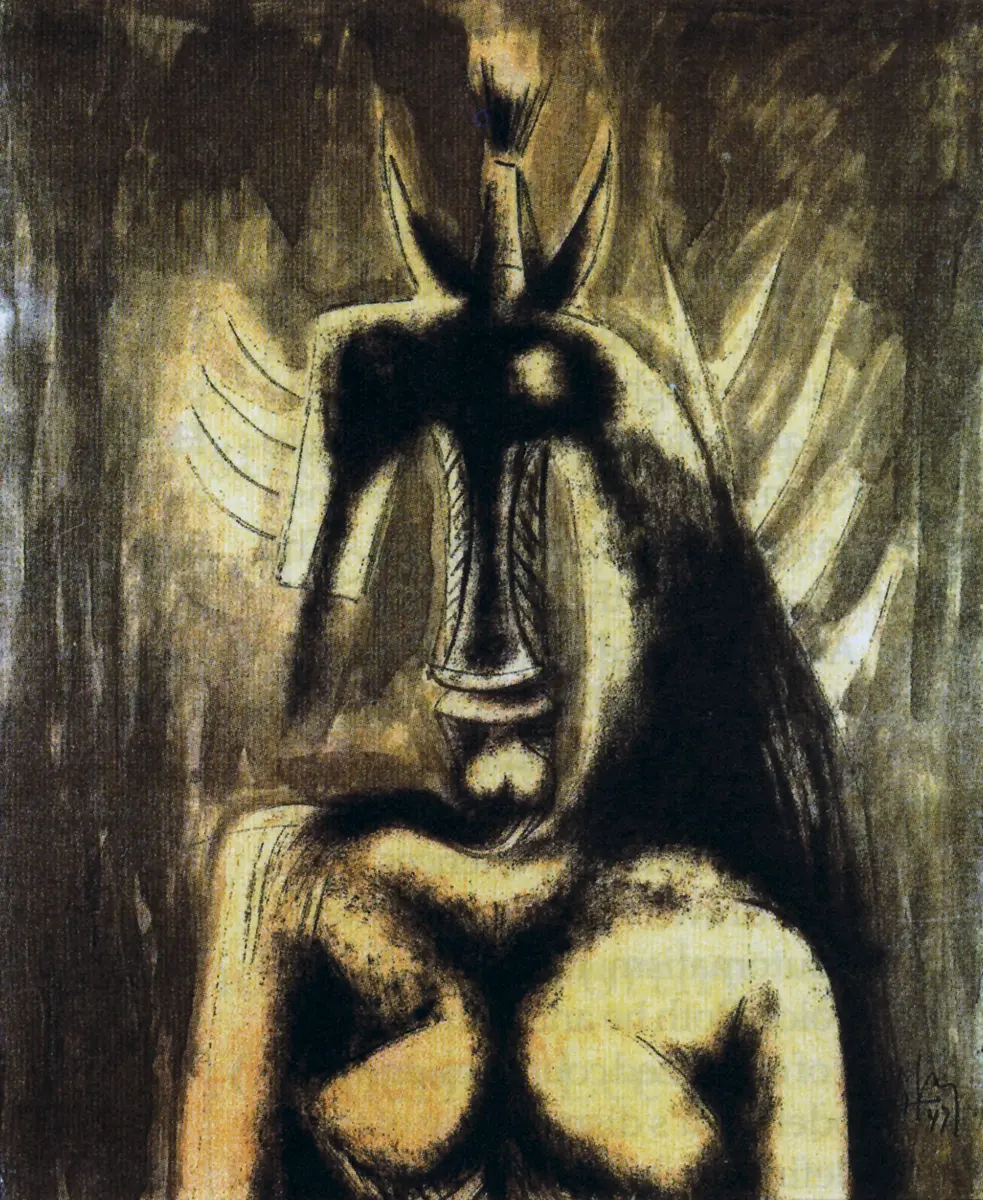
Lam's evolving vocabulary is discussed along with his painterly techniques. For example, in the early 1940s, Lam worked primarily with gouache and kraft paper. He employed two techniques: he either applied a thin coat of undiluted paint to the surface, as is noted in his single figures of 1942, or he applied a more lush application of paint affording the appearance of drips, splatters, and overpainting as noted in The Green Morning of 1943. In the mid-1940s Lam created jewel-like surfaces by dappling the paint in Altar for Elegua of 1944. He also executed works at that time such as Oya of 1944 in which he restricted his palette to shades of brown, black, and grey together with white. Lam's work is rooted in expressions of the magical, and the spiritual.
In the late '40s, Lam did the series Canaima. Painted in flat, planar shapes, these feral females display open torsos, spikes along their backs, and manes of hair. This body of work is informed by Oceanic art (particularly that of the Sepik River region in Papua New Guinea), which Lam had begun to collect. At the time Oceanic art was prized by the Surrealists and the Abstract Expressionists.
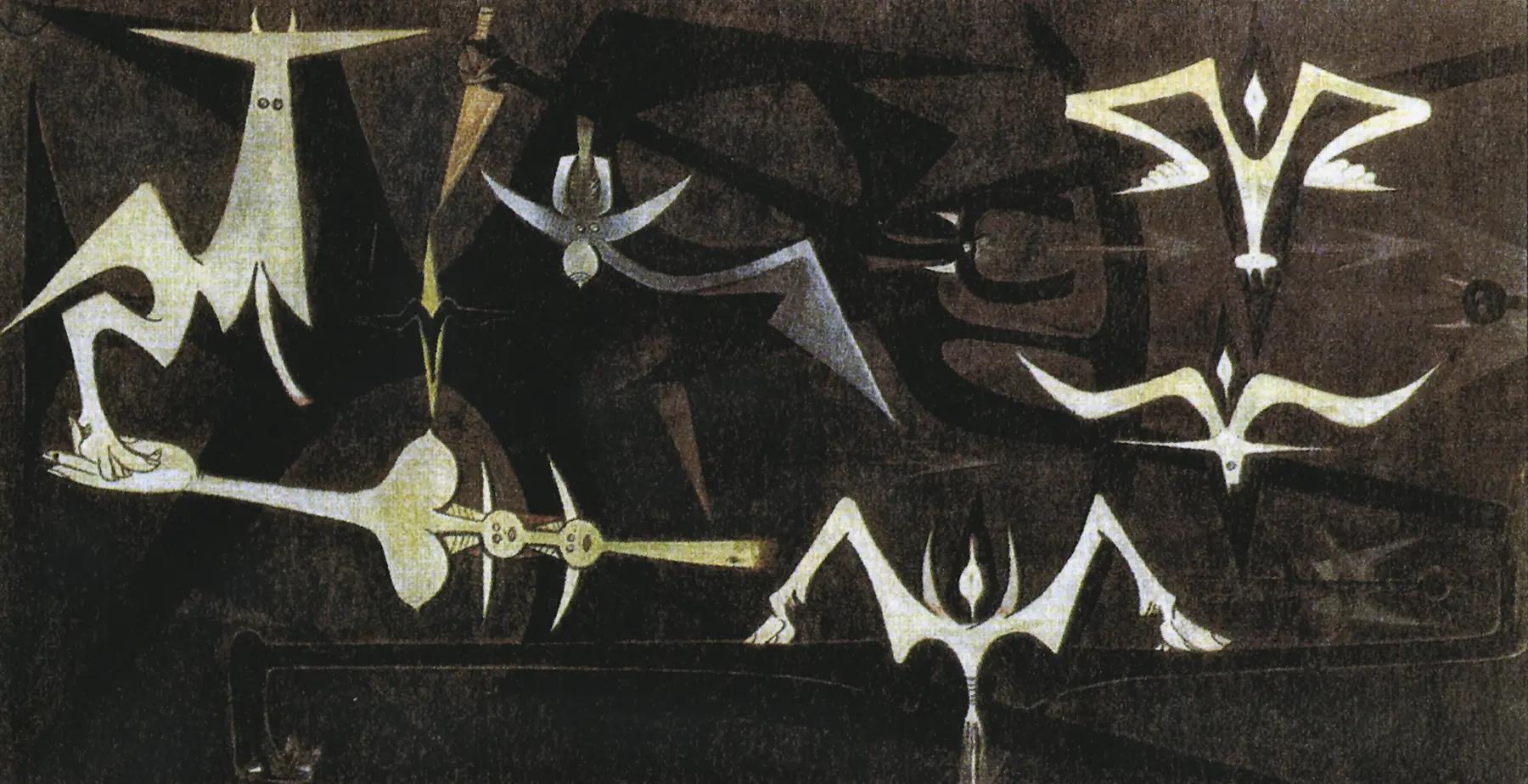
The work of the 1950s is characterized by a new formal and pictorial vocabulary. In La Rumeur de la terre (Rumblings of the Earth) of 1950, the intertwining of the forms creates a sense of rhythmic movement. This effect owes much to the dominance of drawing in his work. In many works, Lam drew his forms directly on the canvas. The fragmented anatomies in this beautiful painting are distillations of now-familiar elements in the artist's world. Sims concludes that the interchange between painting and drawing, surface and line, enabled Lam to create a structured passage for the transfer between the empirical and metaphysical worlds.
By the end of the 1950s, when Lam was living in Europe, he continued to maintain an important presence in the Cuban art world. He was also sought out by the Cobra artists and the Italian avant-garde while continuing to maintain contact with various post-war artistic circles, notably the Phases movement and the Situationists.
As noted in the extensive chronology, the final years of the 1950s saw Lam in Milan, Venice, Mexico City, Caracas, Havana, Rapallo, and Chicago. In the last city, he was a selected member of the Graham Foundation for the Advanced Studies in the Fine Arts, together with Frederic Kiesler and the Spanish sculptor Eduardo Chillida. Concurrently his work was seen in many parts of the world as widely separated as Documenta II in Kasel, Germany; the Solomon R. Guggenheim Museum, The United States Collects Panamerican Art in Chicago and L' Ecole de Paris dans les collections belges at the Musee d'Art Moderne de la Ville de Paris.
The 519-page catalog raisonné is of enormous value to anyone —student and scholar alike —interested in Lam's studies. It is an excellent reference point for questions on individual work, exhibition history, and provenance. Future Lam scholarship has now been given a great boost. We eagerly await the publication of the second volume.
NOTE
1. Maria Lluïsa Borràs’ Lam en España, 1923-1938. In Wifredo Lam (Madrid: Museo Nacional Centro de Arte Reina Sofia, 1992).
* Photographs are courtesy of the Estate of Wifredo Lam.
JULIA P. HERZBERG
She is a historian and independent curator. She was co-curator and essayist along with Giulio Blanc and Lowery S. Sims for the exhibition Wifredo Lam and His Contemporaries organized by the Studio Museum in Harlem, New York, in 1992.