
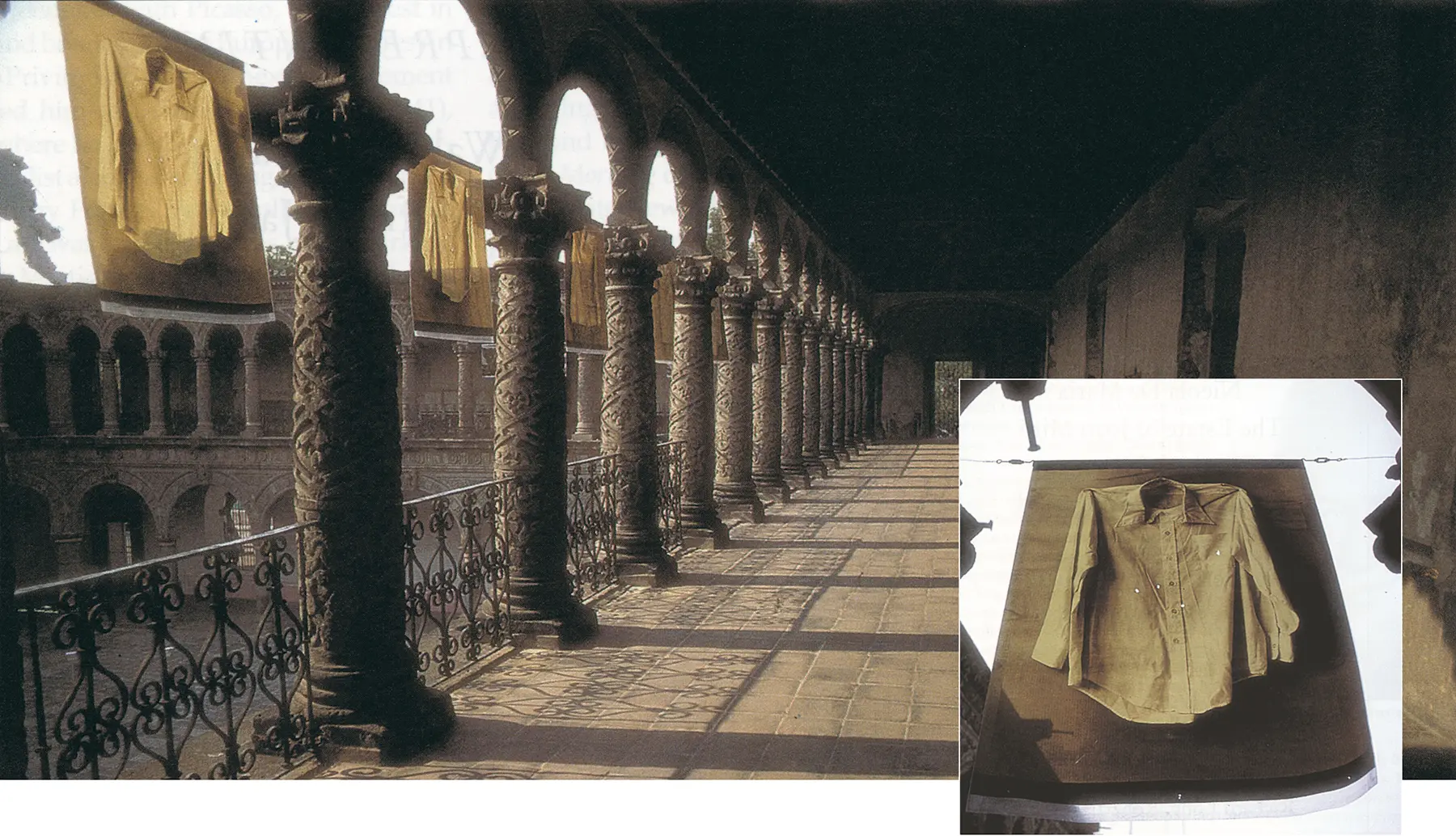
Natalia Gutiérrez: I would like to begin this conversation by referring to your photographs of indigenous faces in the context of collage, because of an idea that interests me: collage seems to have nothing to do with continuity or unity, but rather with elements that have been arisen from the past or present and which are rather ironically mixed together. I see these faces as a kind of continuous assemblage. What is your opinion?
Luis González Palma: I think I have used collage for a long time in my work as a means of making photography into an object, by adding elements, but above all by re-taking the baroque, which I have seen in Guatemala and which has had a tremendous influence on my work process. But I also use popular iconography, full of ribbons and hearts; for example, in a series of skulls which I did earlier, the brilliance was not a matter of photography, but the metal object, as in the baroque image, found and selected, and which emphasized its meaning. But in the work that I presented at the Luis Ángel Arango Library in Bogota, Parallel Histories, collage as a superimposing of images is also used in the light boxes. The idea of the work is that it is not possible to visualize through a single image, precisely because the work is a reflection of the simultaneous nature of events. How is it possible that I live in a country like Guatemala, where there is much mysticism and so much violence at the same time? Where you are enjoying nature and at the same time you are thinking that helicopters are flying overhead and you know they are going to bomb some region, where you know that as you are working, someone is being killed or someone is being baptized. There is also a superposition of different times, which I relate to my childhood and the fear of death. The boxes mark out a circle that you enter, leave, and enter again, a repetitive space that shows in a physical way that time passes, despite events, a passing marked by the ticking of the clock.
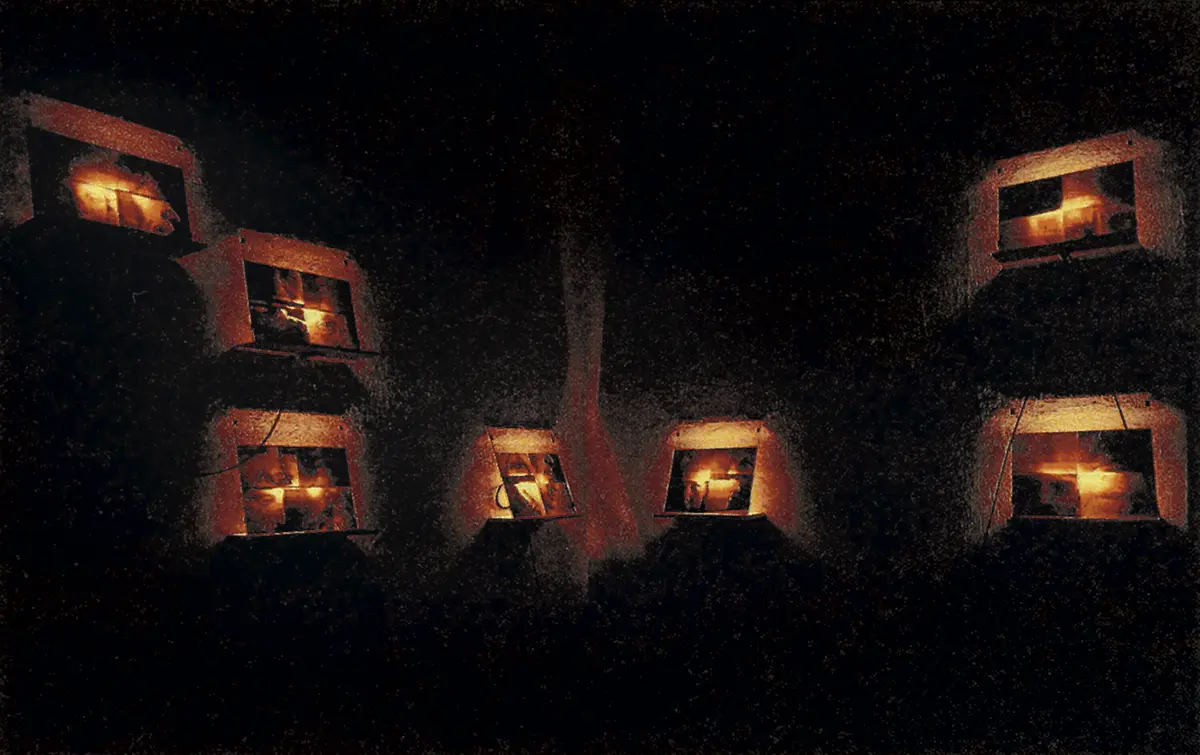
NG: So in Parallel Histories there is a more up-to-date and conflictive image of Guatemala?
LGP: This project parts from a personal experience in which I have tried to show how violence, nature, and armed conflict are a contradiction, expressions which without taking them into reflection, are our way of life. Aspects like violence in religion, waiting, absence, and anguish are elements that I use to establish a tragic vision of life, within a space in which pain and beauty are part of everyday life.
NG: Sometimes, when we look at the indigenous faces in your photographs with their sepia color which, as Fernando Castro says, makes them look like smoky frescoes, you imagine that your country is suspended in time, far from the impetuous attack which is affecting us in Colombia in a wave of relentless Americanization. In accelerating Americanization, What do you think?
LGP: I believe that in Guatemala we are also experiencing the influence of cultural patterns from outside, but this occurs mainly in the capital. On the other hand, in some indigenous towns, certain native religious rites continue intact, rites which have been inherited from the past, although little by little, I believe that all this is being lost, in part because of the growing division between the indigenous populations. Fortunately, there are some groups that are resisting.
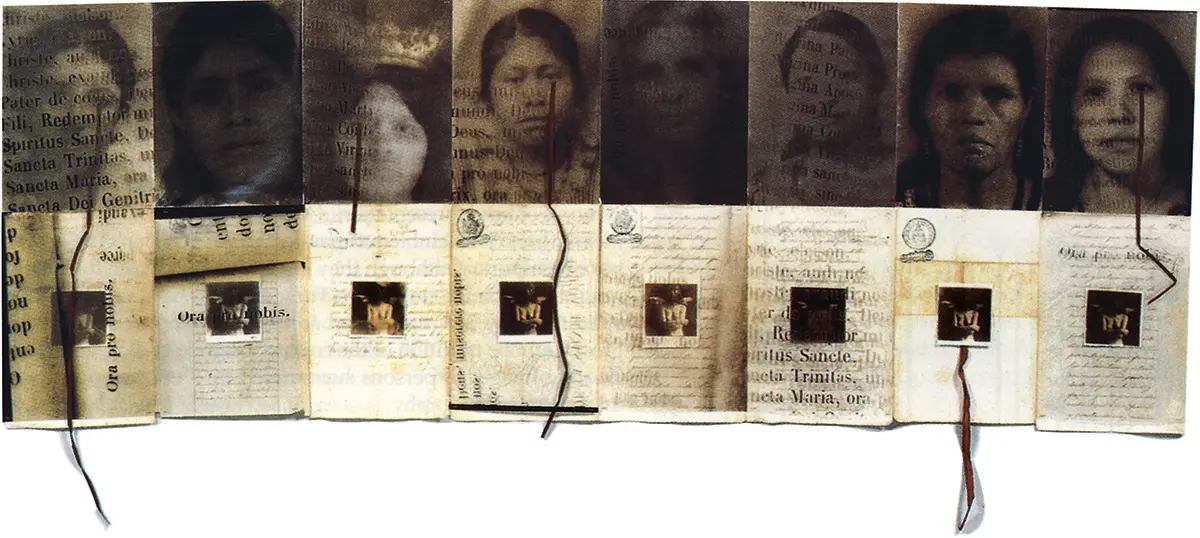
NG: In an earlier interview, you said that photography intervened in this way and permitted you to express your own pain at the awareness of the marginalized condition of some of the population in your country. You seem to be intensely affected by that pain.
LGP: The situation in Guatemala is, like that of many other countries in the Third World, very critical. But I am not interested only in expressing this marginalized condition but in the consciousness of solitude and a reflection on the fragility and temporary nature of life. The indigenous face has been really a poetic metaphor for this awareness of solitude, not only of a human group but of all mankind. Of course, my country causes me pain, just as the human race causes me pain.
NG: Concerning the subject of nostalgia as a fundamental element in the construction of artistic images, Doris Salcedo said: "I do not believe in lost sensibility. I am not interested in working with nostalgia. On the other hand, I believe that the function of the artist is to express a sensibility that is different from that which has taken us towards crisis." And Juan Carlos Pergolis, an Argentinian architect who lives in Colombia, has said that "nostalgia is a way of not looking at the present." What is your opinion?
LGP: I do not see nostalgia as a return to lost emotions. Rather for me, it is a kind of detonator that makes me focus on the present, creating a kind of dialogue with and questioning of the past, but with a view to changing and rethinking certain aspects of present-day life. I believe that my images have an "aura" of nostalgia for the past, but in the final analysis, what I am trying to do is to show that the concepts of solitude, pain, and marginality are not merely problems of the present or of the past, but are the conditions of our existence.
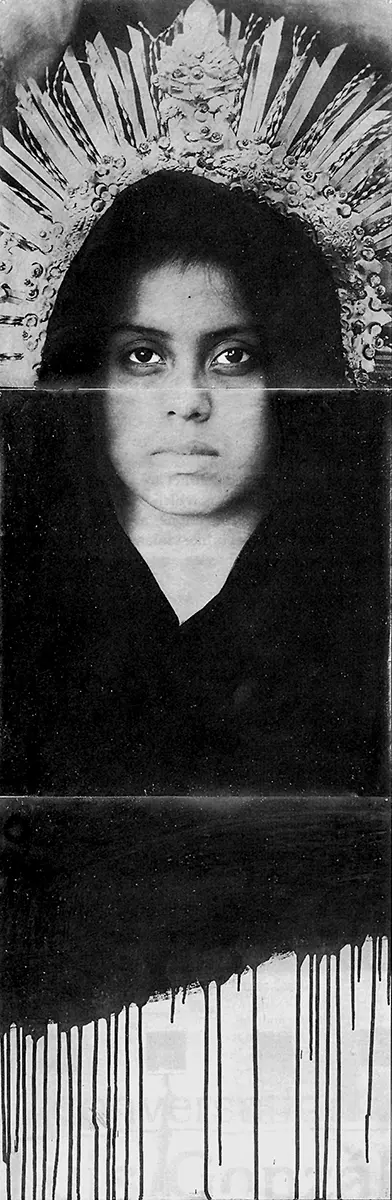
NG: It seems to me that the indigenous faces circled with roses and crowns of thorns seem to be an attempt to create your own indigenous Virgin. Do you not see them in terms of a more contemporary symbology?
LGP: In principle, I have tried to rework the representation of the Virgin and other figures from Christian iconography. I do not know of cases of representing the Virgin in Guatemala, such as those which can be found in Peru, Mexico, and Ecuador. In almost all my work, I have tried to give women in general a kind of divinity, Earthly Mother of the Living God, and the white roses are symbols of her representation. The crown of thorns has a funeral meaning and is an emblem of passion, elements which I believe to be contemporary, although they have been used from the beginning of Christian iconography. These symbols have impressive validity today in Guatemalan culture, possibly because of the great Catholic tradition of the country. In my present work, I am creating images of persons surrounded by non-religious contemporary iconography.
NG: Tell me about the lottery in Guatemala and in your work.
LPG: Lottery is a popular game, which the Spaniards brought to the Americas to teach the native population how to read. It is a game of chance in which, depending on an infinite number of possible combinations, a person who fills in his or her card first will be the winner. In part, it involves the hope of a modest fortune, combining luck, chance, and destiny, elements over which we have no control. I have tried to use this popular game to give a new reading to traditional images, creating a kind of game card that is a reflection on the different destinies we find in life: the Rose, as a being, conscious of its fatal ending; the King, a symbolic coronation of those who are marginalized; Death, the condition of life; the Moon, the imposition of symbols on the image of a woman.
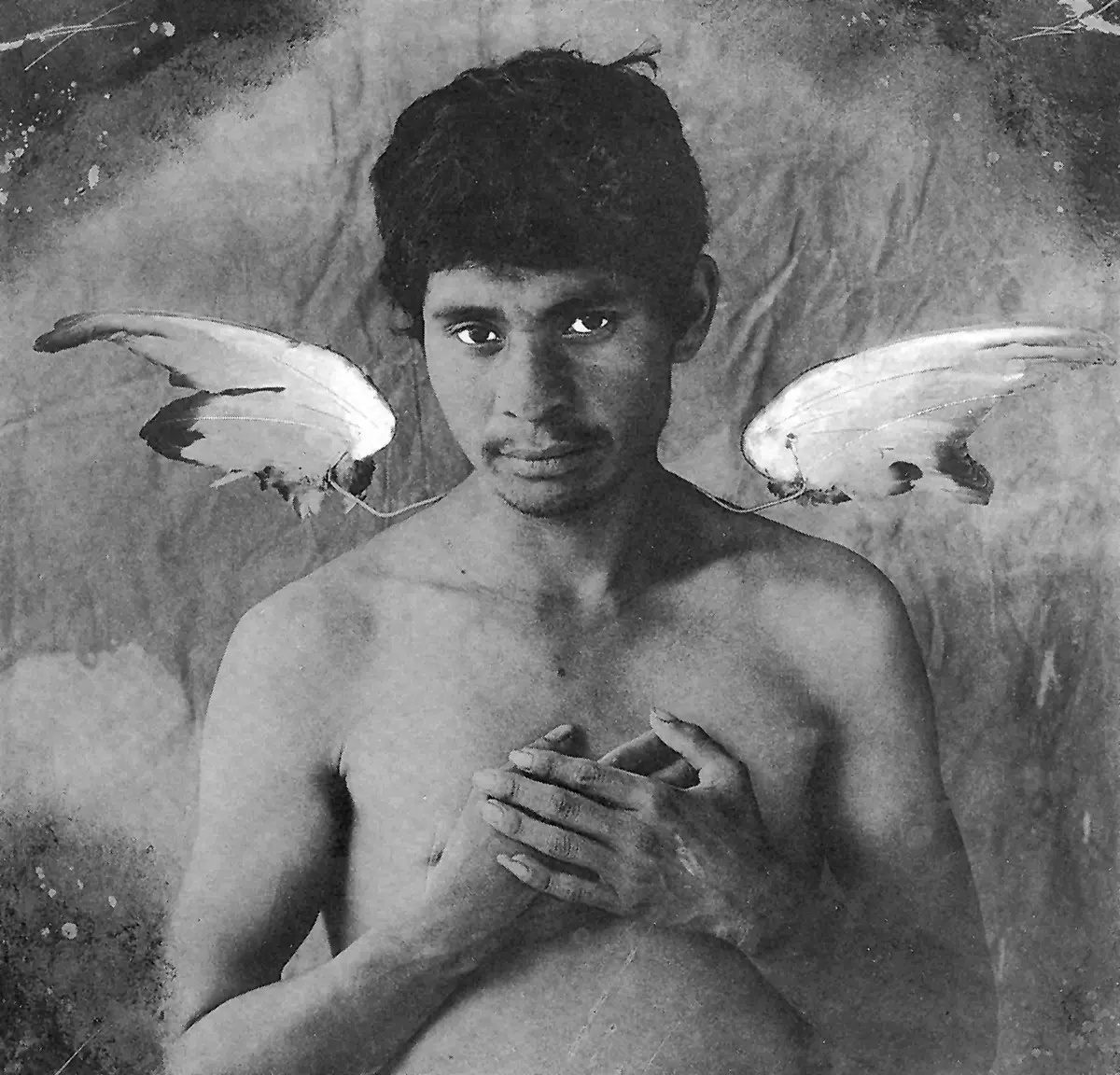
NG: You were saying that the intense white of your photographs is the white of the photographic paper. How then do you use the fixatives and the various technical processes to make them look older, to change them to "another time"?
LGP: The images on the photographic paper have been turned sepia through a chemical process. Then they are treated with bitumen to give the effect of "another epoch." After this process, it is time to reveal the original white of the photograph to create a focal point in the image, mainly in the eyes, and thus establish a direct relationship between the glance of the person photographed and the spectator.
NG: Boxes, light, fossils... What do these three words conjure up to you?
LGP: Boxes as limiting spaces, light as a source of knowledge, and fossils as objects that capture a moment with your own death.
NG: I am very moved by the title of one of your works, A Place without Rest, especially because some of its images in fact show no rest. In Parallel Histories, the images are scratched, full of marks, almost negated. It would therefore seem that photography, for you, rather than bringing an object out of obscurity, as photographers at the beginning of the century did, was in fact to bury the image.
LGP: I would like to quote Fernando Castro, who said of my work that I do not reveal things, but plunge them in shadows. At one time, I was interested in obliterating the medium, but there was also a need to make out of photography a testimony of physical contact, creating in it a sense of affection or rejection through the treatment, obliterating the ascetic sense of traditional photography, and endowing the photographic image with hidden emotions.
NG: If I asked you to mention —without thinking it too much — the photographers you believe to be the most important, whom would you choose?
LGP: Julia Margaret Cameron, Doug and Mike Starn, and many other less well-known photographers, like Chema Madoz, from Spain, and Alexander Apóstol, from Venezuela.
NG: And artists?
LGP: Kiki Smith, Ida Applebroog, Bill Viola, Gary Hill, Anselm Kiefer, or Guillermo Kuitka are artists who move me emotionally.
NG: And architects? Because you are an architect.
LGP: Tadao Ando, Mario Botta, and Jean Nouvel, and someone who is not an architect, but whose proposals in terms of design seem extraordinary to me, Philippe Starck.
NG: And finally, let us go back to the beginning. Your first photographs were about ballet. What remains of this experience?
LGP: The experience of taking dance photographs gave me the opportunity to explore the creation of fictitious environments, to become conscious of the tensions and emotions experienced by the human being, and to be aware of the sense of space and time.
NG: What has the portrait taught you about photography and people?
LGP: For me, the portrait is a kind of complicity established between the model and the photographer. A sort of search for the essential, a desire to create emotional relations through the silence of glances.
NG: Since you are a photographer, I have to ask you about the image of Colombia that you are taking away with you after your visit.
LGP: It is an image of velocity, fear, and the desire to survive.
NG: And of Latin America?
LGP: One of contradictions.
NATALIA GUTIÉRREZ
Dean of the Faculty of Art of the Jorge Tadeo Lozano University in Bogotá.