
With an impressive spring debut at two Manhattan venues, Carlos Garaicoa, the 29-year-old Havana-based conceptual artist, has established a New York beachhead, richly layered with references to the crumbling architecture and infrastructure of Havana and the shaman-esque power of found and reconstituted objects.
Though on a decidedly smaller scale, Garaicoa’s photo-based installation at Art in General (April 10 - May 15) reminded this viewer of Ilya Kabakov’s compelling installation, The Man Who Flew into Space from His Apartment, when it was first shown in New York at the Ronald Feldman Gallery in 1989. The detritus from a communal apartment in the Soviet Union, as filtered through Kabakov’s senses, and Garaicoa’s striking imagery of old Havana layered with emblematic finds from that stately rubble, share a soulful kinship. (The Soviet Union also played a major role in the Cubans’ work since they grew up under that proto-colonial drabness.)
Garaicoa, who hit the international stage in 1994 at the 5th Biennial of Cuba (held at the Ludwig Forum fur Internationale Kunst in Aachen, Germany), is something of an urban archeologist/cowboy, this time let loose on the mean streets of Manhattan. With his artist residency at the alternative space, Art in General, Garaicoa roamed downtown streets, taking photographs and picking up discarded treasures from the dumpsters of Mammón. He traveled back to Havana with some of his salvage and took additional photographs of the pieces reconstituted in that environment. Garaicoa is not simply a photographer. He evocatively intercuts cultural signposts from these disparate islands, creating a kind of multi-dimensional cartography which he calls (in part) ”a map of desire.”
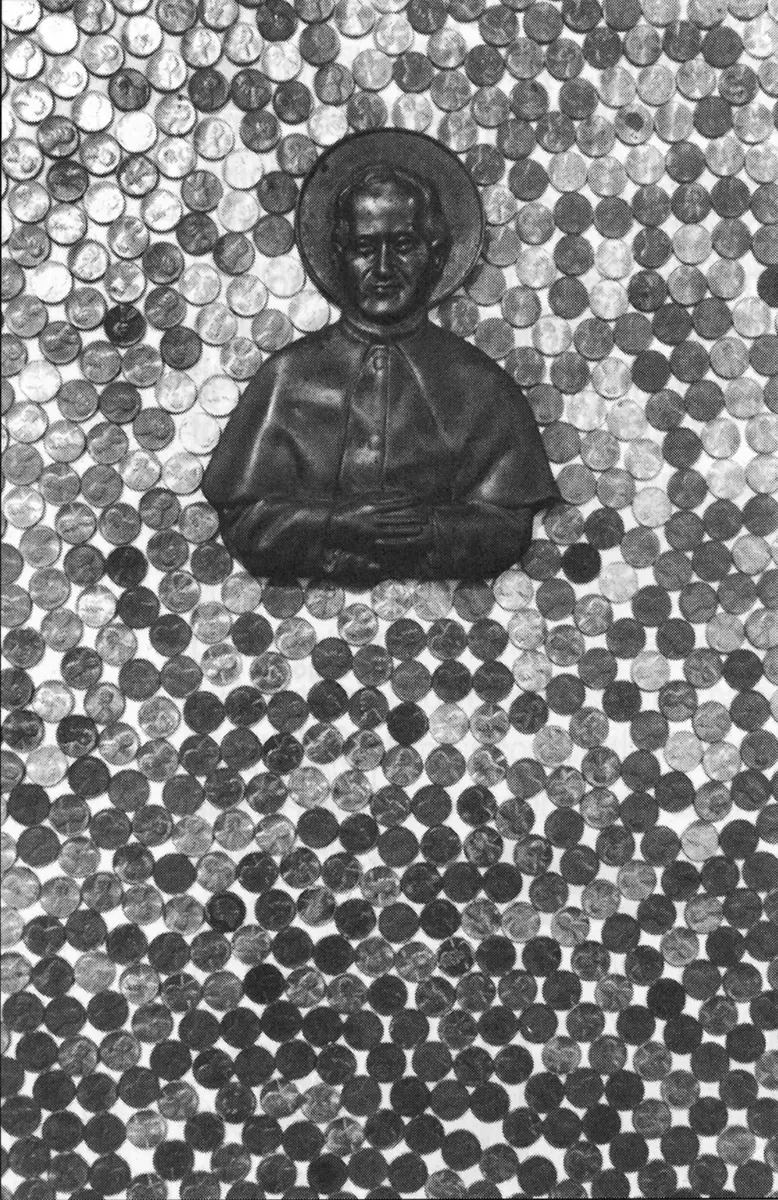
Little stories accompany some of the photo-object tableaux, which read like passages out of Italo Calvino’s Invisible Cities: "When I first came to New York, I thought I would conquer the city in no more than three weeks. Later, days before leaving, I realized that I had used my little bit of money, having to sell my drawings for only $100... Walking downtown, I found a man with a glass of pennies and a religious image. I bought for $ 20 of my $100 the image and the glass. Later, I understood that reality and desire are sometimes irreconcilable opportunities."
Garaicoa’s acquisition metamorphosed into a shrine-like tondo on the white walls of the gallery. The patina bust of the anonymous saint smiles at the viewer, surrounded by a vast halo of copper pennies. Garaicoa shatters the myth of Manhattan and its gold-lined streets with the same understated ferocity as his depictions of a decaying Havana.
Among the highpoints at Carla Stellweg Gallery (May 18 - June 29), Portrait of Architect/Engineer Cristóbal Díaz consists of a Duratran photograph and a hand-painted ceramic plaque. The burnished photograph could be an updated version of a Walker Evans study of Havana inhabitants from the 1930s. A dark-skinned man slouches at a bus stop, fatigued, no doubt, from the long wait and his anonymous years of labor. Less evident, a small plaque on the crumbling facade behind him honors the architect Díaz, a tribute from another time and long forgotten.
A fabricated recreation of the plaque, aglow in red and green hues, hangs under the gritty image, creating a critical dialogue between past and present, glory and resignation. There are many layers of interpretation waiting for a chance to speak.
JUDD TULLY