
As Jorge Orland Meló, director of the Luis Ángel Arango Library, points out in the catalog of this new retrospective exhibition of work by Débora Arango, “...it is a work which, rather than eulogy, needs the elucidation of its complex relations with the varied cultural process of the country and its region, and which continues to require the study of the sensibility and figurative forms which characterized it.” This is a useful invitation to reflection by a historian which raises matters of concern not only to the work of Débora Arango, but to many other historical figures, a full understanding of whose art involves discussion of such matters as the sociology or theory of art. This is a sphere which is experiencing a major crisis in Colombia, not only because those who were its champions—and who made such an important contribution— are no longer on their guard, but because our new generations of students are less exposed to theoretical discussion and debate.
It is symptomatic of this loss of rigor and interest in analysis over and above circumstantial criticism that retrospective exhibitions are held of the same artists with a certain regularity, and that between each show, there appears to have been no attempt at reflection or seeing things in a different manner. And it is also symptomatic that we never see retrospective shows of other major historical figures, such as Pedro Nel Gómez, to give just one example. The fact of the matter is that to see and place an artist within his or her complex cultural and historical relations, without unnecessary passion or regionalism, is a task that undoubtedly requires a commitment to history and the rigors of its methods.
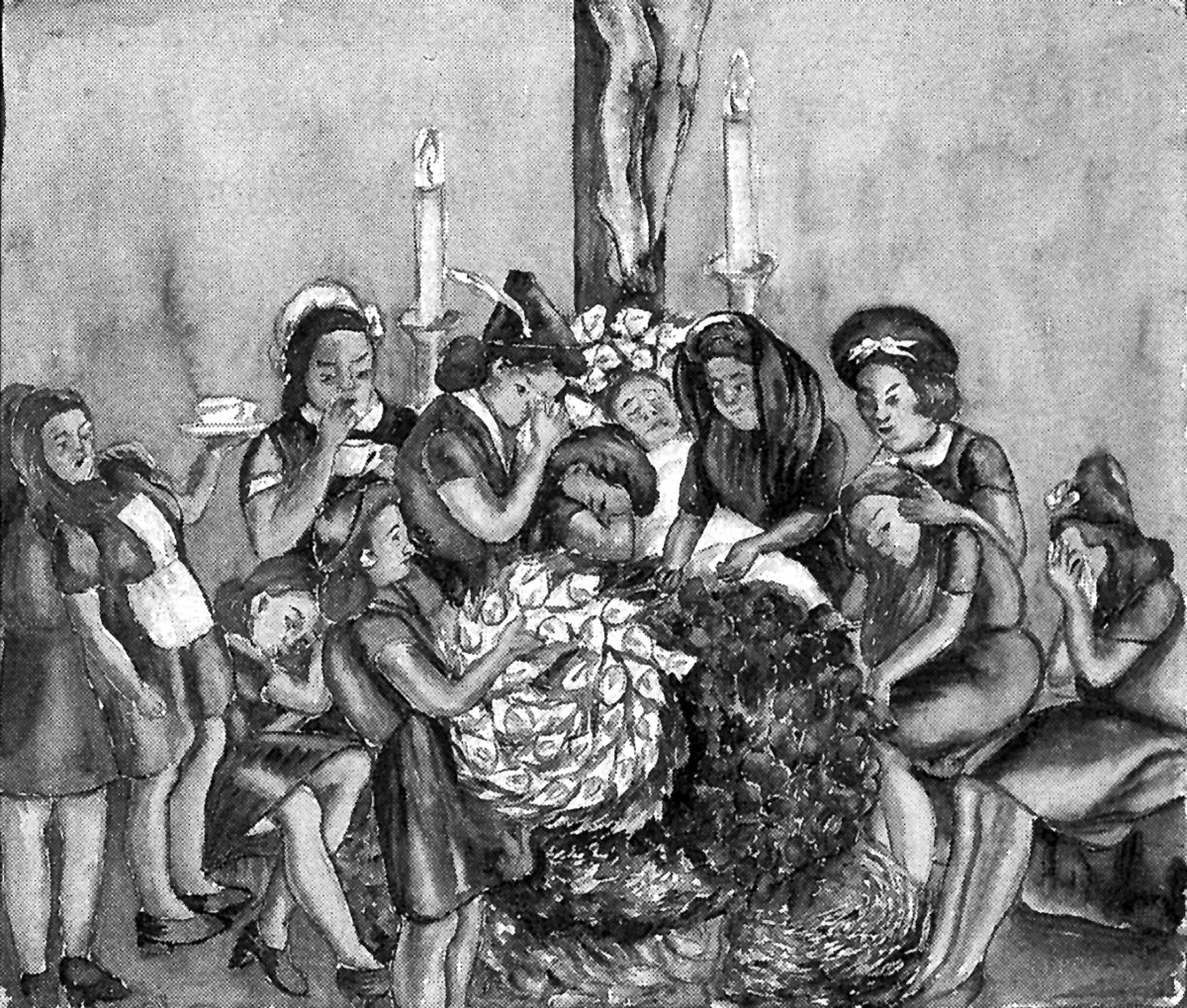
The work of this courageous artist from Antioquia, born in Medellín in 1910, rather than praise or criticism, needs to be placed in its proper dimension. Perhaps those best equipped to do so are the new generations, but also those who have studied her work, who have recognized in her watercolors and paintings the undeniable values which they possess, thereby rehabilitating in the history of Colombian art a figure who was marginalized in her early years by the deformations of a sectarian mode of thought and then by the obsession for modern art. Some of these critics, in their writings and exhibitions, introduced a generation to the work of Débora Arango as an artist whose vision was essentially local, a quality which enabled her, with much common sense and sensibility, to restrict her scope of observation to her home and city, enabling her to recognize more easily what lay around her and to embark on a process of self recognition, in which she questioned not only who she was, but amongst whom she found herself. For this reason, it is surprising that she used such apparently obvious themes as the situation of women, teaching nuns, priests, the nude, which had always been there, but which very few had bothered to look at, perhaps because in the 1940s, epic themes were more important than everyday ones. But this local view is significant, since it not only involves recognition and description of what lay around the artist, but a way of thinking characteristic of the local frame of mind, imbued with irony and devoid of solemnity. This intelligent and sensitive approach also reflected painful events, from the silence of her studio, which she captured in her works, so as not to forget them, such as Train of death of 1950.
All these reasons justified the retrospective exhibitions which were held in the Piloto Public Library in Medellín in 1975 and in the Museum of Modern Art of Medellín and the Luis Ángel Arango Library in 1984, with 240 works. These shows allowed us to begin to recognize ourselves and to understand that to remain vigilant and attentive to our surroundings and to risk a personal interpretation are attitudes of an ethical and aesthetic nature, whether or not the work in question falls within the parameters of modern art. But is there justification today, in 1996, for presenting the same retrospective without some kind of critical review? Was it not time to make a selection of the more significant works? Because it is undeniable that every artist has periods of apprenticeship and mastery, is it necessary to present all her work once again? This is the main symptom of abandonment, which is affecting the history and theory of art in our country. Of course, attempts can be made to identify the guilty parties, including the curators, but what is sad is that no one has proposed a different approach.
It is undeniable that the themes are given priority in Débora Arango’s work, although we should recall here what Francastel said in his sociology of art: namely, that if a person looks at a work solely in terms of themes, then that person is incapable of seeing. In the case of Débora Arango, too, some critics do not want to see. Like it or not, drawing, whether in the more abstract or expressionist work, is a solid kind of grammar, enabling the eye to enter, Private move around, and emerge. I was very impressed by the comment of a critic during a television special on Débora Arango, who said that she was not a caricaturist, like Ricardo Rendón, with this being considered to be a peculiar and positive characteristic. Rendón, whether caricaturist or not, was a great draughtsman, whereas in the work of Débora Arango, drawing, especially in her portraits and nudes, was a gesture which had been learnt and often repeated and which does not capture in the image the sensibility and force of what the artist saw.
It is here that we can see the other symptom of the abandonment of the history of art in Colombia: the context in which we analyze the work of the artist is handled in a fragmented manner, so as to explain what we want to emphasize and to ignore, what we do not want to see. Most of the writings on her work refer to German expressionism, George Grosz, Otto Dix and even the Italian trans vanguard, with the references merely drawing attention to the "learning" of the writer, without any pertinent connection to the work of the artist, and ignoring the fact that in the case of the German expressionists, what moves the mountains is the solid quality of the line- work. Very different, however, is the specific reference made by Beatriz González, when she writes that Débora Arango “... travelled to Mexico in 1946 to drink at the sources of the muralists, amongst whom she had an unreserved admiration for José Clemente Orozco (1883-1949), an artist who had a definitive influence on her painting of social themes... during her stay in Mexico she teamed from Orozco, who only had three years of life left, the extrascale treatment of faces, the handling of space, the use of simplification, narration, the caricaturized vision of politics and the establishment and, therefore, zoomorphism.” And it is here, in this capacity for metamorphosis of her work from the 1950s, that her skills bore fruition in some of her best pictures. That is, there appeared the gift which people from this region use to understand how ideas change the shape of things, with anti-drawing and sensibility being used to capture facets of national life, as in The Military Junta (1957), Justice (1950), the Plebiscite, 13 June, and The Cemetery of the Riff-Raff or My Head (1950).
Reflections have been written about so-called minor artists who are, in fact, greater because they are able to forge their own language by bringing the established language into a state of constant change. It has been said, for example, that these authors use a minor language to put the major language to flight, being a foreigner in his own language, living like a bastard and not through a combination or fusion of languages, but rather through substraction and variation of his own. In the final analysis, the work of Débora Arango still poses a number of questions that it would be worth elucidating.”
NATALIA GUTIÉRREZ