
At just 33, Fernando López Lage already has a substantial reputation to contend with. The young painter from Montevideo established himself early as a brash expressionist, the "bad boy" of the Uruguayan art scene. His canvases were sexually graphic, searingly vibrant, strident from edge to edge. Beginning in the late 1980s, he began racking up prizes and accolades, including the Julio LeParc Prize at the 1989 Cuenca Biennial.
His first North American show, at the same gallery in 1991, confirmed López Lage’s status as a painter of passionate irreverence. Large voluptuous breasts, flying phalluses, and uniformed men in compromising positions gave his work an edgy energy. The uncontainable motion in the paintings invited reading, on one level, as a frenzied backlash, a blatant manifestation of Uruguay’s release from over a decade of totalitarianism, torture, and repression. The brutality was now giving way —on López Lage's canvases, at least—to a sensual purge. Sex, violence, power, and religion all consorted, unleashed, in his art. The paintings felt lewd and free, disturbing and cathartic.
The present show, by contrast, is challenging at times, but also surprisingly gentle and contemplative, more an exploration than an explosion. From the subjects themselves, to the compositions and the handling of paint, López Lage has relaxed. The works, acrylic and oil pastel on unstretched canvas, all dating from 1996, are still very bold, but far less showy and extravagant. This is tamer work, subjected to more discipline and control.
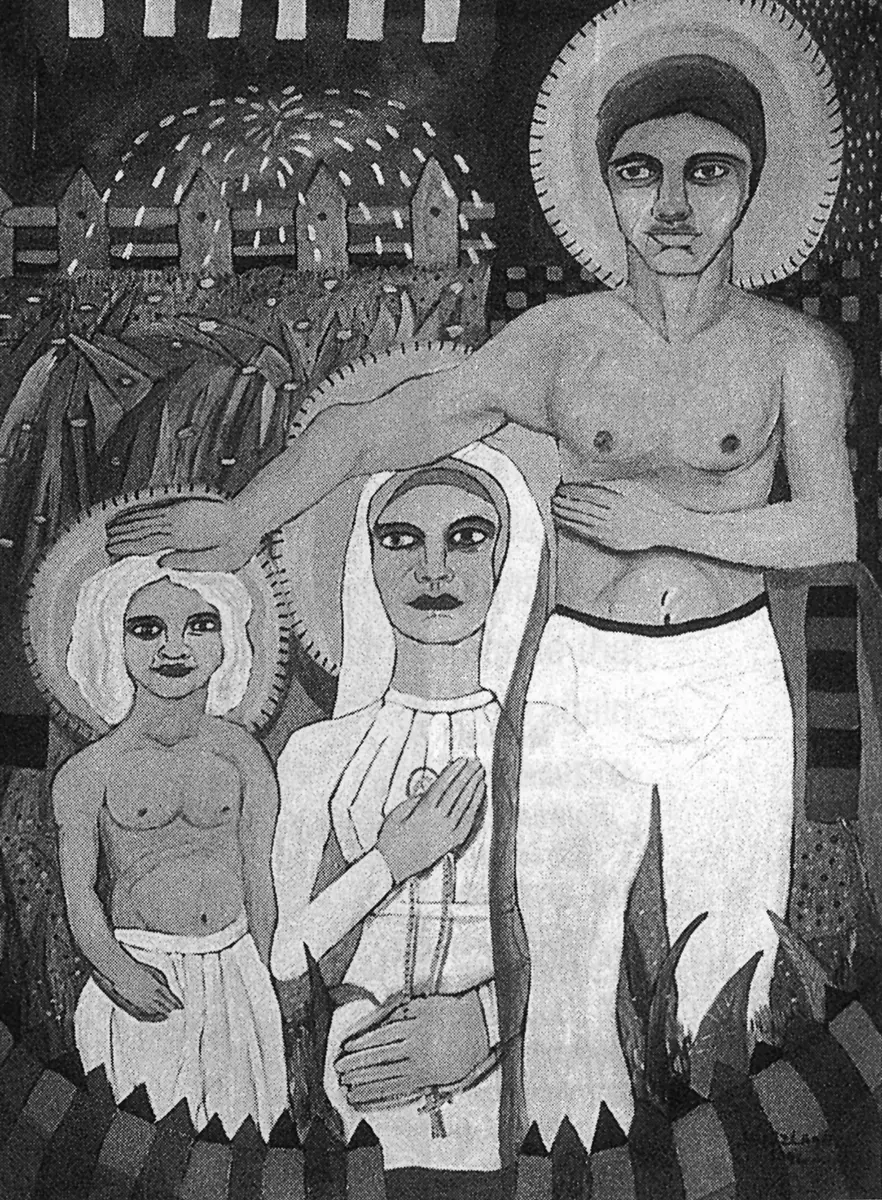
The paintings take their cues from religious painting of the early Renaissance in some cases brashly countering that subdued, meditational style, and in others, more gently updating, humanizing, and personalizing it. Classic Christian themes predominate: the Trinity, the Crucifixion, baptism, the Annunciation, the Madonna and Child. López Lage outlines his forms in dark colors as if anchoring them, rooting them with nearly the fixity of stained glass.
As icons, some of these paintings would serve uncomfortably in a conventional church. Cross of the Pagan Land, for instance, trades the traditional image of the sacrificial Jesus for that of a vital, deified woman, nude from the waist up and wearing an undulating woven grass skirt, her arms outstretched to form a cross. Spirit and flesh reconcile their long-standing rift within Christian doctrine in this singular, striking figure. Her eyes turn upward, toward the heavens, while the rest of her body remains palpably earthbound and robust. She is strong and hearty, and López Lage presents her intense sexual presence as a spiritual quality in itself. While the image might seem flagrantly defiant, it actually updates and recasts the traditional Christian icon to embrace a different cultural ideal, one with the syncretic flavor of religious worship among many in Uruguay and its neighboring countries.
Trinity also recontextualizes a traditional Christian theme. López Lage’s mother, father, and son are fully human, peasants even, standing in a lush field. In white, with radiant gold haloes, they stand beneath patterned bands of color that evoke the architectonic spatial divisions and flatness of Gothic painting. These are domesticized holy figures, laborers whose very earthiness and mortal efforts endow them with a saintly aura. This same fusion of spiritual and material realms characterizes all of López Lage’s recent work, leading to a provocative airing out of iconographic traditions. In Oxhala Child, the baby is a pudgy-faced, nondescript bundle in his mother’s arms, while the oversized mother, hardly Madonna-like, issues a penetrating stare from her pale, ashen face. She is the ultimate protector, both a spiritual symbol (with her brightly dotted halo) and a real mother, wary of external threats to her child. Ultimately, what López Lage creates are new icons, icons of great humanity and accessibility.
Considering the trashing cynicism of López Lage’s earlier work, one hesitates to call these new works reverential, yet they are working within tradition to reshape it. They are not scornful but infused with a subtle respect that makes the spiritual content of the work all the more viable. Again, López Lage addresses cultural/political/religious institutions, but now he shifts his focus away from their fallibility to illustrate the potential and the sense of promise they ultimately provide. If his earlier work revealed the nation’s restored freedoms, this new work takes on the task of rebuilding, spiritually, from the inside out.
LEAH OLLMAN