José Bedia's most recent solo exhibition, Mi Esencialismo (My Essentialism), was jointly organized by the Hyde Gallery, Trinity College, Dublin; Pori Art Museum, Pori, Finland, and the George Adams Gallery. The exhibition consisted of ten drawings and eight paintings, as well as a site-specific installation for the New York venue. The works belong to two series that incorporate, in a collage-like manner, photocopies of 19th-century photographs of the Kongo and Native North Americans.
The images that Bedia utilizes —postcards, travel photos, and ethnological material— have represented the Other of the Western in and as a colonial discourse. These representations have historically reified the Other; they have edited and erased the subject, turning it into an object of colonial gaze and component of a visual language that legitimized its domineering systemic nature. Yet Bedia does not seem to be interested in contradicting the images or calling attention to their purported historical accuracy. These series diverge from concerns he has had with installation work revolving around the theme of the so-called discovery of the Americas [Second Encounter-Segundo Encuentro (1992); Viva el Quinto Centenario (1992); and The Little Revenge from the Periphery (1993)]. In Mi Esencialismo, Bedia appropriates the colonial imagery to re-render and re-cast it in another register and visual context.
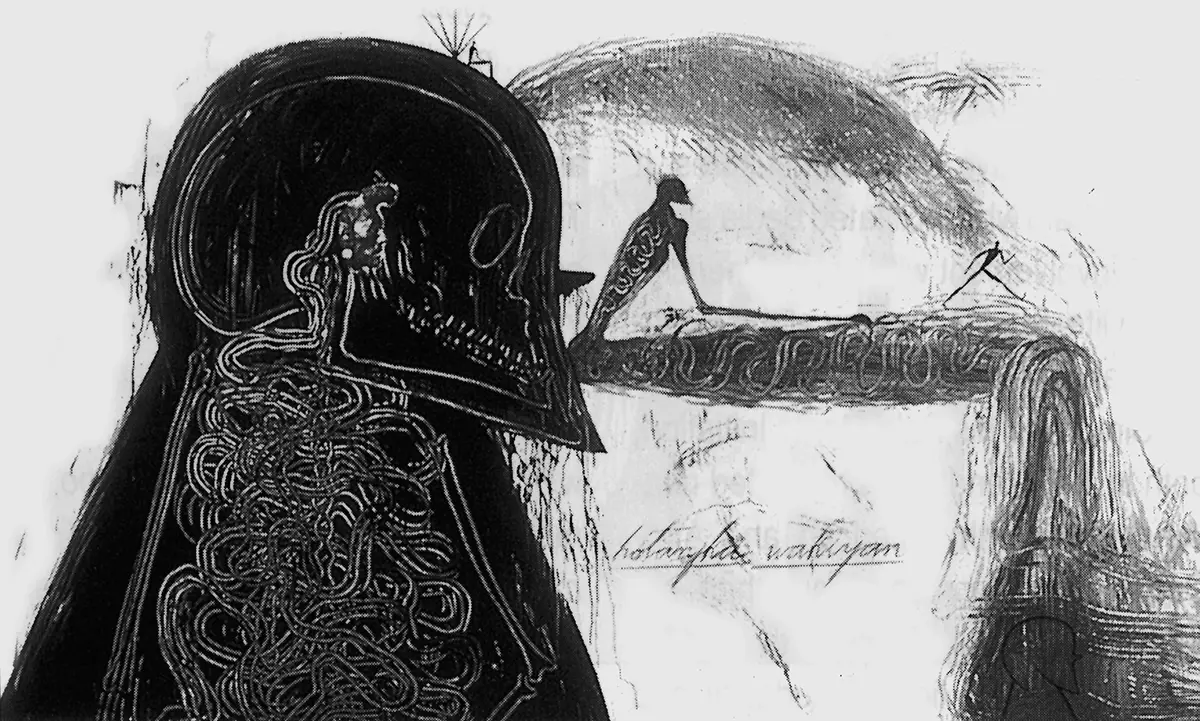
In Bedia’s paintings and drawings, the photocopies, twice-removed from the moment they "captured" on film, are a pretext. The images are re-worked, like archeological data, serving as fragments of material culture to re-construct layers of meaning. As anthropological documentation belonging to colonial genres, they narrate more of the Eurocentric mentality than of the Other. Utilizing the photocopy as a point of departure, a povera and postmodern stance, Bedia adds meaning both to the reality absent in the photographic representation and its narrative procedures. What was left out is as central as who took the photograph and for what purposes. As Melissa Feldman writes, (Bedia) "fills out the image to its full iconic potential."1 What is behind the actualization process is a redemption. If the photograph is a memento mori of a past lived moment, then Bedia, in his aesthetic procedure and visualization, is making the dead present. They are a re-visited vision, linked to tactility and sensuality in both series.
Rendering with brush as well as his hands versions and visions of the photocopy, Bedia engages himself with the materiality and process of drawing and painting. This procedure, in contrast to Bedia’s early signature graphic style with work on paper and on canvas, results in the work having a gestural index and a profound evocative quality. Mi Esencialismo (My Essentialism) has the striking quality that Bedia reserved for his site-specific installations. In these, wall finger drawing and painting as a process create an immediate sense of expression in passion passion-charged environment.
The exhibition’s New York venue had a simple yet breathtaking, powerful site-specific installation, The Things That Drag Me Along. Small-scale toy-like objects —trains, cars, aircraft, and trucks— carried religious offerings and blessings. Grain, tobacco, sugarcane, eau de vie (aguardiente), among other key elements, were delicately arranged and attached to chains anchored in a figure executed on the gallery wall. The linked objects created a web of allegorical relations, which enumerated in a succinct manner the cultural inventory that Bedia carries with him. As symbols with a metonymic quality and as fetishes with animistic connotations, the components of the installation were a cartography of his process of transculturation.
Mi Esencialismo (My Essentialism) may be interpreted as both a parable and a paradox of his artistic trajectory. Essentialism—if one understands it as a determined, fixed, ontological attribute and/or characteristic of an identity/entity—seems to be a construct and concern that is far removed from Bedia’s universe. Bedia, as his critics have argued, operates with a transcultural ethos and perspective that is dynamically linked to and forms part of Cuban syncretism and its particular negotiation with modernity.2 What differentiates Bedia from his compatriots living on the island, in exile and/or "forced nomadism,” is the self-conscious effort and strategy to engage in what Gerardo Mosquera characterizes as "a voluntary transculturation toward the ‘primitive.’”3
Postmodernism continues to be haunted by early modernist "primitivist" impulses. In early modern art, the cult of life and experimentation with non-Western plastic devices, styles, and forms were directly linked not only to a discontent with modernizing endeavors, but most importantly, to colonial collecting and exhibiting of culture. Early modern "primitivist" impulses and stances sought a re-vitalization of the Eurocentric tradition through the appropriation of "non-Western" themes and forms, without ever questioning or challenging its colonial edifice. The same could be argued, with different categories, to be sure, regarding contemporary endeavors from the historical centers of artistic and cultural capital. In this sense Joseph Beuys’ articulation of a Western avant-garde, from an "informed primitivism" to quote Luis Camnitzer,4 while not far from Paul Gauguin’s quest for a lost paradise, is certaintly close to Pablo Picasso’s encounter with the appropriated "artifacts" of the Other on that famous visit, in the midst of working on the Les Demoiselles d'Avignon (1907), to the Ethnography Museum at the Trocadero.5
The "Western" avant-garde’s quest for "primitivism" has been characterized by Jimmie Durham, "...as a never-ending search for true virgin territory. ‘Untouched Wilderness.’ ‘Breaking new ground’. ‘Thrusting through the barriers to new frontiers.’”6 In this respect, the Yanomami Indians, Durham claims, belong to a territory charted by Lothar Baumgarten. And, one could then add, art as healing and ritual, is Beuys' domain within Eurocentrism. Institutions and the art market legitimize the operation of appropriation through exclusionary notions such as "quality" that privilege established centers and their artists. While such operations are applauded by dominant curatorial premises, when tradition is innovated from within the subaltern location to come to grips with contemporary realities, it is understood as a mirror of the dominant. In a similar vein, certain forms, themes, and aesthetic concerns are ascribed to the subaltern; if the artist is not "traditional,” "authentic," or "primitive" enough, as far as the center is concerned, he/she tends to be excluded.7
Knowing not the artist but his work, Durham made a piece titled Bedia’s Stirring Wheel (1984), which dealt with his interest in Native American cultures. It was Durham who facilitated Bedia's first direct involvement with "real American Indian life" during his stay at the Rosebud Dakota Reservation. The stay with the Sioux and his Palo Monte initiation, both in 1984, ended his mediated relations with North American and Afro-Cuban cosmogonies. From then on, Bedia was to experience both as a life practice. Herein lie the audacity and complexity of Bedia’s endeavors and strategies. Bedia’s art, in contrast to a Eurocentric lineage and romance with "primitivism,” is the conceptualization and visualization of his lived experience. Art is a praxis of knowledge through which Bedia expresses, challenges, and undermines "fixed" versions of social agency, culture, and history. The past has exploded, and with it, unforeseen possibilities become real. Working in a translational and transnational mode, Bedia positions himself within the shared history of a heterogeneous tradition as a site and material for change. As Mosquera has pointed out, Bedia, "breaks the orthodoxy of tradition to deal with contemporary situations from the visions and values of subaltern cultures that cease to be traditional and act upon the reality of today.”8
Why then the title of Bedia’s exhibit? He would seem to be going against the grain of "essentialism,” destabilizing and deifying the very notion of it. Bedia’s transcultural operations are engaged in complex visual, philosophical, and spiritual relations. Bedia, on more than one occasion, has described how contemporary culture is formed and enriched by fragments of diverse ones. It is a type of collage that one is constantly learning and to which one is constantly adding new pieces. Mi Esencialismo (My essentialism), in this context, is the desire for the whole. Yet it is a whole that is paradoxically nurtured by diverse fragments that also signal its impossibility. Bedia is in this sense recurring to signs and metaphors from diverse and lived cultural locations, to create an ontology involving difference, contradictory as it may seem, the breakdown of limits, hierarchies, and zones. In Bedia’s words, “The process —transcultural, to call it something— which is currently produced in the heart of many autochthonous cultures, I try to reproduce it in my self in a similar yet inverted manner. I am a man with a ‘Western’ background who, by means of a personal, voluntary and premeditated system, strives for a reapproach with these cultures and, moreover, who experiences their cultures in an equally transcultural way.”9
A bilingual catalogue, with essays by Judith Bettelheim and Sandra Feldman, and with superb black and white as well as color reproductions, was published on the occasion of the exhibition Mi Esencialismo (My Essentialism).
NOTES
1. Sandra Feldman, "Bedia’s Bilingualism,” Mi Esencialismo - My Essentialism, exh. cat. (Dublin: Hyde Gallery, Trinity College), 1996, p. 14.
2. See the splendid catalogue of the monumental exhibition, Cuba Siglo XX, Modernidad y Sincretismo, co-curated by Maria Lluïsa Borràs and Antonio Zaya, and organized by the Centro Atlantico de Arte Moderno (Las Palmas, Canary Islands ); Fundacio La Caixa Foundation (Palma); and, the Centre d’Art Santa Monica (Barcelona).
3. Gerardo Mosquera, "Hacia una postmodernidad otra: Africa en el arte cubano,” in Cuba Siglo XX, Modernidad y Sincretismo, op. cit. p. 244.
4. Luis Camnitzer, quoted by Gerardo Mosquera, "José Bedia: Postmodern Kongo Art,” Review: Latin American Literature and Arts (New York: The Americas Society), Spring 1996, p. 20.
5. William Rubin observes that Picasso’s revelatory visit to Trocadero provided him with "a solution to the search for plastic correlatives to express feelings about sexuality and fate with which Picasso had wanted to invest the Demoiselles from the beginning.” Rubin notes that notions such as "exorcism,” "magic" and “intercession” become a concern for Picasso. Of note in particular is Rubin’s mention in passim are the Trocadero museum labels which explained that particular artifacts protected against "malicious spirits” and that particularfetishes "could cure gonorrhea,” "The Genesis of Les Demoiselles d’Avignon,” in, Les Demoiselles d’Avignon, Studies in Modern Art 3, Special Issue by William Rubin, Helene Seckel and Judith Cousins, (New York: MoMA and Abrams), 1994, p. 104.
6. Jimmie Durham, "The Search for Virginity,” in The Myth of Primitivism: Perspectives on Art, Susan Hiller, ed., (London and New York: Routledge) p. 289.
7. See: a) The special issue, Magiciens de la Terre, with contributions by G. Brett, B. Buchloh, J. Clifford, J. Fischer, L. Lippard, J.H. Martin and Y. Michaud et al, Les Cahiers du Museé National d’Art Moderne (Paris: Centre Georges Pompidou), No. 28, Summer 1989; b) The Jean Fischer and Max Wechsler’s reviews of Les Magiciens de la Terre, Artforum, September 1989; and c) Thomas McEvilley review of Les Magiciens de la Terre, Global Issue, Artforum, March 1990.
8. Gerardo Mosquera, "Hacia una postmodernidad ‘otra’: Africa en el arte cubano,” Cuba Siglo XX, Modernidady Sincretismo, op. cit. P. 245.
9. José Bedia, quoted by Ivo Mesquita, "José Bedia,” in Cartographies, exhibition catalogue (Winnipeg: Winnipeg Art Gallery), 1993, p. 91.
VÍCTOR ZAMUDIO TAYLOR