
In the United States, key group exhibitions of contemporary Mexican artists —Rooted Visions (1988), New Moments in Mexican Art (1990), Aspects of Contemporary Mexican Painting (1990) and Espíritu (1995)— have focused to a greater or lesser degree, and from different curatorial premises, on the Neo-Mexican impulses of their representational endeavors. Few, if any, exhibitions have researched one artist and his/her place in and complicity with the Neo-Mexican. Despite the interest in Neo-Mexican art and its promotion and support from diverse entities, there had yet to be a solo exhibition in the United States that gave an artist his/her more than deserved due.
Nahum B. Zenil: Witness to the Self-Testigo del is the first one-artist exhibition of this major figure of Mexican contemporary art in a U.S. museum. Co-curated by Eward J. Sullivan and Clayton C. Kirking for The Mexican Museum, the exhibition is a most welcome in-depth survey of the diverse media that the artist has privileged over 20 years to depict one subject he cannot seem to exhaust: himself. Borrowing over 75 works of art from important collections, the exhibition highlights the dynamic counterpoint between the fashioning of the self and the discursive constructions of the nation in Zenil's iconographical inventory and self-referential endeavors.
As a subject of his work, Zenil represents himself in a multiplicity of personas, this manifold self-discursivity revolves around different thematic concerns, which in turn, the curators have utilized to organize the exhibition. The viewer is visually led around galleries dedicated to eight themes, which include "The Family," "The Flag," "The Virgin of Guadalupe," and "Masks." The themes organize narrative components built around the autobiography of the artist, and the cultural corpus and its historiography to which he belongs. The gaze of the viewer is led around the topography of Zenil’s juncture of self and nation, sites where adoration and lamentation, convergence and rupture, and affirmation and defiance meet and trigger metaphorical associations and layers of significance.
Self-portraiture in the work of Zenil has an epistemological impulse. The desire to know and understand is the basis for self-inquiry art in this sense, for Zenil is a cognitive form of knowledge. For Zenil self-portraiture, more than a gesture of self-invention and mirroring is a process of personal analysis and cultural critique. Knowledge of the self can potentially bring about the demystification of culture, and in Zenil’s universe, this results in empowerment and in the defiance of established relations of power. The more lyrical the representation in art, claims T.W. Adorno, the more social of an endeavor and critique of the social world it may potentially be.1 Viewing Nahum B. Zenil: Witness to the Self - Testigo del ser, one is left with a sense of the subject as cultural location, and the body as the materiality and mediator of history as lived experience. In Zenil’s artistic production, the viewer is witness to Zenil’s witness to himself.
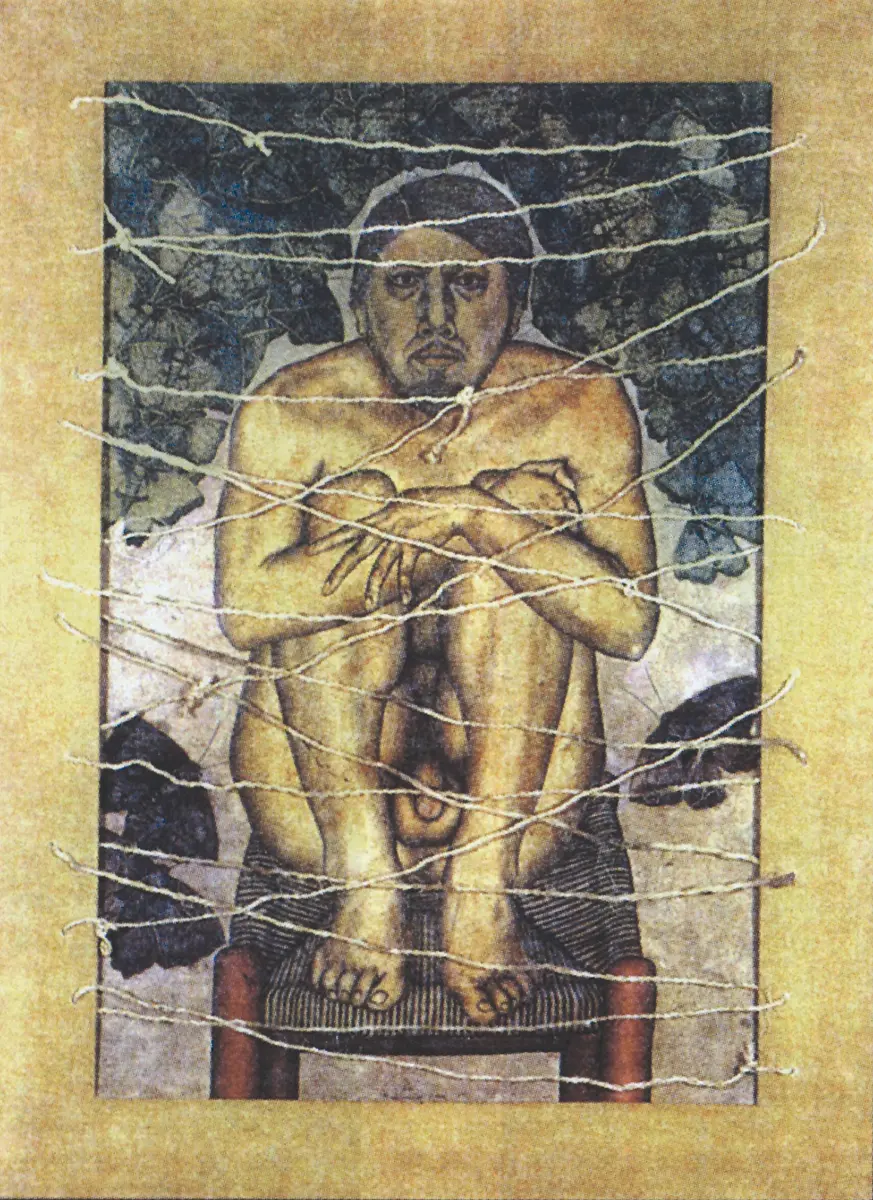
Through baroque-like rhetorical devices of fragmentation, enumeration, and paradox, Zenil visualizes his secrets as social facts. This passion is most emblematic in works revolving around religious and sexual themes. Zenil’s intense and extensive references to religiosity are not, as some critics have maintained, cynical or irreverent. Rather, as Edward J. Sullivan has underlined, "the element that lies at the heart of Zenil’s imagery, however, is the continuing conundrum of how to define, through the use of visual analogues, his position as a gay man in the Mexican society of his time."2 Zenil appropriates Catholic emblems, themes, and topoi of the body and its passion. Martyrdom, hagiography, and the imitatio Christi are registers that deploy the narrative. The artist’s indictment of homophobia and domination is exemplified in his mixed media work, Esperar la hora que cambiara nuestra costumbre no es fácil (Waiting Time When Our Customs Change Is Not Easy), 1984. The artist portrays himself nude, crouching amidst a swarm of moths or butterflies, signs of metamorphosis; twine criss-crossing the picture plane binds the image. Bound up by cultural constraints, the subject suffers and begins to heal in the act and form of self-annunciation and social indictment.
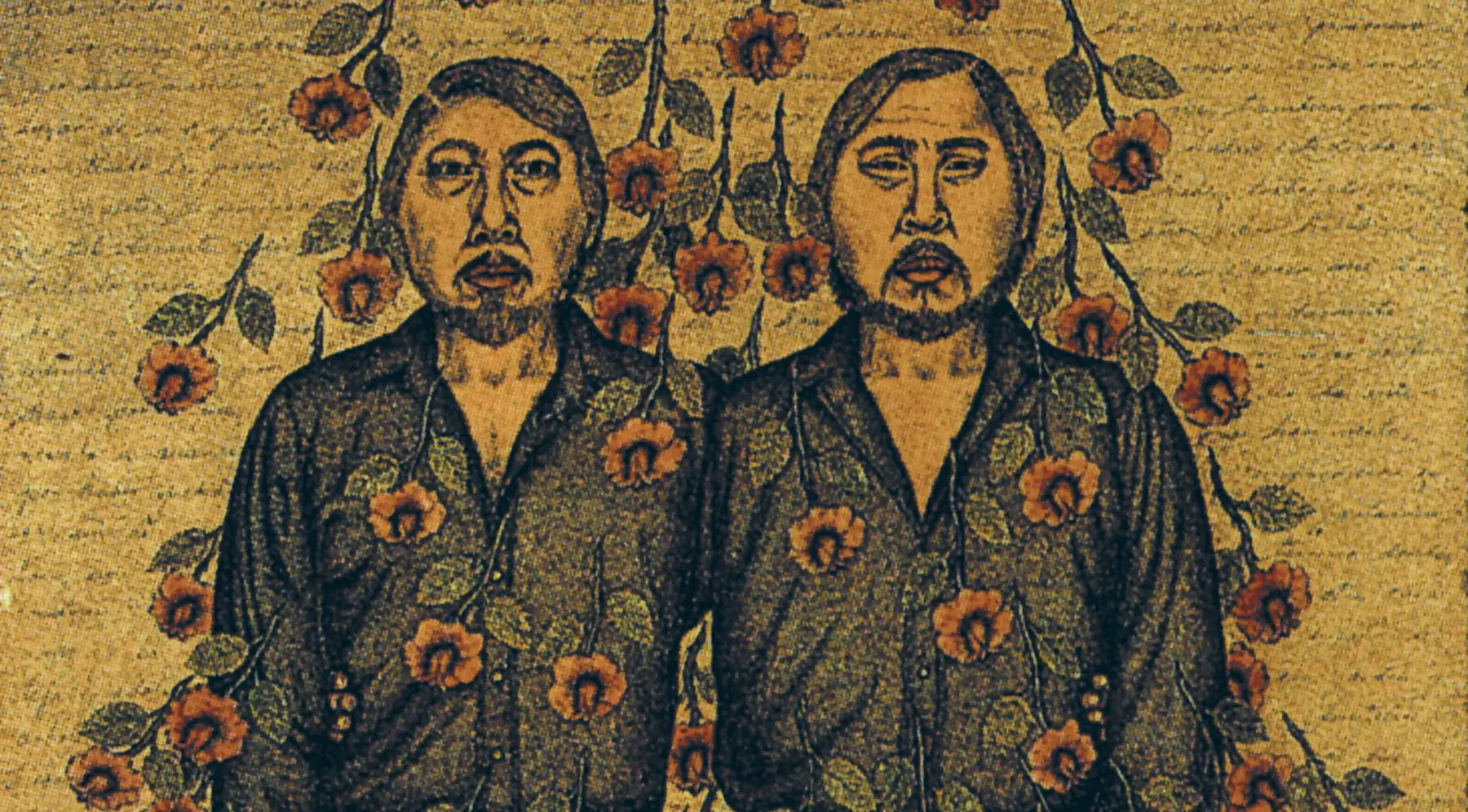
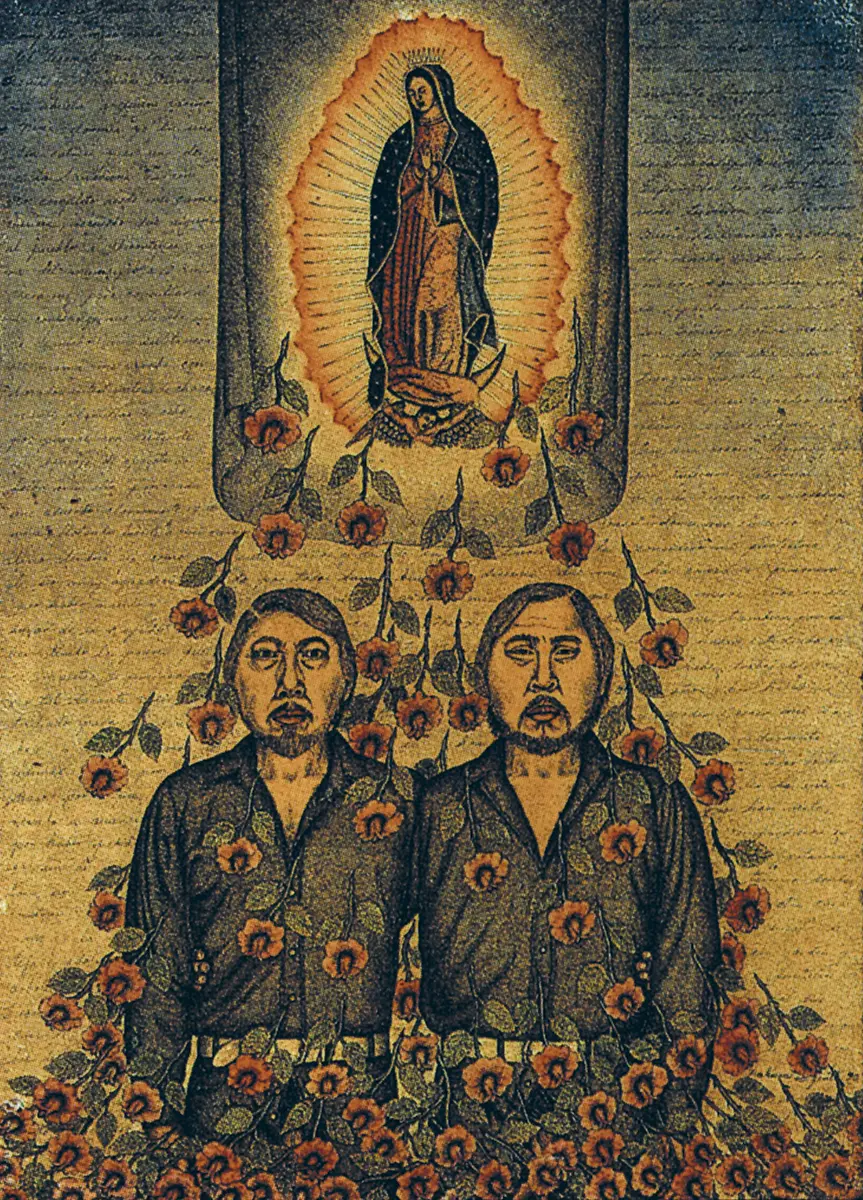
In contrast to tradition understood as bondage, in Bendiciones (Blessings), 1990, the popular cult of the Virgin of Guadalupe is portrayed as emancipatory. Inscribing himself into a tradition that since the 16th century has utilized the Virgin of Guadalupe as an emblem of resistance and revolt, La morenita (the little dark one), as she is popularly referred to, blesses the artist and his love, Gerado. The lovers are showered with red roses like Juan Diego, the Indian to whom she first appeared on the Tepeyac Hill, the ancient site of devotion to the Mexica goddess Tonantzin. The blessing has both a mystic and utopian dimension, the inefable moment of union with her and between the lovers, resounds with words Zenil has spoken regarding afreer society, "My desire, my intention, is that there comes a time when sexuality can be lived without guilt (...) [sexuality,] should be as something fresh, natural, agreeable, as enjoyable as a game."3
The inclusion of three-dimensional work belonging to Zenil’s own personal collection was a highlight of the exhibition. In Zenil’s appropriation of devotional, colonial, and popular arts, a contemporary experience is expressed. Academic distinctions of "artistic" and "vernacular" expressions blur and collapse in the syncretism of forms and references. Cajas (boxes) and reliquaries, some executed with the love of labor of domestic crafts, become depositories of signs and fragments of lived experience. Also included were curtained-off, like Lenten ceremonial objects, which seduce the viewer into becoming the voyeur and witness of Zenil’s confessionary mode as he/ she peeks into hyper-personal sites. In this sense, the three-dimensional works functioned as shifting zones of signification, gliding around and undermining notions of the self and the other, the sacred and the profane, and the personal and the public.
Zenil’s visual discursivity collapses self and nation. As a former public school teacher and an artist passionately interested in colonial art, Zenil knows all too well that the icons he works with and the references with which he operates belong to a shared cultural past and invented tradition. Constructs such as the Indian, the mestizo, popular culture, and all that is considered Mexican are subverted and romanticized in Zenil’s self-centered universe. Zenil is, in this sense, a postmodern allegorist. He operates with what Frederic Jameson has denominated “situational consciousness or national allegory (...) where the telling of the individual story and the individual experience cannot but ultimately involve the whole laborious telling of the collectivity itself."4
Nahum B. Zenil: Witness to the Self - Testigo del Ser will travel to the Gray Gallery, New York University, New York, among other venues. A splendid bilingual catalogue was published by The Mexican Museum on the occasion of the exhibition. The catalogue includes essays by Edward J. Sullivan; Agustin Arteaga, an interview with Nahum B. Zenil by Cristina Pacheco; and an anthology of texts in the form of an appendix with short texts written on Zenil by Teresa del Conde, Luis Carlos Emerich, Leila Driben, Raquel Tibol, and Oliver Debroise.
NOTES
1. Theodor W. Adorno, "On Lyric Poetry and Society,” in Notes to Literature, Rolf Tiedemann, ed. and Shierry Weber Nicholsen tran., (New York: Columbia University Press), 1991.
2. Edward J. Sullivan "Nahum B. Zenil: Witness to the Self - Testigo del Ser," in Nahum B. Zenil: Witness to the Self - Testigo del Ser, exh. cat. (San Francisco: The Mexican Museum), 1996, p. 16.
3. Nahum B. Zenil, interview with Cristina Pacheco, "Between Sexuality and Guilt - Entre la sexualidad y la culpa,” in Nahum B. Zenil: Witness to the Self - Testigo del Ser, op.cit. p. 31.
4. Frederic Jameson, "Third world literature in the era of multinational capitalism," Social Text (Fall 1986), p. 69.
VÍCTOR ZAMUDIO TAYLOR
Independent Curator and critic teaches contemporary Art from the Americas at the Department of Art History at the University of Texas at Austin, Texas.