For those who have followed the pictorial work of Orlando Vallejo, the artist has constantly tended towards the expression of situations which serve as a starting point for atypical perspectives, and that kind of optical approach provides the observer with a sort of fascination. His canvases take those who place themselves to study them, to consider their refreshing elements, which respond to his peculiar manner of envisaging the world and its circumstances. Sometimes, the artist surprises us by combining a sense of both the unadorned and the unknown. Other times, the works are conceived as if the artist were lifting a curtain protecting prohibited places, where creatures exist that nourish the spirit. The delimiting lines of his configurations do not act as a retaining wall, but are rather areas of passage permitting the integration of organisms into the surrounding cosmic order. There is about them a cosmovision in which living entities can either appear or even see themselves due to the fact that the artist is endowed with the capacity to capture changes in the state of matter. In Vallejo's artistic universe, there is no room for death, since his conceptions seem to respond to a cyclic order.
In the works presented recently at the Prinalde Gallery, there were some instances of a return to earlier themes. The groups of houses emerge like beehives where life is a matter of physical accumulation, reflecting the current demographic explosion. However, the unreal gardens are sources of hope, since the vegetation seems to be a direct descendant of the legendary seeds of the long-disappeared earthly paradise. There are also stairways that remain erect despite all the physical laws, since they have no visible support. In that sphere, we begin to see people whose presence was earlier felt but not actually seen. The persons are protected by geographical conformations which project themselves like enormous cells, whose function is to ensure their continued presence in these uncontaminated panoramas. There is no nefarious trace of any contaminating agents. The profusion of color reflects the atmosphere with which the artist endows his ideal and therefore unreal landscapes. In the same way, the simple buildings are integrated into the surroundings. These examples of ecological purity refer back to existing situations, which are becoming increasingly acute as the nefarious effects of a concept of progress run counter to the preservation of the still unpolluted parts of the planet. Vallejo’s works are, therefore, a systematic denunciation of the indulgent acceptance of the indiscriminate destruction of flora and fauna. At the same time, he highlights the emergence of virgin forces with regenerative powers, which will overcome the uncouth use of technologies, which could be a source of benefit. The search fora primitive refuge can be compared to the quest for pure thought, which requires no verbal articulations to become coherent.
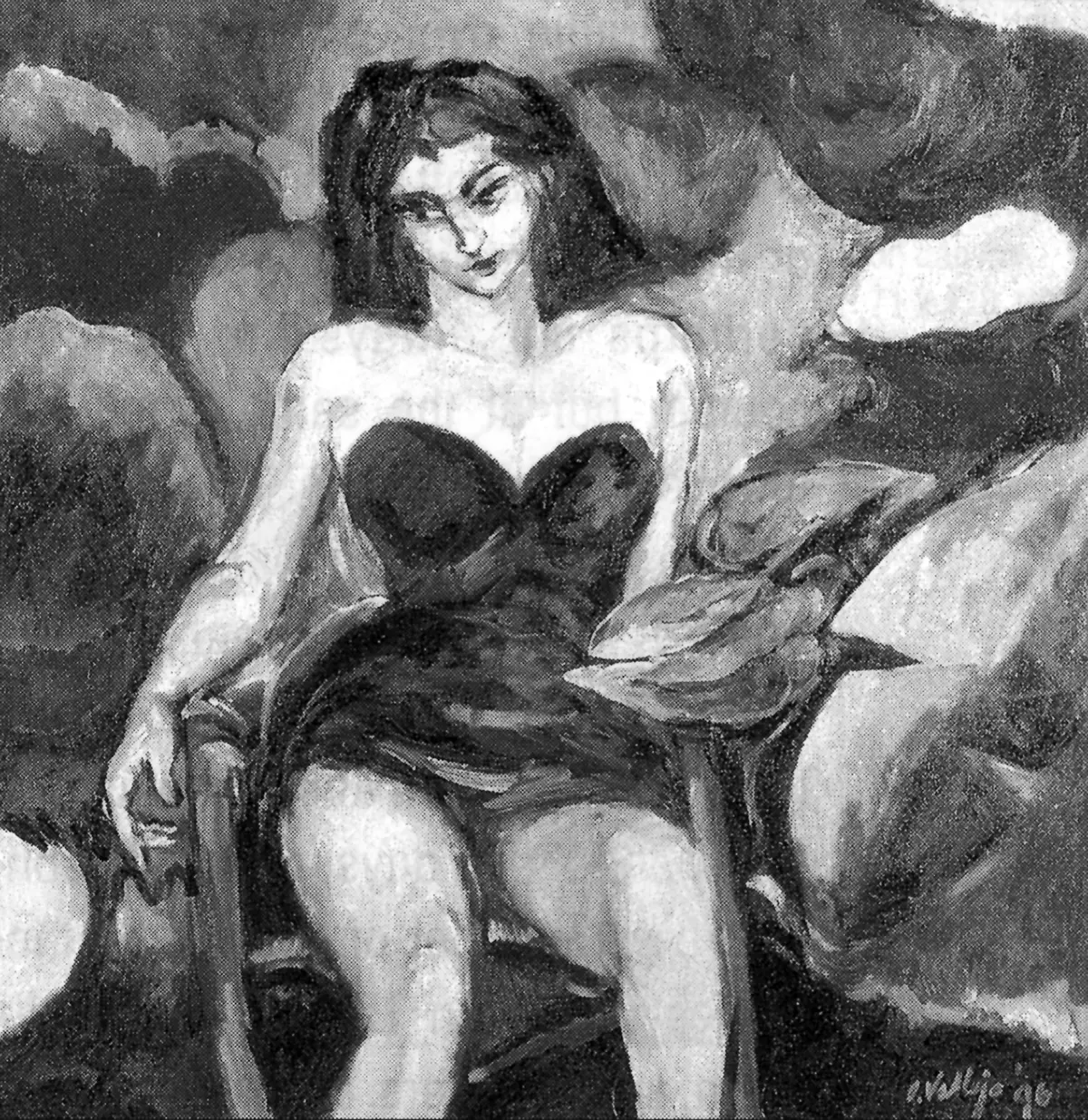
These urban landscapes are very different, and offer no possibilities of hope. The horizon is dominated by chimneys that belch forth their poisonous waste in all directions. The profile of the city seems to be covered by a thick mist, gripping it like some straitjacket. A reddish sun hangs in the dark sky, although it barely sheds its light below. Although I have noted above the idyllic allusions to a bucolic reality, mention must also be made of this apocalyptic dimension of Vallejo’s vision. Most of the figures in his canvases are female, giving the impression that the artist wishes to emphasize the pro-creative force of the female sex. Many of the figures are in a suggestive pose, and some reflect contrasting attitudes, such as candid gestures combined with a kind of apparent abandonment of the body. Some evoke thoughts and desires that seem to be trying to express themselves openly. This is the case of one woman with a rather street-like appearance who appears against a background which might be dubbed by some cosmetic manufacturer as a sort of "passion in red.” The woman and her context are projected like a sort of walking temptation. It is worth noting the control over the brushstrokes exercised by the artist. Vallejo’s habitual expression is here attenuated by the respect he shows towards his representations of the human being. In conclusion, this exhibition by Vallejo confirmed the maturity that he has achieved over the course of his career.
JOSÉ ANTONIO PÉREZ RUIZ