
Last May and June, the El Museo Gallery in Bogota presented a brief and intense exhibition of pictures by Rafael Ortiz. They did not total more than twenty and were "installed", if by installation we mean that their presentation on the walls was accompanied by trunks resting against the walls. Obviously, the point of interest was not this in itself, but rather the overall concept of the show, which proposed a revision of the theme of landscape in painting. A revision, or rather an examination of the problems of landscape painting, which is clearly a genre painting, whose sublimely romantic origin has given way, in historical terms, to the prosaic and "technical" multiplication of the landscape scenes on the walls of countless sitting rooms throughout the world. It is precisely from here that Rafael Ortiz—one of the most restless and suggestive contemporary painters in Colombia, a nomad, an "appropriationist”—begins.
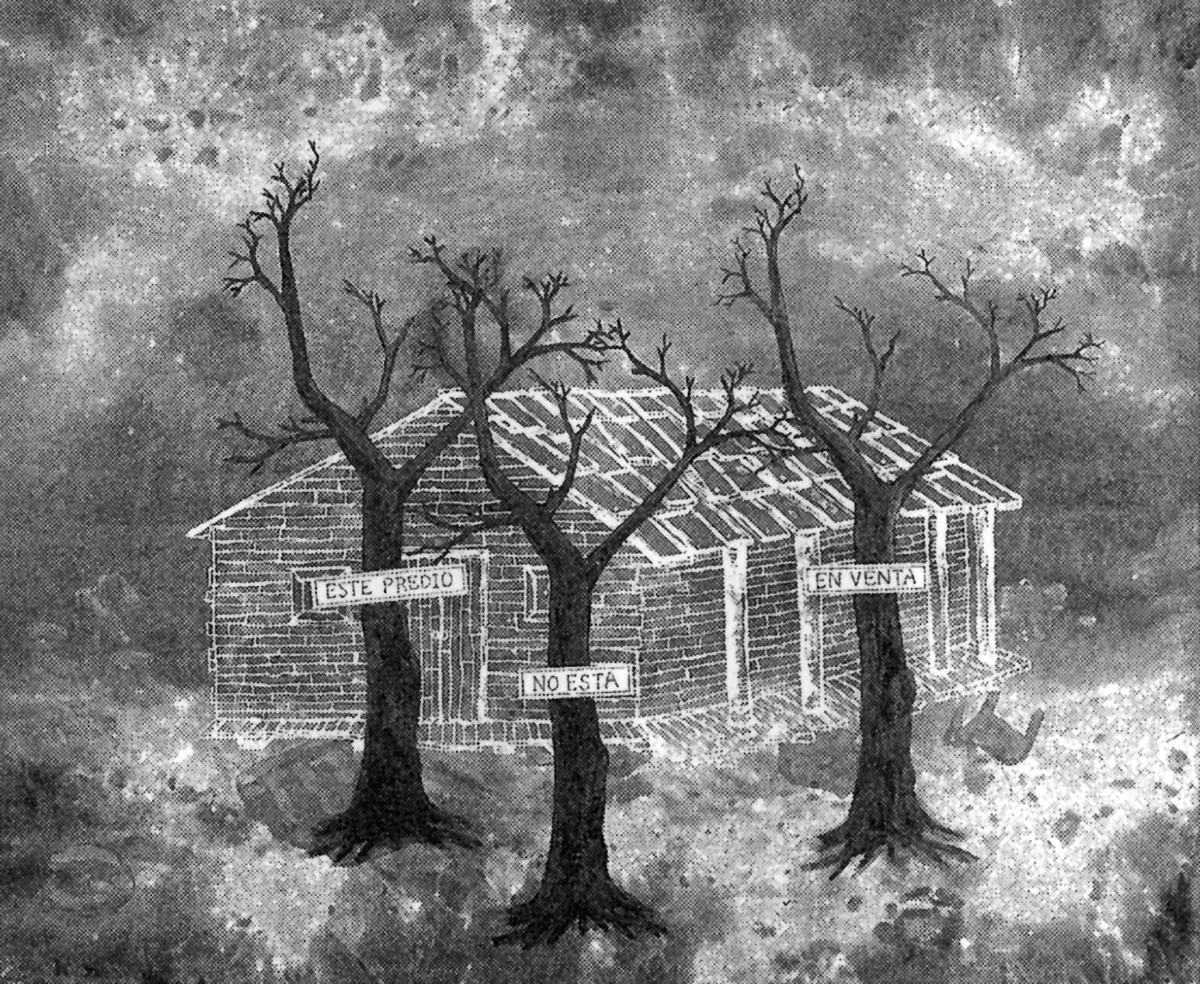
His exhibition at the El Museo Gallery in Bogota begins literally with four or five banal, anonymous landscapes, identical in their anomie to those to be found in almost any house of any anonymous inhabitant. Ortiz hangs them on the walls of his own show so that the visitor may see from the beginning that his problem does not concern this or that landscape but rather the concept itself of landscape painting. That is why he isolates the elements making up the structure of such a concept: the house, river, tree... What then followed were his own pictures, if you are allowed to speak of ownership, origin, and authorship within such a circumscribed field. Pictures in which Ortiz proposed his own version of these elements, adopting an attitude which is romantic, although it does not appear to be so, precisely because it is exercised in a field that, because it is limited by both genre and anonymity, is hostile to the exaltation of the self. In presenting his grandiloquent rhetoric, the same which was emphatically achieved by Turner, Delacroix or Géricault, Ortiz paints his own version of the tree, the river and the house, and in doing so, he asserts himself as different, as a painter seeking individual expression amongst the virtually endless series of painters who before or after him have painted landscapes. But his artistic identity, a double or manifestation of his individuality and self, becomes completely revealed. His paintings do not begin with a void or chaos, as was the case with some authentic romantics, those who thought and still think that the Cartesian cogito ergo, "I think, therefore I am," had been directed exclusively to them. On the contrary, the starting point, as noted above, is the previously established and well-known context of anonymous landscape painting, which may be anything but void or chaos. Thus, Ortiz, as the author of the works, can no longer appear as a heroic, original, functional artist, but as a "weak" author, capable only of "interfering", in a presumably meaningful way, in the anonymous course of painting, whether landscape or not. In an art scene such as that of Colombia, overfilled with emphatic gestures, it is pleasing to see a painter like Rafael Ortiz who knows exactly what he is able to do. He offers us an authentic lesson which we would all do well to learn.
CARLOS JIMÉNEZ