Traditionally, Costa Rica has served as a bridge between two cultures in the socio-political sense, and to some extent, this has influenced the policies of concertation and dialogue—through forums, encounters with artists, and exhibitions, which have characterized the work of the Museum of Contemporary Art and Design (MADC).
Recently, between 15 March and 15 June, another exhibition, entitled Relations (curated by the director of MADC, Virginia Pérez-Ratton), took up some of the themes of Meso-America,1 although this time the emphasis was not on a specific style. The show was an attempt to establish a dialogue between artists of different origin (including three Costa Ricans), "selected for the special way in which they relate to the physical or social environment, or the way in which they established relations or associations within their works themselves,"2 without reference to their various geographical or cultural antecedents.
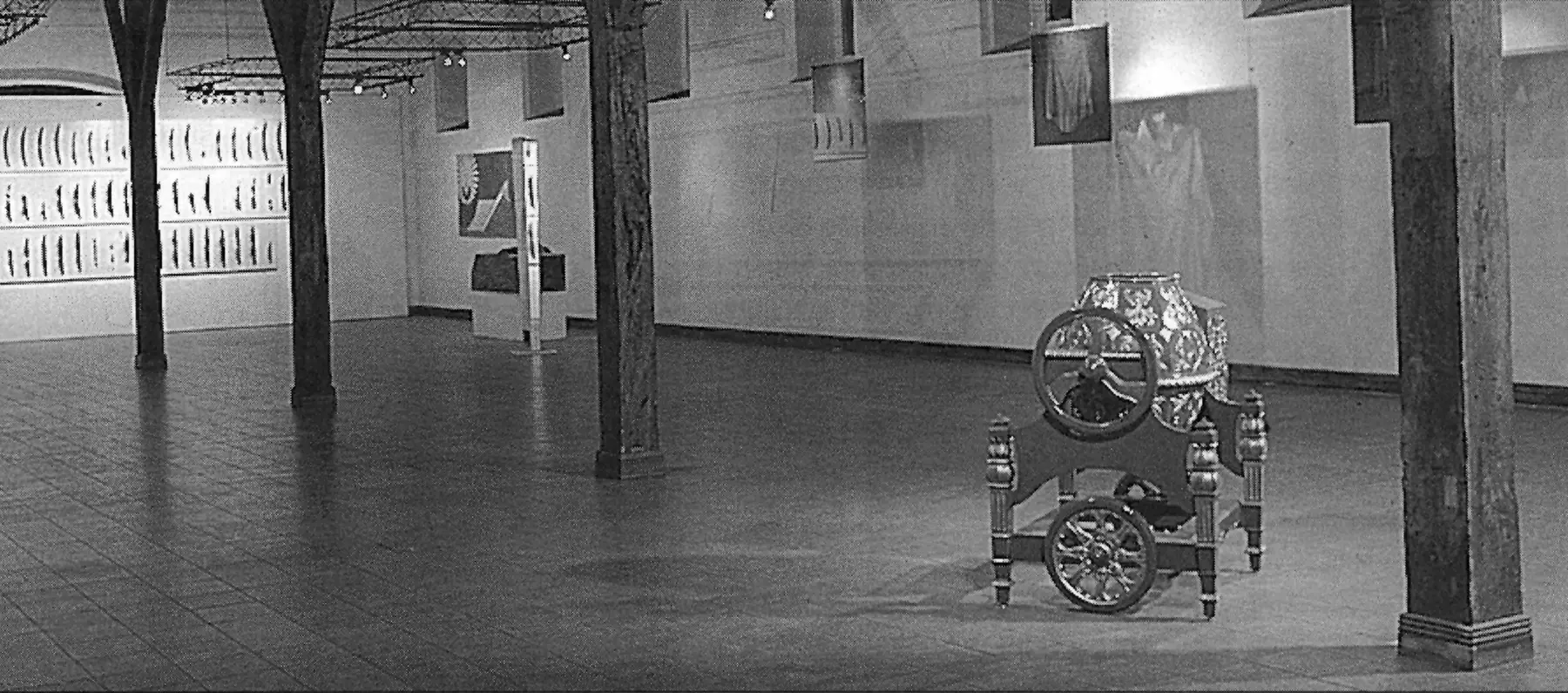
The large size of the first salon and a fitted curatorial disposition permitted that each work has its proper space, without lessening the other, within its own space, which made possible an independent reading. Thus, the show gathered together several artists, such as the Japanese Matsutani, the Belgian Wim Delvoye, the Guatemalan Luis González Palma, the Costa Rican José Miguel Rojas, the Colombian Óscar Muñoz, and the North American Charles Ross. This last artist presented two maquettes of his well-known monumental works, as well as drawings and a selection of his work entitled Solar Burns. This piece took almost the whole back wall, plus the end of the space.
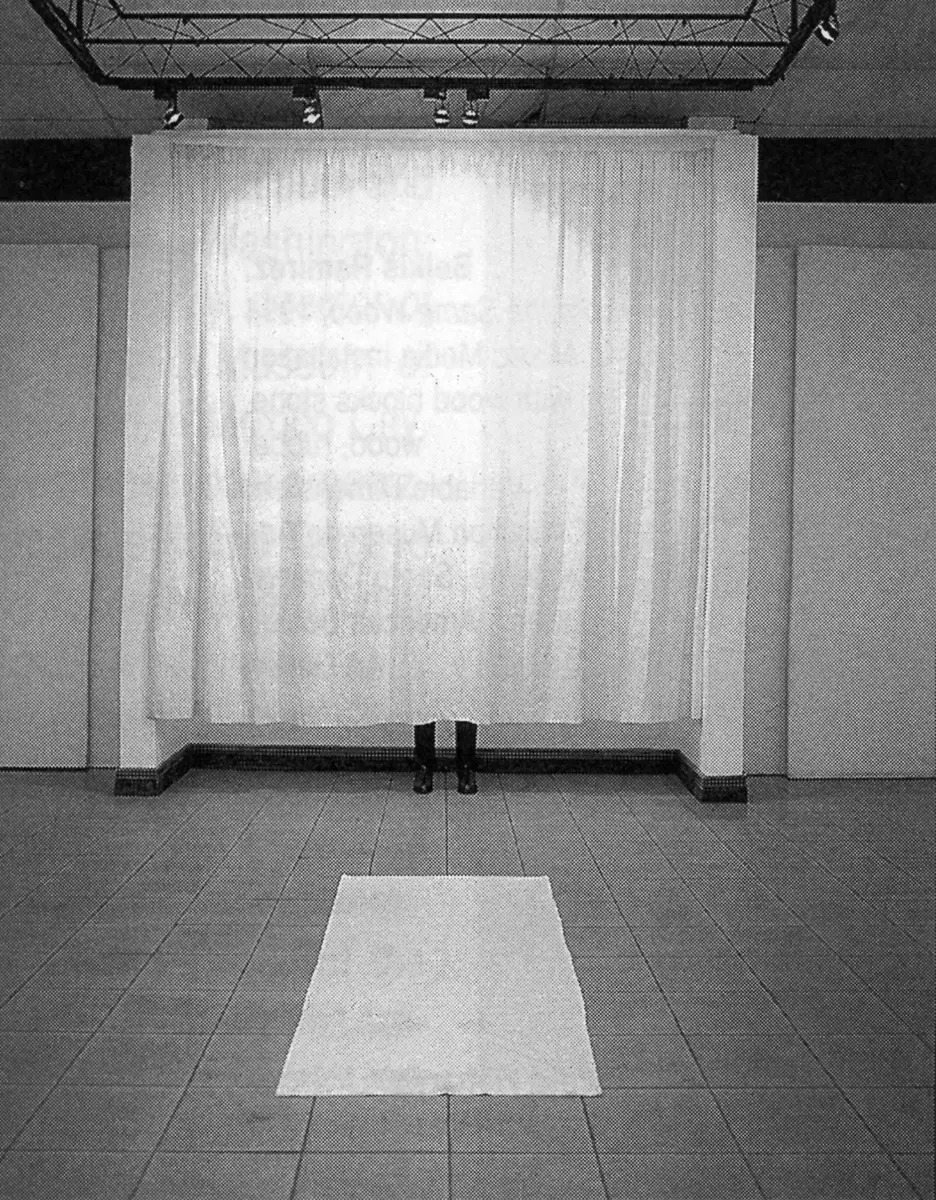
The second salon, much smaller and of a rectangular form, showed two installations by the Costa Rican artist Priscila Mongue and Marisel Jiménez, and in between, a piece by Óscar Muñoz.
At the entrance to the Museum, in a setting which made use of the steps, there was Matsutani’s installation, entitled Stream. The Japanese artist placed a piece of canvas seven meters high, with graphite and turpentine drawing, simulating the fall of a cascade into a zinc bucket filled with water —a suggestive metaphor of a tranquil lake— on which a linen stretcher was suspended. The stretcher acted as a filter for the incessant dripping of Indian ink from a bag placed above, and into which, on the day of the inauguration, before the anxious looks of the spectators, the artist drove a nail, which gave rise to the continuous and transforming flow.
A member of the Gutai group, which took post-war Japan towards a cultural revolution against the traditional culture of "not copying anything, inventing everything,”3 Matsutani assumed this aesthetics of rupture with tradition and, without disowning it completely, worked with simple materials—pencils and paper—and subsequently, with canvas and water. He replaced Indian ink with graphite as a source of black, a color which, in his case, is in no way pessimistic, since for him it evokes a sense of quietude, dream, and repose. An artist of synthesis, Matsutani works black lines on white in a constant flow which takes him towards a void and the creation of poetic spaces through his monochrome images, which are sometimes executed by himself or, as in the case of Stream, continued by a process in time from which the artist is absent, although creation is not.
Óscar Muñoz, draughtsman with a long career, is another artist who conceptualizes his work on the basis of processes occurring in time. His work is both handsome and poetic, with something within it which prevents us from grasping it entirely, which creates an interplay between representation and reality. In his Bathroom Curtains, nude figures are sketched out on plastic curtains, creating the illusion of presence, seen through a kind of vapour which encourages us to look behind, where we find only emptiness and absence. A visual deception that the artist uses to interpret the concept of traditional painting, which supposes the existence of a reality that is depicted in an illusory way on a two-dimensional support.
This idea was subsequently replaced in Narcissi, a work which records the contingencies of life subjected to the passage of time, making it more "real.” Several glass buckets full of water contain self-portraits of Muñoz drawn with charcoal dust on cuttings from maps, magazines, and books. Subjected to the passage of time, Narcissi becomes a metaphor of creation, the time of life and death, and the faded traces left on memory by the forms of the faces, repetitions of the same theme in different contexts and stories.
Luis González Palma studied architecture and film, although he finally became a full-time photographer. He is now one of the most outstanding figures of the continent, with a very unusual way of focusing his work on the characteristic problems of his country, Guatemala, through wider contexts which cover Latin America as a whole. He transcends photography as a mere documentation of reality or its naturalistic presence, and creates his own version with its own meanings.
In this series of Parallel Histories, González Palma was inspired by a photograph by Frangois Aubert (1829-1906) of the shirt of Maximilian of Habsburg, the Emperor of Mexico installed in power by the French, after he was shot in 1867. In this way, the work links the past with the present, suggesting the dramatic realities of the violence now affecting Guatemala. The same articles of clothing personify absence and at the same time are symbols and presences which tell the stories of people whose destinies have been the same, ending with disappearance or death.
The sepia color of the photographs gives them an air of a distant past, a kind of nostalgia, melancholy, or sadness. The artist uses the predominant tones of colonial baroque architecture, painting, and sculpture, as well as the dress of Guatemalan natives. His work is a synthesis of a distinct culture and a poetic expression of the pain, over history, of the marginalized members of his people.
Wim Delvoye presented two works: a concrete mixer and three pigs’ skins with tattoos. The first work was an unusual and paradoxical piece which combined materials, everyday objects of a banal or utilitarian kind, but accompanied by a refined and handsome sense of design, based on the decorative patterns of Delft china, well-known for its color combinations, so as to disguise the object and make it unusable, but without eliminating references to its use, i.e. combining materials to create a mixture. This is, in the final analysis, what an artist does with his art, changing its logical sense, playing with and manipulating its meanings, contrasting and combining the rough with the smooth, the functional with the unusable, critical, aesthetic work versus contemplation.
In this way, Delvoye tries to change the meaning of his objects and make them seem what they are not, or broaden their original meaning. Trivial or industrial objects become images, works of art, which, however, may not only be for consumption by the elite but can be enjoyed and appreciated by a wider public. Delvoye destroys hierarchies and brings together different concepts in art: the traditional with the avant-garde, the high with the low, the "artistic" with the "artisan.”
The tattoo work also reflected these concepts, but in addition, the artist sought to transgress other frontiers by using pig’s skin, on which he engraved a tattoo like those of convicts in prisons. It is the use of design and decoration in a way that was disdained by modern painters up to the middle of the century. (In his book Ornamento y Crimen, the architect Adolf Loos (1908) condemned ornamentation and classified persons who tattooed themselves as criminals).
Delvoye does some handsome tattoos with women’s names on these skins, to express a feeling, but also (an artistic paradox) to become a criminal in the arts, but a likable criminal who makes us think about these relationships between objects, their functions, meanings, "great" art, decoration, handicrafts and industry which equalizes and mass produces everything.
Priscilla Monge’s work was an attempt to make the spectator sensitive to the violence that characterizes everyday life, the lack of innocence of certain objects, symbols, signs, and slogans in the street. Earlier, she had explored the death sentence in the nineteenth century; she has now focused her work on family life, the relations established within the home, in particular as regards women, their obligations, and what is expected of them.
As a result, her work has moved from painting or embroidery on canvas towards a direct presentation of themes and motifs: in other words, she has taken the objects out of their representation—painted boxing gloves in fabric—and actually shows them—the actual material glove, while continuing to allude to the manual arts. This time she presented two works in which the message is suggested with few means. Room No. 2 shows a sheet which used to cover the bride on her wedding night, with an orifice through which coitus was achieved, according to the old Judeo-Christian tradition. The hidden and indirect repression to which women are subjected is furthermore institutionalized by a machistic society, represented by the impressive male presence of the boots.
This critique of violence is more evident in the case of the boxing gloves and the sparring bag in Room No. 1, a metaphor of human relations that have become a kind of battle, which the artist extends to society as a whole.
José Miguel Rojas presented an installation that also touched on the theme of violence between couples. Using well-known figures from the Old Testament as universal symbols or metaphors of man and woman, he "speaks" to us of the union of the couple, their intimacy, and the violence involved in relations of domination and power. Two canvases depicting Adam and Eve—one in each—emphatically separated by an unmade, threatening iron bed, transcend commentary on myth and image to express the real world in which we live, a world torn by solitude and a lack of communication, but also by our failures and sin. The serpent has been replaced by the bed, the symbol of union and love, which often becomes a place of pain, a veritable "battlefield" in which the result may be aggression and even death. In this way, the artist tries to establish a dialogue with the spectator and make them reflect on the subject of violence in the relations between couples in everyday life.
However, all these interpretations do not prevent the work from having a certain redundancy. The discourse is not sufficiently elaborated to include various European referents on the subject of the expulsion from Paradise, and when compared to the stylized and intellectualized installations by Monge, although they are stylistically different and less focused on the violence against women, Rojas does not seem to contribute much to the subject.
The work of Marisel Jiménez is characterized by a number of constant characteristics: the use of installation, combining various pictorial and sculptural techniques in a masterly fashion with simple materials (in this case colored pencils and wood), the scenographic nature of her works and the oppressive atmosphere which she manages to create in the transmission of her message on the repressive relations hidden within the family, the terrible feelings of castration, abandonment and solitude which make us feel somehow defenceless. Eighth Sacrament, an installation which referred to a closed space isolated by a wall drawn totally with lines, and a metal door which leads inside, where there two small children’s feet sculpted in wood, set on a pedestal and dramatically lit, suggested a number of possible readings due to the many meanings of the word "sacrament.” The work could be seen as a reflection on ourselves, the sense of God’s presence, an act of confession or penitence, an extreme function, as well as the Eucharist.
Charles Ross gives a fresh dimension to the individual and individual history within the stellar cosmos through a revelation of astronomical cycles within a specific period. To this end, he constructed a monumental observatory, Star Axis, of which he presented a maquette and a drawing. With mathematical precision and scientific rigor, Ross dug a tunnel eleven floors high, parallel to the axis of the Earth and aligned on the polar star. Within this huge orifice, stairways were built leading to the surface. Each step indicates a specific date, which establishes the exact alignment of the Earth with the star within a period of 26,000 years corresponding to each one. The construction, which was begun in 1976, was opened to the public and is not yet finished.
The other maquette showed the Chapel of the Harvard Business School in which prisms were placed in the roof in such a way that each was aligned specifically with the sun at a specific time on a given day in a given season. With the breaking up of the light inside, a totally spiritualized but also rigorous and scientifically calculated atmosphere was created.
The use of time and light is present in almost all of this artist’s work. Solar Burns showed the effect of the sun each day, over a period of one year, on sheets of wood. Prepared with paint, under an enormous magnifying glass, the sheets were marked, profoundly or lightly, by the sun depending on the exposure. In this way, the artist created very beautiful abstractions that also revealed a solar cycle in time.
To this end, projects as Relations place the MADC within a contemporary context which will define its image and importance in Costa Rica, and its transcendence throughout the continent in the difficult context of globalization.
NOTES
1. "Indeed, in the words of Raphael Rubinstein, co-editor of Art in America, it was the first Latin American museum to mount a show gathering together artists from all the Americas, and in which the starting point was not their national or regional origin, or their relationship with the hackneyed concept of center/periphery.” From the essay by Virginia Pérez-Ratton quoted in the Relations catalogue.
2., Relaciones, Pérez-Ratton, Virginia, p.24, FANAL, journal of the MADC Research and Documentation Center.
3. Relations. Ibid.
DERMIS PÉREZ LEÓN