
I believe that the work of Rolando Peña (Caracas, 1942) and the figure with whom the artist has for many years been identified, the Black Prince, require opinions and interpretations, since these constitute the cultural object which the work and the artist endeavor to create. It is a need which is implicit in various experimental approaches, although there is a great difference between some of these and that of the Venezuelan artist. In the attention which Rolando Peña requires, the debate is postponed so as to include in it contemporary opinions and interpretations, while in other cases, the discussion is forced by altering the content of the work and thus thwarting its process of real penetration in society.
These lines are therefore one more interpretation of the position of a figure who has studied theater, dance, design and architecture; who dressed in black has appeared in the international art centers; who has gathered together opinions from various places; who has taken the plunge in video and film work; who has created happenings and performances and who, since the 1980s, has concentrated his attention on the theme of oil, a basic factor in the economy of his country.
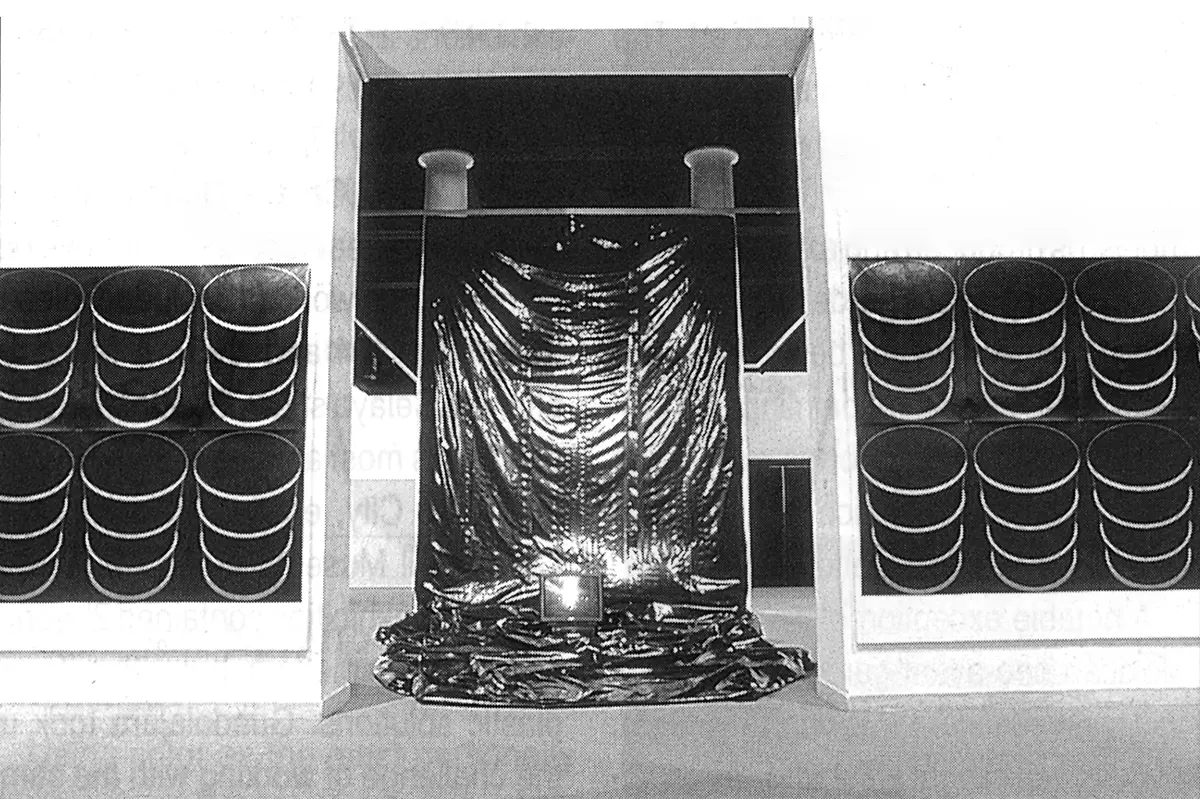
Oil has provided well-being and produced activism, and Rolando Peña takes its psychological and social implications as constant features of his artistic reflections. By means of an alchemistic-artistic process, the oil rig and the barrel —elements which are used to extract and contain the black gold— are transformed into yellow metal, the maximum symbol of wealth: they become the insignia of the economic transformation of the raw material into opulence. The artist arranges the barrels in diagonals, verticals, which are sometimes phallic totems, creating spiral labyrinths and installations. The graphic work, a reproduction of projects and works already constructed, is done with a very sophisticated process of computerized digitization. The images are fed against a black background, which, by avoiding simulation, has been obtained with oil or mene, an Indo-Venezuelan word used by the artist.
In the work of Rolando Peña, there is a display of the gold paint which he uses to cover both rig and barrel, without making them kitsch. In this coming to a halt before the precipice lies the sensitive balance of his work. How does Roland Peña see oil? Like the Golden Calf of the Bible, the generator of idolatry. The biblical golden idol is an interesting point of association with Peña’s operation. Moses found that his people had modelled the figure and destroyed it. Roland Peña constructs it, giving life to the unconscious yearning of society, but presenting it in its falseness, as a disguise. If it were of precious metal, it would be the Golden Calf and would lose its meaning as
a maxim; neither is it an illustration nor an explanation. The work of the Black Prince is symbolic of a common attitude, which is a source of emotion because it confronts the world like a form that encompasses its own exorcism: by expressing mystification, it produces catharsis.
For Rolando Peña, oil is also a threatening divinity, Zeus, with his extraordinary strength. In an installation at the Italo-Latin American Institute in Rome (May-June 1996), against an expanse of black plastic, a television set shows terrible, fascinating, apocalyptic pictures of oil rigs and wells burning, accompanied by the threatening, roaring sound of the fire. The black plastic simulates a sea of oil, and in formal terms, the artist was inspired by the plastic sea in Federico Fellini’s Casanova. In its content, plastic is an inert element, the negation of life. The video has been edited by the artist to include a montage of sequences of towers and wells burning during the 1991 Gulf War.
Artists spend their lives advocating their utopias, which, after all, are based on real intuitions. I have the impression that Roland Peña is telling us to shun false brilliance and to concentrate on life. All this is confirmed by this Black Prince character, his symbols, and distinctive emblems. His disgust with vacuity is the same as that to be found in a stanza by Salvatore Depau: "No. We cannot long for and desire the void and nothingness. To love such things would be stupid of me."
SAMUEL MONTEALEGRE