The European ascendancy which is a traditional characteristic of the pictorial work of Latin American artists among the intellectual elites of their respective countries is the product of a training that takes the metropolitan referents as models, generally to be assimilated and adapted to the requirements of a "peripheral" reality. It is precisely in this work of selection and re-elaboration that the work of these artists often shines through the cultural conditions of the local environment, conditions which predispose them to certain possible aesthetic options.
The case of Torres-García is, of course, one of the exceptions to this rule. In the first place, because of his return to Uruguay, after 45 years of absence and with the prestige which he had won abroad, he comes to revive in Latin America the problems and the proposals of his final years in Europe—a circumstance which compels to discard the possibility that his art was related a priori with the local cultural reality, which in essence was unknown to him. Secondly, the contribution of his thought to the local and regional context of 1940 goes well beyond the limits of a mere pictorial "style": it establishes rather a global interpretation of art and painting in Western history, particularly sifted by the European debate about the avant-garde movements. It means that for his disciples, "Torres is not merely a painter of a given magnitude, but rather the living and biographical way in his approach to painting... Thus they acquired a concept of painting (...) as an aptitude to feel and to judge things, and this concept enabled them to recover the entire history of an art of which they did not have at hand, but only poor and adulterated reproductions." (Juan Flo) This is so because his discourse—both plastic and theoretical—is not the result of contact more or less contingent with specific aesthetic variants, but it comes along with a personal situation that led him to seek out answers consonant with a reality experienced as a crisis of Western culture.
The ambiguity with which Torres-García confronted his doctrinal relationship with the European aesthetic avant-garde movements is well known, as it is the resistance expressed in his ideas to give credit, within artistic work, to the scientific-technological process of modernity. On the one hand, Torres rejects the purely aestheticizing results of the avant-garde, but on the other, he retrieves from modernity the idea of re-integrating art into the fabric of everyday life. Opposed to the utopia of technological progress that had inspired movements between the two World Wars, he supported another kind of utopia typical of the modern movement: that which conceives art as the fundamental cornerstone on which the cultural unity and the social development of people could be constructed.
Torres embraces those avant-garde postulates tending towards the semantic autonomy of art, but he rejects its institutional autonomy in the context of the modern process. For its part, the European avant-garde had not been able to resolve its own essential contradiction: the re-integration of art into social life by questioning its role in bourgeois society, but without renouncing autonomy of the artistic sphere. Torres-García therefore believes that this challenge could be resolved in a country such as Uruguay, where the cultural tradition lacked the historical inertia of Europe and where the course of modernity followed a rather eccentric process, permitting a more archaic and more receptive relationship with the constructivist proposals.
When Torres inverts the map of South America, he is locating the axis of his avant-garde discourse in the inquiry of one's own cultural "north." But the regionalist connotation of this proposal had devoured itself since the moment it tried to fuse with the transcendent discourse of the "universal."
This first renunciation implied in turn another: that of the individual artist to his pedestal in society, since the new art would be collective and anonymous. For Uruguay, such a proposal meant that the final meaning of art would lie not only outside the already established national imagination but outside the realm of any immediate social credibility. An apocalyptic sense of art with such characteristics had only been seen in Montevideo just one year before the arrival of Torres, on the occasion of the sweeping visit of the Mexican Siqueiros.
Furthermore, the Indo-Americanist discourse of Torres-García constituted in such a context a first metaphor of taking root (A. Bosi) , an argument difficult for the country to assimilate. The local cultural problem was above all related to the hybridization of European origin, and the political discourse of identity consisted of highlighting Uruguay's differences from the rest of the Americas.
For this reason, Indo-American art can not acquire the meaning of an original myth but fulfills, for Torres, the role of pointing out a path toward the necessary metaphysical unity of any culture. The literal origin proposed by constructivism does not lie in the past but in the immediate present—but in a present that goes in search of the Great Tradition with a view to its further continuation. For Torres, only the present could have a founding role similar to the archaic past, since both admitted to be out of time extracted out of history.
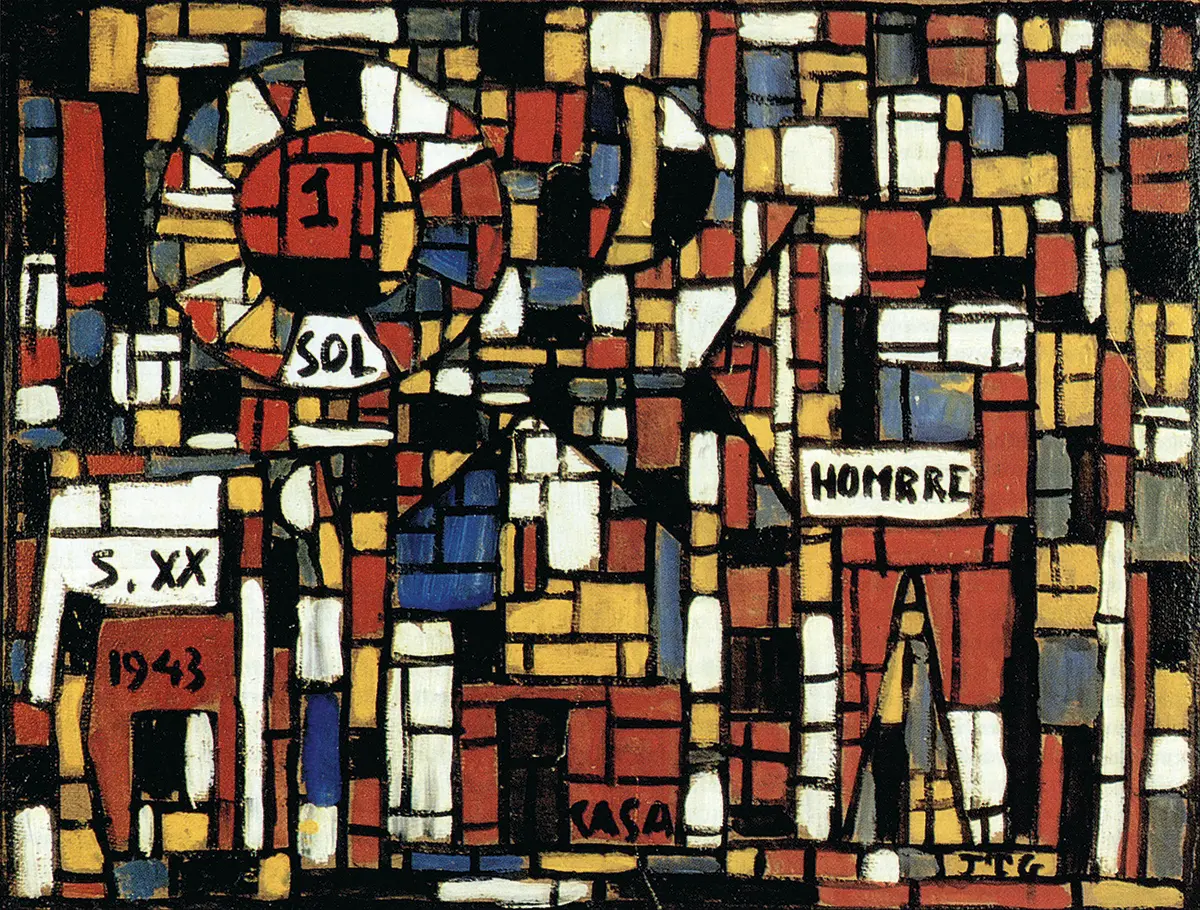
The argument based on the Indo-Americanist discourse has a span of time between 1934 and 1940.1 In the following period, constructivism —still without lowering its Americanist flag— confronts its second root-taking metaphor: the emphasis on the local. During this period (1941-1949), there emerges the Torres-García Workshop and the publication Removedor (in which substantive articles alternate with militant journalism), and Torres develops his teaching of a constructive painting."It would be expedient to compare the vignette of the Circle and Square (the same as Cercle et Carre) which had appeared on the cover of the publication between 1936 and 1938, with that of the same journal in 1943, as to have a visual indication of the distance covered by constructivism in Montevideo towards cultural establishment during this period. Simultaneously, with this process, the development of a self-critical intellectual attitude takes place, in particular in the literary field, which contributes to giving an avant-garde dimension to Torres's teaching and its interpretation through new regionalism matrices underway at that time. They did not constitute any body of doctrine, but rather a tendency in local imagery which limited and modified Torres-García's utopia itself.
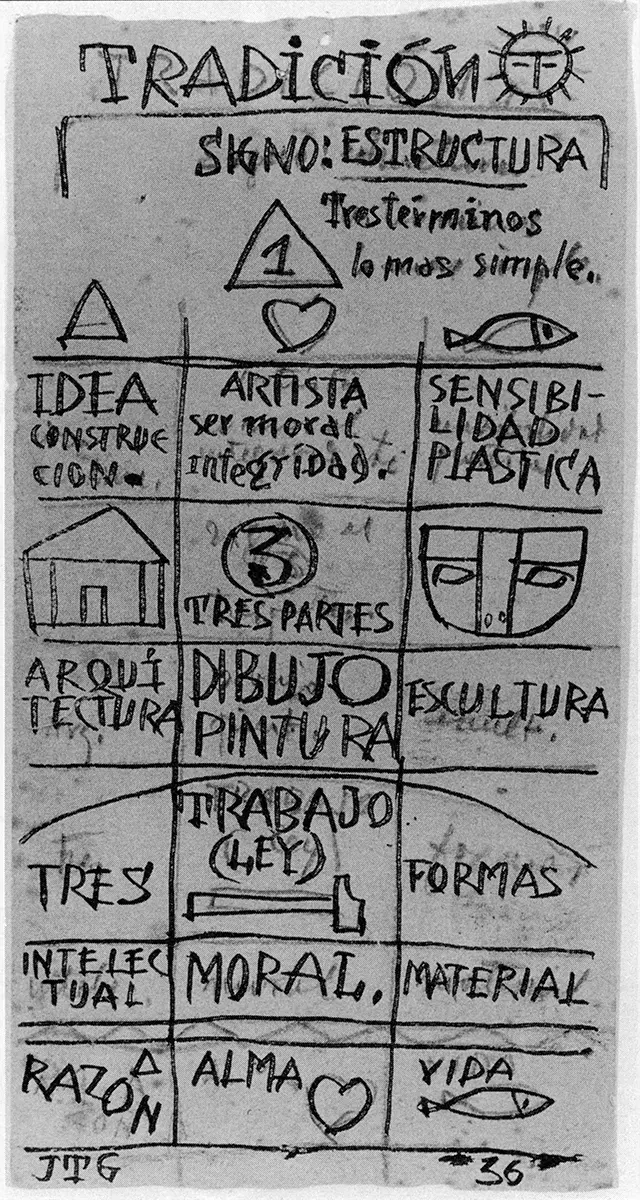
The initiation of this second regionalist discourse, in which constructivism moves resolutely towards strengthening the local component, can be dated from 1940, when Torres publicly acknowledged the failure of his initial project and established the "Bases for a Constructive Painting" in his celebrated Five Hundred and Fiftieth Conference. Throughout the decade he continues to operate on these bases and makes various pedagogical proposals, concerning such matters as the restriction of tones, measured landscapes, central perspective, constructed painting, etc. The social and cultural heterogeneity of the members of the Workshop meant that Torres had to refine his dialogue and the resources tending to the achievement of desired plastic results. For the most part, the disciples came from the urban middle class; some were from the rural and semi-rural environment (approximately 40 percent in 1946), and a smaller number were from the upper middle bourgeoisie. The only experience common to all was the apostolic presence of the master. It is therefore not surprising to find in the pictorial production of the Workshop a repeated thematic use of the local landscape and even, in some cases, as with Nelsa Solano Gorga, a Torres-García-like version of social realism. The distance between the publication of Structure (1935) and the lectures on The Recuperation of the Object (1948) reflects this process in which the universalist argument endeavors to adapt to the heteroclite and provincial nature of the Montevideo setting.
Torres-García’s Project and the Obstacles of Local Culture
When Torres-García arrived in Uruguay, the country was facing an acute political and economic crisis. The comfortable climate in which the activity of artists and intellectuals in the 1920s had developed suddenly broke up abruptly in the following years. This is due not only to the dictatorship of Gabriel Terra and the internal political and social crisis but to the international situation, which required intellectuals to adopt an ideological line with respect to the great events occurring in the world, from the advance of fascism to the Spanish Civil War.
For its part, the figurative and landscape tradition in national painting, which had been nurtured in this century by Spanish luminism and French post-impressionism, could provide no adequate response in the new Uruguay, which could no longer hide its internal political, social, and cultural cracks. The panorama of pictorial tendencies at the time reflected at least three different artistic discourses that capitalized, each in its own way, on that figurative and romantic tradition of national painting. First, there was a discourse of "official" art, which attempted to act as a reference for a culture operated by the State and of a populist kind. This discourse emphasized both the pater familiae of a patrimonialistic model of identity (the paradigm of which was the painting of Juan Manuel Blanes) and the mundane spirit established by the Uruguayan painters of the nineteenth century.
Second, there was a consolidation of an artistic project created by the intellectuals of the left and influenced, at the time, by the proposals of Alfaro Siqueiros,2 as well as by such Argentinian painters as Urruchua and Berni. This project, above all under the impetus of politically organized artists, was expressed in the pictorial variant which sought a vernacular social realism. Third, there was a group of artists gathered around the Workshop School of Plastic Arts (ETAP),3 which proposed an eclectically oriented kind of teaching, although in fact it consisted of the renovation of the coloristic and formal bases of the Montevidean school of the 1920s, and its replacement by the precepts of French post-Cubism.
These were the three main variants of national painting that Torres-García found on his return to the country. All were in one way or another inherited from a certain kind of figurativism of a markedly literary kind. A good deal of Uruguayan art reflected, in its cult of painting as spectacle, the attitudes of a passive society that was merely a spectator, trusting only in the paternalism of the Welfare State. Thus, the battle waged by Torres-García against the figurative mimetism of Uruguayan painting is the touchstone in his fight against cultural mimetism which presupposes an ape-like, colonized gesture.
One of the most serious clashes that Torres-García sustains on his return to the country is with representatives of the social realism current, who see him as a bourgeois, "purist" painter. In the journal Movimiento, the organ of this current and founded by Alfaro Siqueiros in 1933, the individualism of Torres-García is said to "prevent him from finding subjects of interest to the popular masses."4 Torres responds with his Manifesto l, threatening to undermine the foundations of national art with the possible dissolution of artistic individualism and romantic genius. "This art of mine, he said, because of the way it is conceived, could become a collective and impersonal art."5
The subsequent development of these events shows that from the very beginning, Torres managed to destabilize the ideological aesthetic hegemony which artists from the Movimiento group were trying to impose on artists who had sided with the political left.
The third breach that Torres-García opened between the art promoted by the Government and the art of social denunciation could explain in part the support that Gabriel Terra gave Torres-García when the artist returned to Uruguay.6 Between the cultural project of the organized left and the Government project, there emerged the Southern School as a "shock-absorbing" project, even though something of this kind was totally alien to Torres-García's intentions.
Although the School proposed a mystique of self-sufficient group work independent of the "official" cultural initiatives, it managed to achieve the respect and support of Government bodies, from which it obtained, over many years, relatively substantial economic support. In this sense, it might seem paradoxical to note that Torres-García's attack against the figurative and romantic tradition in national painting (a tradition which was protected by the cultural initiatives of the Government) was often made in the name of "development" and "progress," i.e. that is, in the interest of an aspiration which coincided with the discourse of the political authority. However, the apparent alliance between the constructivist doctrine and modernity is part of a misunderstanding that Torres tried to clarify, in various texts, particularly during the final years of his life.7
Moreover, his intransigence also clashed with the artistic goals of the ETAP, an institution which, although some of its members were politicized, endeavored to steer clear of ideological disputes and to accept the broadest aesthetic-doctrinal integration within its ranks. This eclectic, acritical, and tolerant attitude was based on a strong tradition in national thought which had reached its high point in the 1920s. The most "avant-garde" aesthetic doctrine in Uruguay in those years had encouraged, as an intellectual attitude, the need to go beyond any form of intolerance and by extension, beyond any kind of avant-garde.8 This was one of the main difficulties for Torres-García as soon as constructivism was presented not as yet another doctrine, but as an exclusive doctrine: the only one capable of leading to a kind of individual and social redemption through art. As Torres-García wrote in 1940: "Like a spring which always returns to its normal position each time we try to pull it open, so, following the onslaught of my affirmations, this indeterminate spirit has predominated. And here I touch upon the heart of the matter, the source of all my tragedy and struggles in Uruguay, and, if you like, the reason for failure."9
We might say that Torres-García's objectives went beyond the idea of creating a local avant-garde movement in Uruguayan art: what he wanted was to create, on the basis of the latter, a collective art and a universal language such as had never been imagined in the avant-garde utopias of the developed countries. "It is not a matter of establishing just another art school or working for artistic culture in a vague manner. On the contrary, the goal is to achieve something very specific here: to continue the European process of development which, as a result of present circumstances there, has been interrupted... If this goal is achieved, Uruguay will enter the avant-garde ranks of art."10
Although on the one hand, the avant-garde objective of Torres-García was based from the beginning on an evolutionary argument, which endeavored to bring art to the same level of development achieved in other material social spheres, on the other hand, his writings and lectures reflected an explicit lack of faith in the global model of technical and industrial progress. In 1940 he wrote: "The lesson we have learned is that we must create with our own resources: to make the pot with our own clay and according to our own desires and needs."11
This regionalist archaism and cultural endogamy clashed with the easy belief in the future in Uruguay which aspired to the kind of development subsidized by the war. But at the same time, he drew closer to a number of Uruguayan intellectuals who were interested in redefining the "national identity" in critical terms and from the standpoint of the present, in a way that coincided with Torres-García's idea of a founding present.
The Regional Matrices of the Southern School and its "Legacy"
In the context of these events, the School acquired an image in Uruguay in the 1940s that seemed to signal a rupture. It was not by chance that Torres-García's friends and frequent visitors to the Workshop included two writers whose work already offered a precedent for the development of a new "critical generation" (A. Rama) in this decade: Francisco Espínola (1901) and Juan Carlos Onetti (1909).
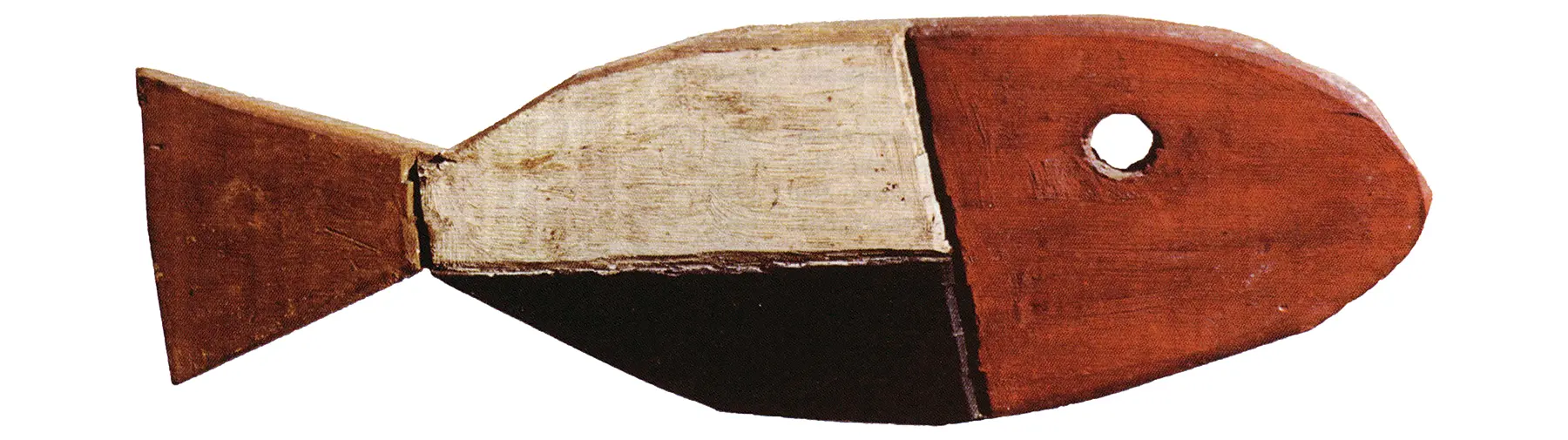
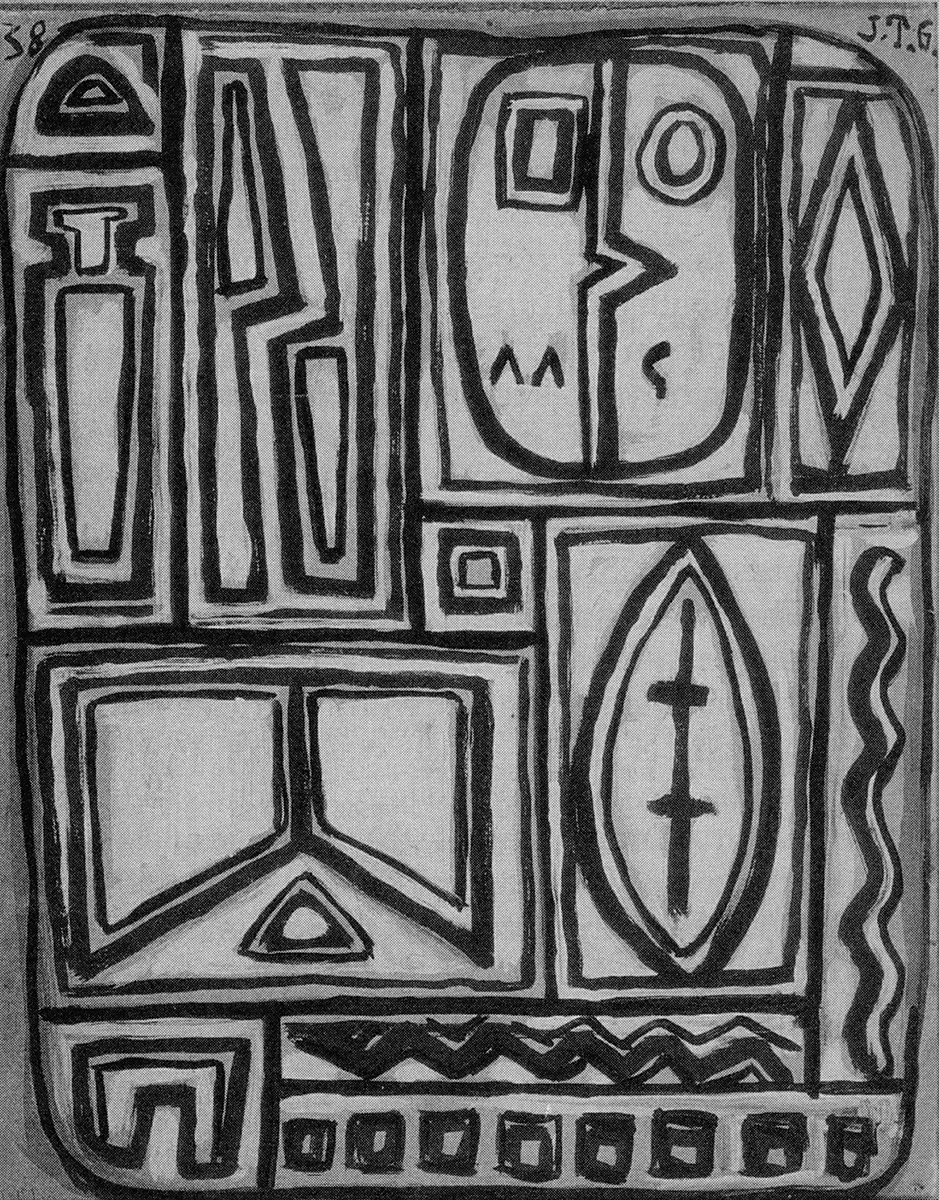
There were also a number of young persons and adolescents who came and created their own atmosphere of Dada-like anger in the literary circles of Montevideo of the time.12 The constructivist nucleus increased from three members in October 1943 (the month the Torres-García Workshop was founded) to 66 disciples in March 1945.13 It was from those years that we can begin to speak of a genuine local development of the teaching of Torres-García. It was a development that expressed itself through the work of the Workshop when certain ingredients of his "style" became configured into a metadiscourse that extended to other areas of cultural activity. They were fundamentally four in number: 1) the consolidation of new pictorial imagery of the city; 2) the exercise of a tonal kind of painting with a restricted palette and a predominance of grays, which was a constant practice throughout the life of the Workshop; 3) a cult of elemental geometrical structuralism; and 4) the mystique of craft, associated with the use of rustic materials and the production of constructivist objects integrated into the wall and architectural space.
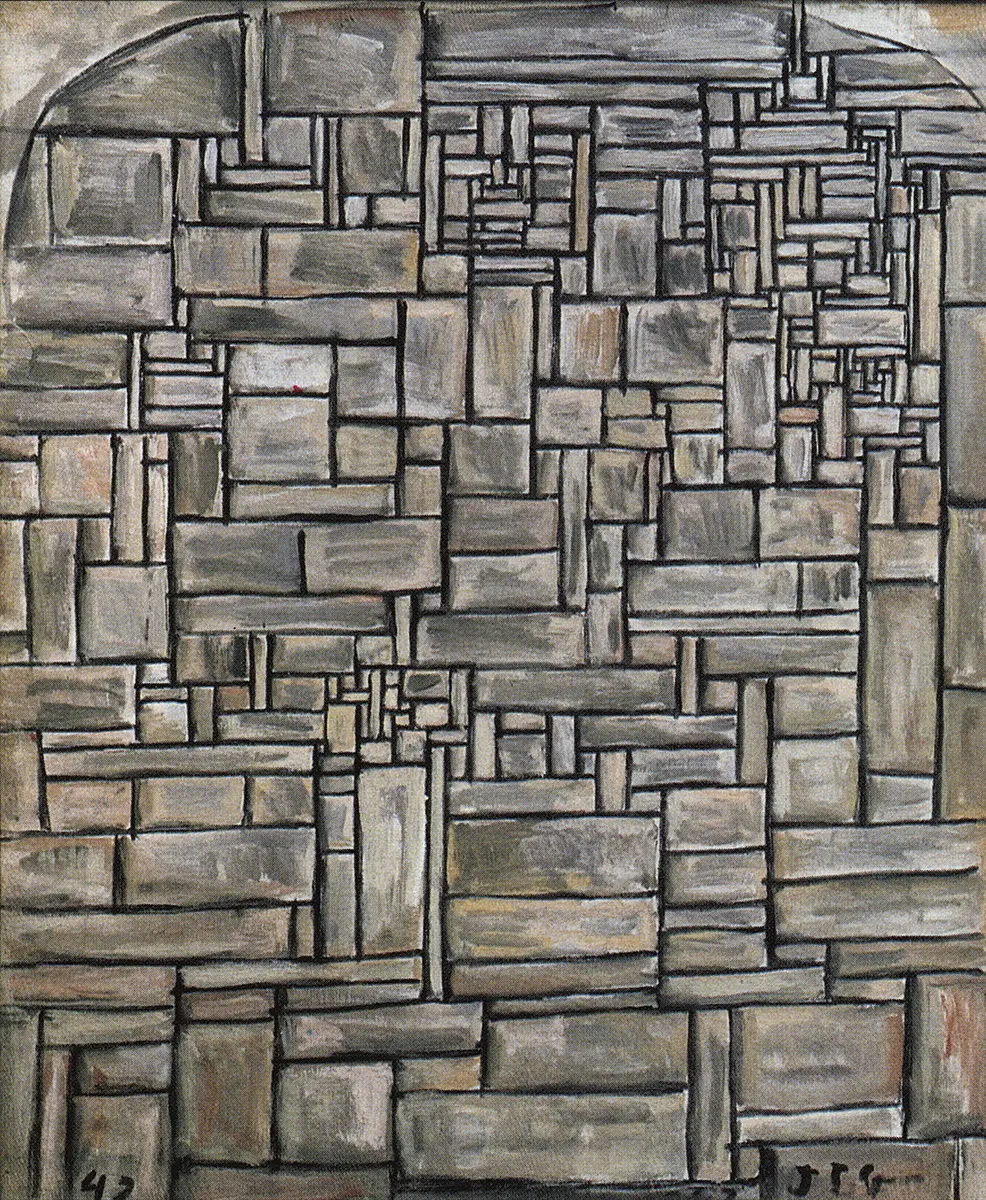
The restricted range of tones and the consolidation of a new Torres-García iconography of the city were aspects that were intimately linked with the Workshop activities. The new harbor landscape which—following the master's guidelines—was cultivated by several disciples; served to reinaugurate the city in a way that was both lyrical and cerebral, affectionate yet distant.
In The Bases for a Constructivist Painting, Torres-García had in fact proposed a thematic study of present-day Montevideo on both the walls and the easel. This resulted in painting which offered both an unusual view of the city and a renewing alternative valid against the naturalist and creole-based imagery of the national picturesque tradition.
Outside the Workshop, an isolated figure like that of the painter Alfredo de Simone had already been incorporated into his painting of the 1930s, an "onettian" vision of the city; however, it was only with the production of the Workshop that the new image of the city develops and becomes associated with the exercise in tonal painting.
Although during the early years of the Association of Constructivist Art and of the Workshop the constructivist nucleus created many works based on primary colors, the continuity of tonal painting based on the discretional use of grays remained a dominant feature. This painting needs to be analyzed in the context of the ideological debate between the master and the naturalist and ruralist tradition of vernacular impressionism, in the same way, that his doctrine of tone (related to the use of gray and earth colors) acquires a special meaning by configuring a retrieval of the mediterranean tradition accompanied by an attack against the strident use of colors as practiced by the Circle of Fine Arts of Montevideo in the 1920s. In 1947, when he was promoting among the members of the Workshop painting based on the combination of seven colors, Torres-García also introduced perspective into the city theme. It deals, of course, with a "concrete" perspective, stripped of any illusion of depth, and reinforced and regulated by a new frontal construction of the landscape, where the slanting lines permit a different tension-based organization of the surface.
But Torres-García's city is not only the city he painted but that which he contributed to be painted. He created a new pictorial "Montevidean" imagery, by incorporating constructive and abstract proposals, unmistakably local references. These include a theme of the port image, which served as a basis not only for the poetics of large mechanical forms (both nostalgic and "progressive" at the same time), but as a metaphor on the umbilical cord of our urban culture, since the port is, by definition, the place in the city which is open to the rest of the world.
The other aspects noted above—the elemental structuralism and the mystique of craft, applied to architecture—were also intimately linked together. In this respect, mention may be made of the well-known collaboration between Workshop artists and certain architects in the creation of murals, sculptures, ceramic works, textiles, etc. For the master's disciples, this interdisciplinary collaboration in the design incorporated into architecture was a social extension of the Workshop experience, a sphere of collective participation and creation. But it was also the only possibility that allowed constructivism to achieve its own environmental work, since until then, it had been little more than an apostolic style of life and reflection endeavoring to project itself into the system of objects. However, the few experiments carried out were limited to the nucleus of architects associated with the Workshop and to some extent committed to his doctrine.
This is the case, first of all, with the architect Ernesto Leborgne, who gathers a large number of pieces by Workshop artists in his own home. Leborgne's work as a whole is an attempt to achieve a critical re-appropriation of the legacy of the modem movement within a constructivist mystique transferred to the intimate scale of space. In this kind of option, perhaps Torres played—although not necessarily intending to do so—a very important guiding role, not so much in terms of his ideas about modern architecture (which were rather contradictory), but through his specific action as a designer and artist. A similar influence, within personal and different registers, can be found in the works of the architects Mario Payssé Reyes and Rafael Lorente. The use of brick and rustic materials is precisely one of the symbolic keys in this architectural variant. However, the characteristic constructivist features of the work of these two architects are not to be found so much in the common use of this or that material, or in the possible collaboration by Workshop artists in the creation of "artistic" works, but rather and above all in the marked predominance of an ethical component which formulated and regulated the actual design of the architecture.
This ethic of the "constructor,” a term synonymous with "artist" for Torres-García, is linked with the concept of "truth" both in the use of materials and procedures and a mystical concept of the visual environment adapted to life.
There is an example in which this ethic emphasizes the conceptual clarity of the technical procedures and the mastery of inventive craft: I refer to the work of the Uruguayan engineer Eladio Dieste, a friend of Torres-García's from the time the painter arrived in Uruguay in 1934.14
His invention of a system of ceramics structured according to the technical resources and climatic conditions of the region has opened up a rich spatial repertory. Here, too, there flourishes the metaphor of poor materials and the use of procedures not based on technological prowess but on the discovery of solutions in which conceptual originality makes up for the lack of advanced technology and economic resources.
It is this ethical legacy of Torres-García, based on the ideas of constructive truth" and "shared work," which acts as an archaic force opposed to both the values promoted by competitive struggle within the capitalist society and to the values underlying the pragmatic and classist concept of solidarity, explicit in the ideological discourse of the left. This ethical component acquires a local historical development that goes beyond any decontextualized and strictly aesthetic reading of these objects. It is present in the desire to convert artistic practice into a utopia of group-based communion, fitted to the development of an inter-subjective experience that from the beginning knows how to marginalize from the relentless course of modernity. It deals with a utopia based on reduced models of ideal collectivity, which had a significant impact in Uruguay in the 1950s and 1960s, a period that saw a flourishing of workshops particularly concerned with the problem of identity and cultural appropriation.15
But above all, that ethical dimension of constructivism is reflected in the theoretical idea —which has guided many generations—that the cultural relationship between man and his "place" (in urban terms) is an intellectual construction, and that art must be a symbolic ingredient of this construct.
NOTES
1. During this period, the Torres-García project was centered around the Association of Constructivist Art as a nucleus of proposals. Towards the end of this period, in 1939, Torres-García published his Metaphysics of Indo-American Pre-History.
2. In 1933, Siqueiros spent some time in Montevideo on his way to Buenos Aires.
3. The ETAP was established in 1932 and remained open until 1937. Its members included the painters Carlos Prevosti and José Cúneo, as well as the sculptors Bernabé Michelana and Germán Cabrera.
4. Norberto Berdia, "EI arte de Torres-García,"in Movimiento, No. 7, June-July 1934, Montevideo. (Publication of the Confederation of Intellectual Workers of Uruguay - CTIU).
5. J. Torres-García, "Contestando a N.B. de la CTIU", in Manifiesto I, August 1934, Montevideo.
6. Torres-García arrived in Montevideo on April 30, 1934. On May 3, he visited the President of the Republic, Gabriel Terra. The following year, Torres-García had a weekly page in the Terra-oriented newspaper El Pueblo, and in November of that year, he began to receive a monthly payment from the Ministry of Public Education, which will continue at least until December 1945 (documentation in the Archives of the Torres-García Museum, Montevideo).
7. "This spectre of the modern, which has caused me so much uncertainty (bewildered as I was by the confusion generated by the artists, critics, and pro-business propaganda of those who dealt in pictures), I now want to liquidate once and for all..." (J. Torres-García, January 2, 1949, mimeo publication, Archives of the Torres-García Museum, Montevideo). "We were confused: because if we had to accept objects (all the things being created in the world), we did not have to accept the new interpretation." (J. Torres-García, Mística de la Pintura, published by the Association of Constructivist Art, Montevideo, 1947, p.32).
8. Alberto Zum Felde, director of the La Pluma magazine, said: "Eclecticism (is) a necessary standard for a review which aspires to cover all the aspects of the national intellectual movement... There is something which must always take precedence over the avant-garde: the vigilant spirit," La Pluma, year 1, No.1, August 1927, Montevideo, p.9.
9. J. Torres-García, 500a Conferencia, November 12, 1940, Montevideo, published by the Association of Constructivist Art, p.23.
10. J. Torres-García, Entrevista de Iturbide, undated manuscript, Archives of the Torres-García Museum. According to the artist’s personal agenda, the interview takes place in January 1935.
11. J. Torres-García, "Puede gastarse de lo propio y de lo adquirido. Lección 125," Universalismo Constructivo, Alianza Editorial, Madrid, 1984, p.688.
12. The group of young visitors included José Parrilla, Humberto Meget, Juan Flo, Manuel Aguiar, and others.
13. Documents of the Archives of the Torres-García Museum, Montevideo.
14. The engineer Eladio Dieste is a direct relative of the writer Enrique Dieste, who introduces Torres-García to many intellectuals who subsequently supported him, as in the case of Dr. Cáceres and his wife, Esther.
15. The workshops from this period that were directly related to Torres-García’s teaching include those of Alceu Ribeiro (El Molino) in Montevideo: Edgardo Ribeiro in Rocha; José Colell in Montevideo; the Sotano Sur Workshop; and the Montevideo Workshop, with disciples of Gurvich, the Dumas Oroño Workshop in San José, the Guillermo Fernández nucleus in Paysandu, among others.
GABRIEL PELUFFO LINARI
Uruguayan art historian and critic. Lives in Montevideo where he directs the Municipal J.M. Blanes Museum.