
As is the case practically everywhere in the world, in Mexico to the "idea" of painting has led to the development of neo-avant-garde artistic expressions which, as we approach the end of the century, have acquired a truly unusual force in the form of objectual art, environments, installations, multimedia art, neo-graphics and performance art. The use of such disciplines is now perfectly legitimate and valid. What is reprehensible, however, is that very often so much rubbish is produced and exhibited under the guise of avant-garde art, with the public’s leg sometimes being pulled too often. The rejection of painting and other traditional artistic forms very often leads to proposals that lack any kind of creativity or imagination.
A notable exception in the context of Mexican neo-avant-garde art is that of Víctor Guadalajara (Mexico City, 1965), a young self-taught artist who has distinguished himself in the construction of some very powerful "pictorial-sculptural" objects which seem to combine artistic inspiration with artisanal dexterity. Practically from an excellent trade —carpentry— Guadalajara proposes in his work an ambiguity vis-á-vis painting and sculpture, creating a visual discourse which is halfway between two traditional artistic expressions, integrated harmoniously and subversively into a single language.
In 1992, Víctor Guadalajara presented an exhibition that signified the auspicious beginning of his journey within art. The show was entitled Urban Archaeology, held between 6 and 30 August of that year at the San Ángel Cultural Center, and introduced a young avant-garde artist who seemed to have well-defined proposals. He was a skilful "painter/constructor"(in the words of Francisco Castro Leñero in the exhibition catalogue), who through his artistic zeal managed to subvert the very concept of the picture, breaking the format and audaciously launching himself into constructive production proposals, an artist who knew how to handle his materials, who was sober in his use of color and who constructed works which sought out a formal logic combined with considerable visual impact.
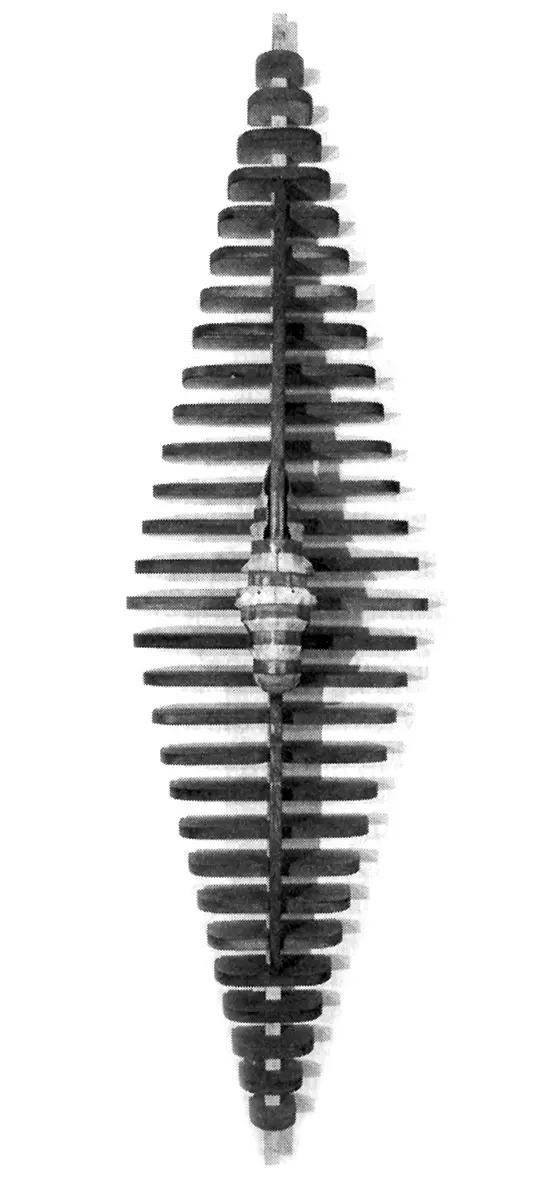
Four years have passed since that exhibition. During this time, Víctor Guadalajara has matured as an artist and has considerably developed his neo-avant-garde proposals, as could be seen in his exhibitions at the Salon de los Aztecas (De-forma-to, 1994) and the SEDESOL Tonalli Gallery (Ten Pieces, 1995). Culture of Celaya (Celaya, Guanajuato) last May gave a clear idea of these developments in his work (it included pieces from 1992, 1994, and 1995). A few days after the Celaya show, Guadalajara presented its most ambitious show to date in Mexico City, entitled Ellipsis, at the Carrillo Gil Museum of Art (12 June - 21 July). The exhibition contained 21 works, all with the same form but with different plastic solutions. Guadalajara took up the challenge of working with the same geometrical structure, the ellipse, as a means of exploring its various possibilities of expression. His creative-constructive process began with the elliptical base (a stretcher made with stretched wood) on which he carried out some meticulous work with assemblage, canvases (almost always encaustic painting), and sometimes objects, in order to give each work a different image. The only piece that did not follow this pattern was Ellipsis XVIII, which had no pictorial work and which belonged rather to the conceptual-objectual avant-garde.
With this interplay of physical and visual tensions that manipulate our perception of reality, Guadalajara has become one of the most audacious and meaningful of the neo-avant-garde artists in Mexico today.
ANTONIO ESPINOSA