
For some time now the work of Alvaro Barrios has been part of our visual memory. From his early work in the 1960s down to the present, his images have been shown in one-man exhibitions, collective events and National Salons. It was precisely at the last Salon, in the midst of so many young artists, that his work appeared as a singular example of those mature artist who continue to be committed to a constant search, which in his case reflects the lucidity and humor of a process which retains all its validity, all its topicality. For these reasons, his works continue to be young.
The one-man show recently held at the Garces Velasquez Gallery provided an opportunity to see at close hand the context of those works shows at the National Salon. Of the many aspects of those works, I should like to mention two essential characteristics: the value of the image and the presence of reflection.
In The Fifty Paths of Life, Alvaro Barrios makes use, as in his earlier work, of the technique of collage. This time he uses as a support a faithful reproduction of the Colombian landscape artist, Francisco Antonio Cano, including a reproduction of the frame and the craquelure of the painting, revealing the fine layers of paint and brush-strokes which make it up. The work appears signed by F.A. Cano, 1892 and Alvaro Barrios, 1995, the date when time began its work on these seductive and intriguing images.
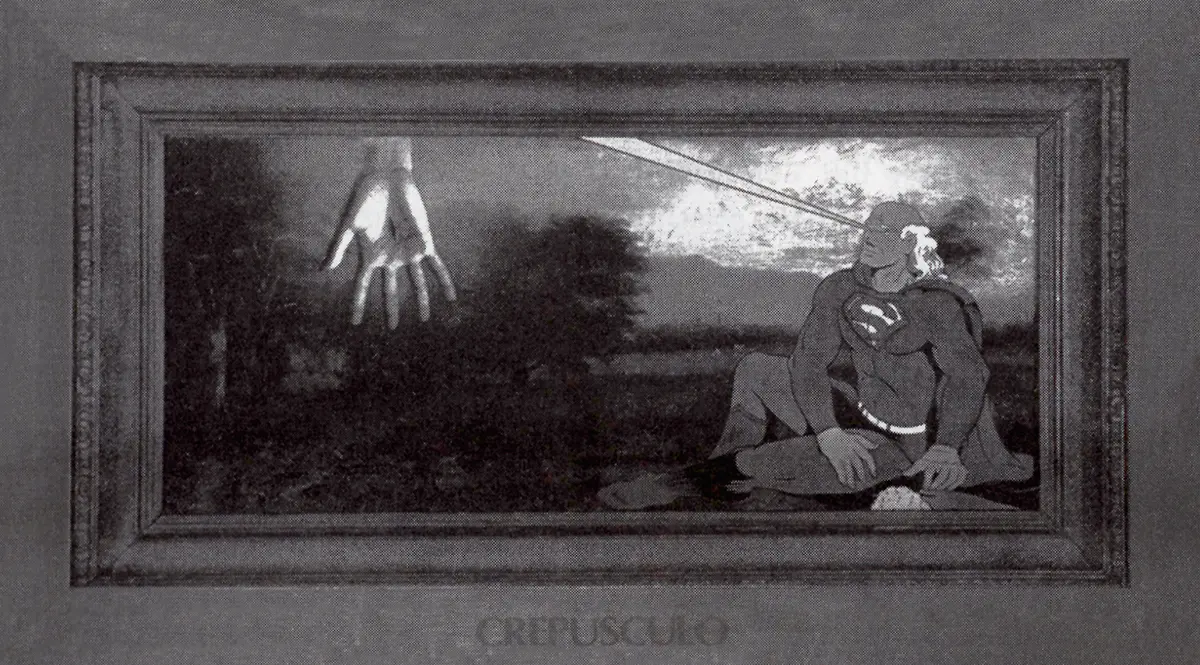
The Time, iconography and action presented in the collages activate our perception, immediately awaken our visual memory and lead us towards a world of almanachs with religious motifs from our local culture, as well as the world of comic strips, which are highly appreciated by this artist who also cuts out images from books showing the complicated anatomy of the human body, up to the ancestral picture of a bucolic landscape full of colorful and evocative atmospheres as a point of departure. In other words, it is a purely visual universe, made up of various layers ranging from the popular to the cultured.
This pure visuality which Barrios creates, highlights the retinal condition of the plastic arts, which has been so much undermined by another artist close to Barrios himself, Marcel Duchamp, and subsequently by the conceptualism of the 1960s. The emphasis on the visual which we find in these collages, whether directly or indirectly, reminds us of the other images which accompany us in our everyday life, and which sometimes invade and saturate us. This is a phenomenon which on the one hand encourages an immediate cohabitation with the image - leading to a greater understanding and assimilation of the visual element; but the omnipresence of the image, through redundancy and abuse, ends up by undermining its actual value. The Fifty Paths of Life help us feel a sense of pleasure on discovering that we are still sensitive beings, with a capacity for emotion and thought when faced with purely visual elements.
The pictures in this exhibition and the contact with each of the images constructed make one think, as Kant would say, of many ineffable things. In order to achieve it, Barrios uses various resources, such as the titles of his works ( Chance, Offering, love, Enigma, Awakening, etc.), which barely suggest an idea. Once this key has been suggested, the image is constructed with the help of other images which, as noted above, come from other contexts. Each particle of the image thus expresses itself and from within itself, from within its intrinsic value as a visual vestige full of cultural echoes, memories known to the spectator who, on looking at Barrios’ work, is free to appropriate the entire image which he has before his eyes, and can do so in the light of his own subjective experience. In this way, we recuperate art as memory, as an echo of all that we have within us. And given Barrios’ sense of subtlety^ humor and lucidity, we have no other option but to look, smile, reflect and yearn.
But Barrios’ collages on the other hand, also remind us of the fact that after the conceptualist current which dominated art from the time of Duchamp and then in the middle of the 1960s, art was never the same afterwards. Whether for the better or for the worst, these movements emphasized the reflective nature of art which had already been following its own path from the nineteenth century. But unlike the romantic and avant-garde kinds of reflection, the conceptual stance brings a chill to artistic perception, tends to destroy the sense of aesthetic pleasure and places art in terms of analysis and the formulation of its own nature.
The exposition of Alvaro Barrios The Fifty Paths of Life oilers an interesting experience in as much as it provides two possibilities which, sometimes in an exclusive manner, have characterized modern art: on the hand, there is the value already noted of the image as a self-sufficient phenomenon linked to aesthetic pleasure, and on the other, the value of art as an idea, art as a kind of reflection out of it and about itself. This last condition seems to be an essential requisite for an understanding of contemporary artistic practice.
At present, perhaps from the time of Kosuth, this act of reflection allows us to see how art asserts itself from within, in terms of its own particular method of procedure. Such a consideration may be useful at a time in which art is becoming increasingly interdisciplinary and plural and, because of such characteristics, seems to be fading and disappearing in the diverse forms of its expressions. It is therefore necessary to recall what has been said, namely that art asserts itself from within, in term of its own peculiar method of procedure and its particular means of reflection. Within this peculiarity, the history of art, as a complex succession of artistic proposals, is a form of knowledge which can become part of the artist of the visual arts. From the current perspective in which art is undergoing a constant process of redefinition, the history of art and the different problems affecting it may also be viewed as a redefinition of art - which would make history into one more tool for the artist.
Alvaro Barrios, in assembling and constructing his collages, incorporates this knowledge into his images - something which is to some extent evident in all his works, but particularly in a group of collages which form part of this series, The Fifty Paths of Life, in which the format is amplified. With this change in scale, the perception of Cano’s landscape is transformed, so that the atmosphere of this bucolic setting is presented in a very dark manner, acting now as a backdrop for a series of different characters, sometimes taken from paintings which are landmarks in the history of art, and communicate a sense of humor and tenderness in their own condition of images. These figures alienated from their own context relate absurd dreams which disrupts the normal meaning assigned to major works of art; thus Beuys’ thought is interwoven with that of other significant artists, creating an endless number of paradoxes in which the history of art and its meaning becomes a central component of this visual and reflective game proposed by Barrios through his images.
Suddenly we find ourselves before the figure of a girl looking out at us with her enormous eyes, almost certainly taken from some picture by Rivera, and she says: «When I grow up, I want to be a figure from Picasso’s pink period. Marry a man from the blue period and have many children from the cubist period. I don’t know if what I am asking of life has any meaning, but I believe that this is what I want.» With this quotation, I want to stress that it is not intended to be a pedantic, intellectualizing reflection, but a playful one - as can also be seen in the form in which each image is constructed, through the resources employed and contents which inspire it. In conclusion, The Fifty Paths of Life is a series made up of reflective images, full of humor and tenderness, but all endowed with a powerful sense of lucidity.
MARTA RODRIGUEZ