
The figure and work of Ana Mendieta have in recent years acquired a mythical dimension which have made her both an emblem of feminism and an illustrious exponent of multiculturalism.
The strange circumstances of her death in I985, after a fall from the windows of her New York appartment where she lived with her husband, the sculptor Carl Andre, and the subsequent legal proceedings, in which the latter was first accused and then acquitted, without the causes of the accident ever being fully clarified, have also contributed to the many readings which reached the conclusion that Ana Mendieta was the victim of social oppression and a rebellious symbol of uprootedness. Even if such interpretations have some real basis, they are excessively superficial: the intensity and energy of the work of this artist of Cuban origin who was educated in the United States from the age of thirteen, goes beyond the tight pattern of such a mythical characterization which very efficiently serves the needs of the dominant cultural discourse of the moment. Her work too goes well beyond any labels and reveals, from a global and articulated reading of her production, the complexity of her aesthetic options, bound as they were to a need to construct an identity on the basis of a new idea of subjectivity.
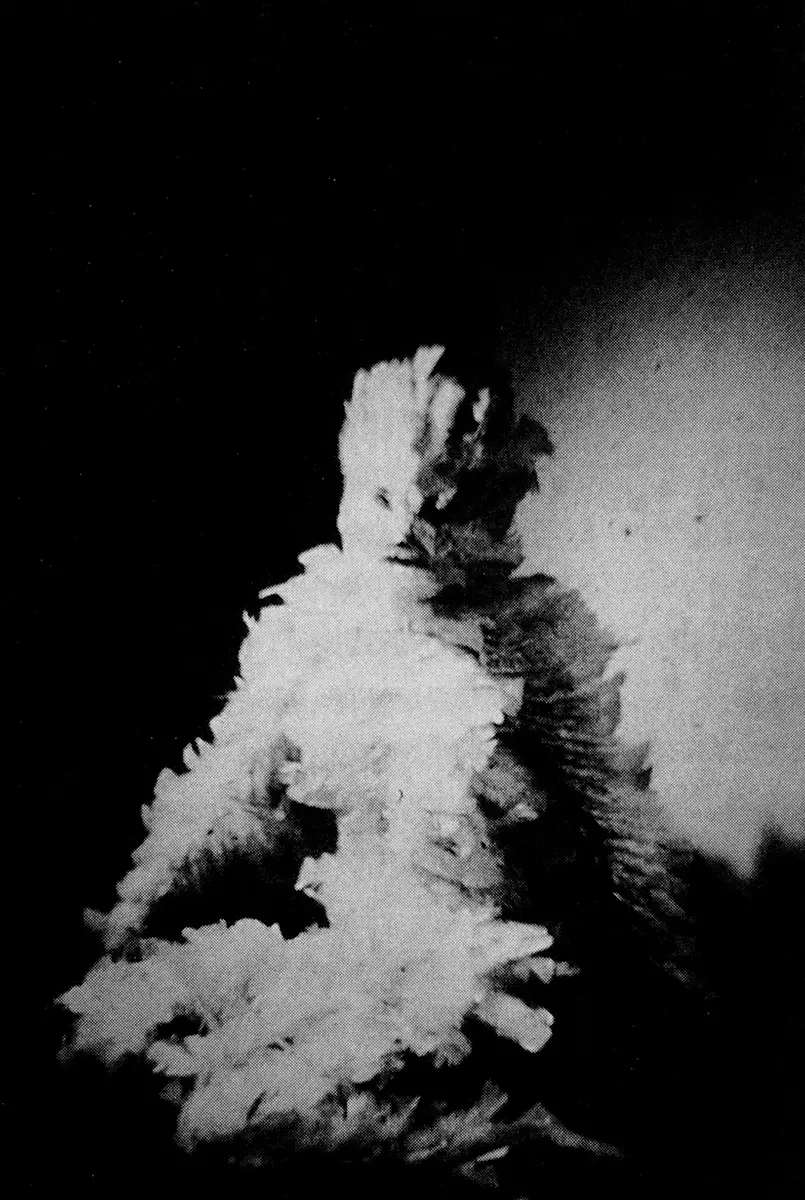
Without doubt the political and social elements are essential to her work, but in no case can the renovating power of her art be reduced to these elements alone.
This would seem to be the thrust of the retrospective exhibition recently presented at the Galician Center of Contemporary Art in Santiago de Compostela (Spain), curated by Gloria Moure.
It should also be noted that Ana Mendieta’s work was shown individually in Spain for the first time in I995, at the DV Gallery in San Sebastian, accompanied by a catalogue and magnificent essay by Kevin Power. Ana Mendieta is currently the subject of considerable interest, precisely because her work can be seen as a contribution to the debate on multiculturalism. The Santiago exhibition was an attempt to do something more than give a rigorous and systematic picture of a short but very intense artistic career.
The exhibition includes very different kinds of works, from drawings done on vegetable leaves to the recreations of installations, photographs, earth molds and a video presentation and slide show of her performances, which are both the most well-known and essential aspect of her work, and perhaps the highlight of the show. In some cases, such as the performances from the I970s, the material had not been seen before and enables the spectator to see how already during those years Ana Mendieta establishes a connection with the ritual practices of the Antilles.
As an attitude, the aesthetic synchretism proposed in Mendieta’s work has now become a common and widespread kind of artistic practice in Latin America, although there is now the risk of it becoming an artificial kind of identity style, often producing tragically trivial results expressing an academic spirit excessively conscious of the opportunities offered by mere circumstance.
Ana Mendieta’s attitude was a reflection of the need to find a vehicle which was sufficiently revulsive, sober and complex in its meanings and rich in nuance, which would allow for efficient action within the dichotomy between modernity and tradition. This attitude, which was anxious to underscore the substrata which could be defined as ethnic identity, did not exclusively result from individual personal experiences, but was shared by many artists who began to work in the 1960s and 1970s in various countries throughout the continent, with particularly rich developments in Cuba and Brazil. In the case of just Cuba, for example, it is easy to discover parallels between Ana Mendieta and artists such as Bedia, Padilla or Brey (whom she frequented during her various trips to the island) and who, from other perspectives and each using their personal options and varying degrees of intersection, have helped shape an aesthetic synchretism, whose traditional references have been taken from Afro-American religious ritual, the beliefs which have emerged from the fusion of Catholicism and the yoruba religion.
However, Ana Mendieta did not simply use these references as a way of indicating and emphasizing traditional elements or the conditions of a specific identity of cross-breeding. Her objectives concerns rather the reelaboration within a global vision of resources taken from land-art, Body Art, performance and even conceptual art and feminism, along with references to santeria and the cult of ancestral female deities.
In a sense, the artistic and aesthetic attitude of Ana Mendieta can be understood better, or rather it can acquire a richer meaning, if it is looked at in conjunction with the work of certain Brazilian artists, such as Helio Oiticica, Lygia Clark and Cildo Meireles, with whom she seems to have many common characteristics, and who also created their own synchretism between the avant-garde and traditional or popular substrata - without forgetting the importance of their interest in all things political, in the broad sense of the term.
SANTIAGO B. OLMO