
Asdrubal Clmenarez’s work is characterized by the investigation of space, the idea of a journey (both atemporal and imaginary), pieces of work in process or whose construction is to be completed by the spectator, products intended for children, with art being seen as a toy for intelligent recreation.
The artist invites us to embark on a spatial journey: sophisticated machines cross the sky and are barely captured by the unreal and real radar screens. There are two kinds of surfaces in his work: one, which is dark, is the surface of the receptor where the Hertzian bands detect the passing of the space vessels. The other, which is the whitish surface on which these movements are projected, full of rules, squares, scales, radius numbers which only those familiar with physics will understand, but which the artist transforms into a plastic and visually understandable fact.
These sixteen aparatus-pictures, in one meter formats, placed at a certain height slightly higher than the spectator, side by side one another, form a continuum and awaken the sense of astonishment which man feels at the conquest of the galaxies. The general title is Objects almost identified - one of which belongs to Neil Armstrong.
The main room in the Museum, of monumental and awkward dimensions, contained three works: the series of screens, images framed in a black structure, which required careful attention to be deciphered, and one of which was dedicated to Frank Popper, a critic and teacher, and a colleague of Colmenarez’s at the University of Paris VIII, the author of books on various expressions and subjects of contemporary art, such as the crisis in objects, installations, the participation of the public and, in his most recent study on art in the technological era. It is within the framework of these theoretical and
practical aspects that Colmenarez’s work over the last two decades has been developing.
The second piece was a drawing on the wall - a pencil drawing on an heroic scale on a white wall and lightly masked by a fine layer of painting, depicting the trace of a vessel in space or signals of a very discrete light on radar. In the center of the enormous wall, there was an iron structure which from a distance would suggests a rocket. At the other end of the room there was a large-scale space vehicle, which seemed to have been crashed: a sculpture placed in an apparent accident, possibly as a tribute to the difficulties of science.
All this which is synonymous with adventure, the passion of flying, of going faster, of challenging gravity, of going from one place to another, like in a film. And the movies and planes will be the subject of this exhibition - the journey through the sky and the journey through a film.
In a room, at a certain height, a fold of paper more than forty meters long, displays a charcoal and ink drawing on Da Vinci paper, in the form of a sequence, of photograms, and the representation of planes with their wings, bodies, fugacity and air. In the middle of the room, the visitors could admire all around the majesty of the setting and the magic of these aircrafts.
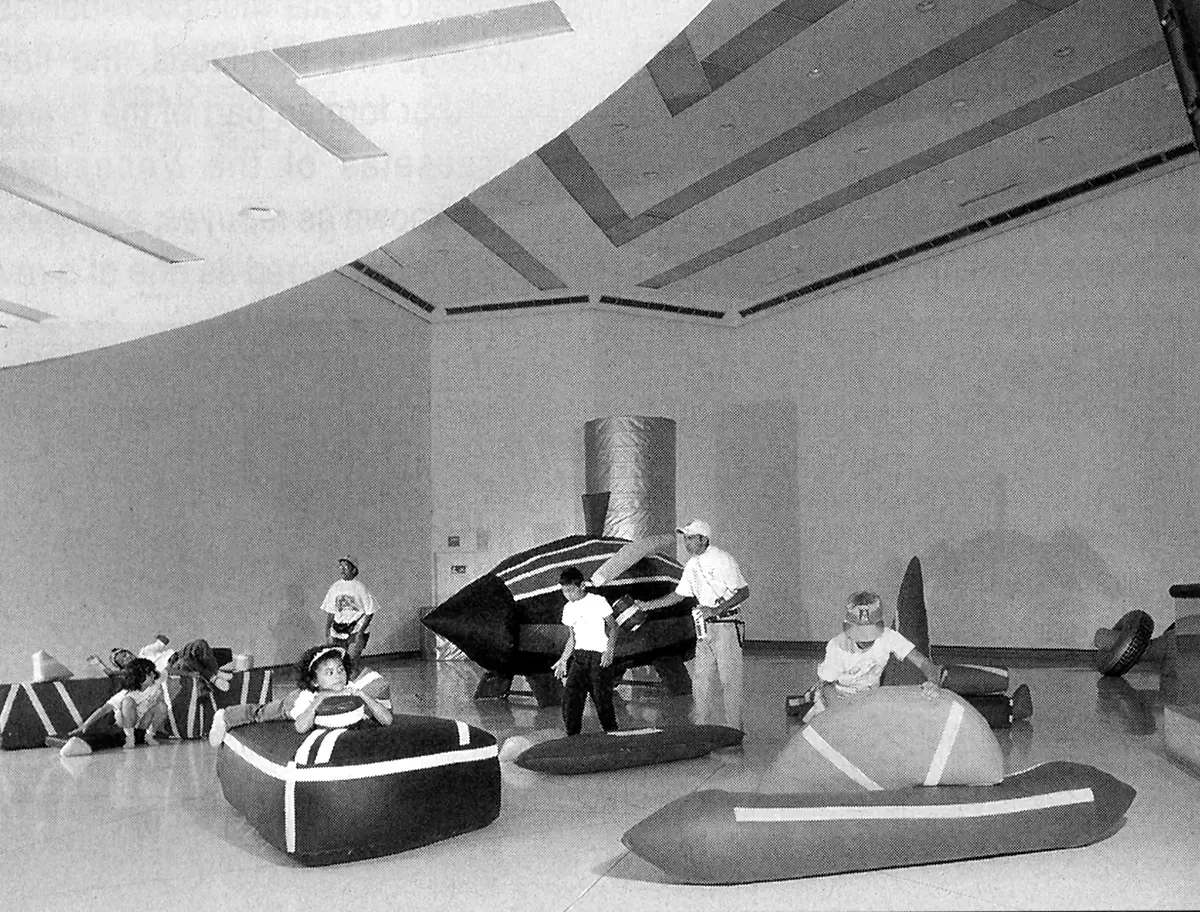
Finally, Colmenarez invites us, once again, to explore the real game and sense of invention of his work. Five soft sculptures, in fabric, plastic, rubber and air, can be recomposed, manipulated, assembled, according to the wishes of the younger visitors to the Museum, who in adittion can inhabit them and become crew members. Their titles are Kleper, Copernicus, Galileo, Newton and Halley. They are like festive and multicolored Zeppelins celebrating the spirit of communication between men.
JUAN CARLOS PALENZUELA