
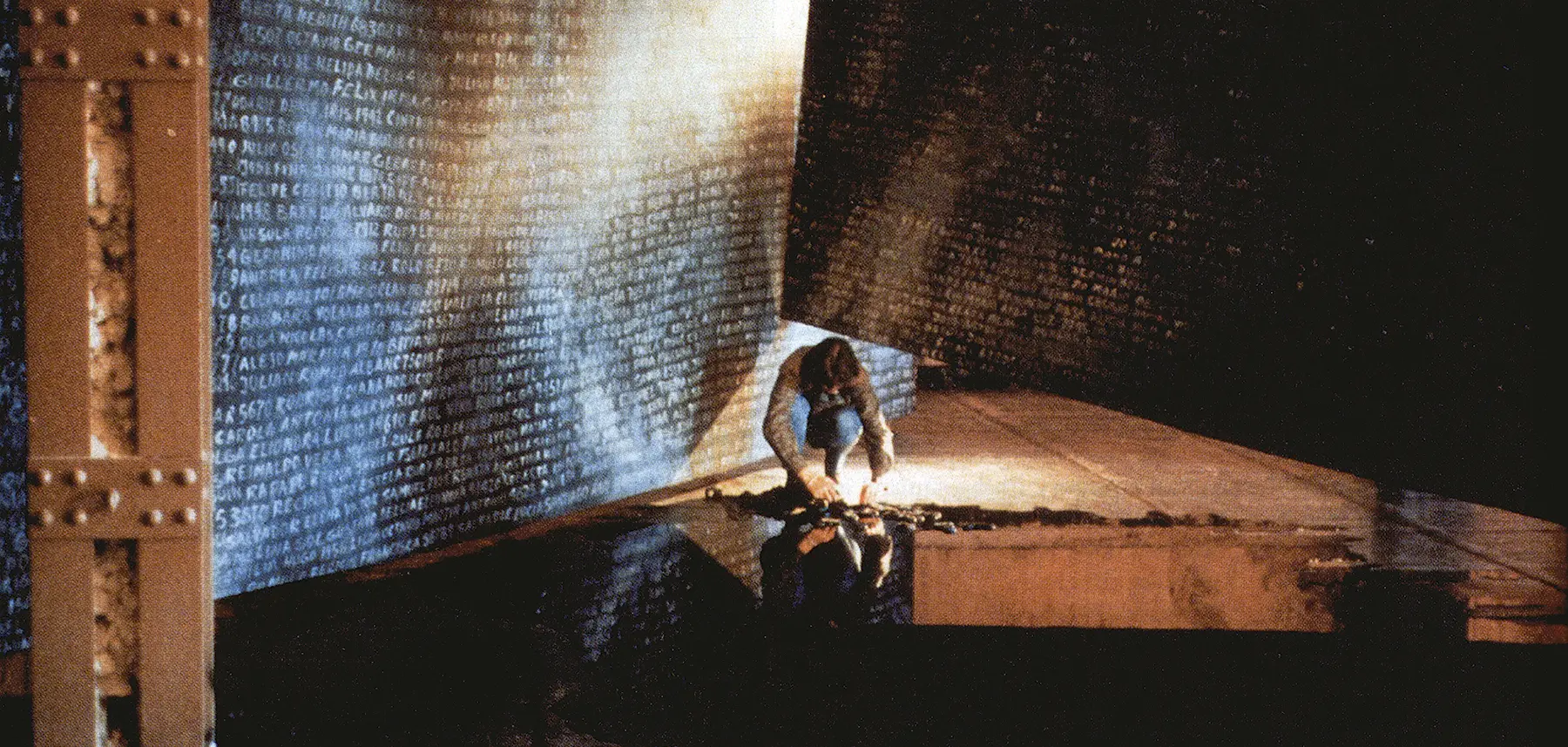
If each artist is the product of his or her time, the works of the Argentine- Canadian artist Carlos Gallardo (1944) inquire and at the same line explore into the time of the artist.
But Gallardo, like any other human being, has two times to take into account: that of his own life and that of his epoch, an individual and a collective time. His works which he calls reflection spaces» are the product of their inter-relationship, since they pro- cede from his own reflection and seek that of the recipient-spectator.
Gallardo abandoned his career as a graphic designer in 1985, to devote himself entirely to painting. He also left Buenos Aires to settle in Montreal, where he has lived since then. «If I had stayed, I would have grown fat and ended up by doing what all the others wanted», he says, explaining his change of country and artistic medium.
It is perhaps this decision which canbe seen as the starting point for Gallardo's discourse. For the «going away» is also a two-fold process: it means leaving the place of his birth and individuality, as well as its kind of collective contribution. Philosophers have always agreed that the individual is both undivided and indivisible. But this is not the case with the collective being. However the artist who projects his own self into the torrent of society reflects in his work those same conditions of the undivided and indivisible being, in an attempt to thwart the dispersion and separation of the collective being.
Although art has no frontiers yet cultural differences are unavoidable between different societies, because they enter into the mode of operation of the artist. To suppose the contrary would be to fetichize the very idea of art and* culture. But Gallardo has managed to resolve the differences between Buenos Aires and Montreal, or rather, he has used them to organize and support his own conceptual message.
Transplanted as he is in Canada, on his own accord, and consequently requiring (a new or different) sense of individuality, Gallardo has recuperated through and within his art the indivisibility which he lost when he left Argentina and abandoned graphic design.
This recuperation has occurred within a different but equally fragmented society; however Gallardo's work, which is undivided and indivisible, agglutinates both the dissemination of the collective being to which he now belongs and the differences between the latter and the former.
Thus all the differences between Buenos Aires and Montreal, Argentina and Canada, disappear in the process. But their disappearance is also due to the artist's search for his own time and that of his epoch.
Let us look more closely at the latter. «I believe that we have reached a point of fracture which in our century had never been so great as it is now», says Gallardo. Social structures, political organizations, the globalization of the economy all help us, as we draw closer towards the end of the century, to escape from the main questions which frighten us: who we are, where we have come from, where we are going, what happens with death...».
Gallardo is a sarcastic and bitter observer in this respect. One of his works reduces to just three physiological actions the life of contemporary man: Eat/Shit/Sleep, (1994) a polyptich comprising four elements, shows a table, a toilet and a bed. These objects seem to be lost in a kind of vastness, which the artist has emphasized with enormous stains. But the fourth panel does not contain any image, in a direct allusion to the loss of being.
I Buy, Therefore I Exist (1994), gives another turn of the screw to current social reality: on a fringe of canvas measuring 260cm. long, male and female names appear, followed by numbers; the former are arranged in order, the latter in disorder. This work repeats its codes in Debit and Credit (1994), where this time the organization is vertical, with a number alongside each name. In both cases, the names and numbers not only refer to consumerism but, in the final analysis, to the «massification» and «thingifica- tion» of man.
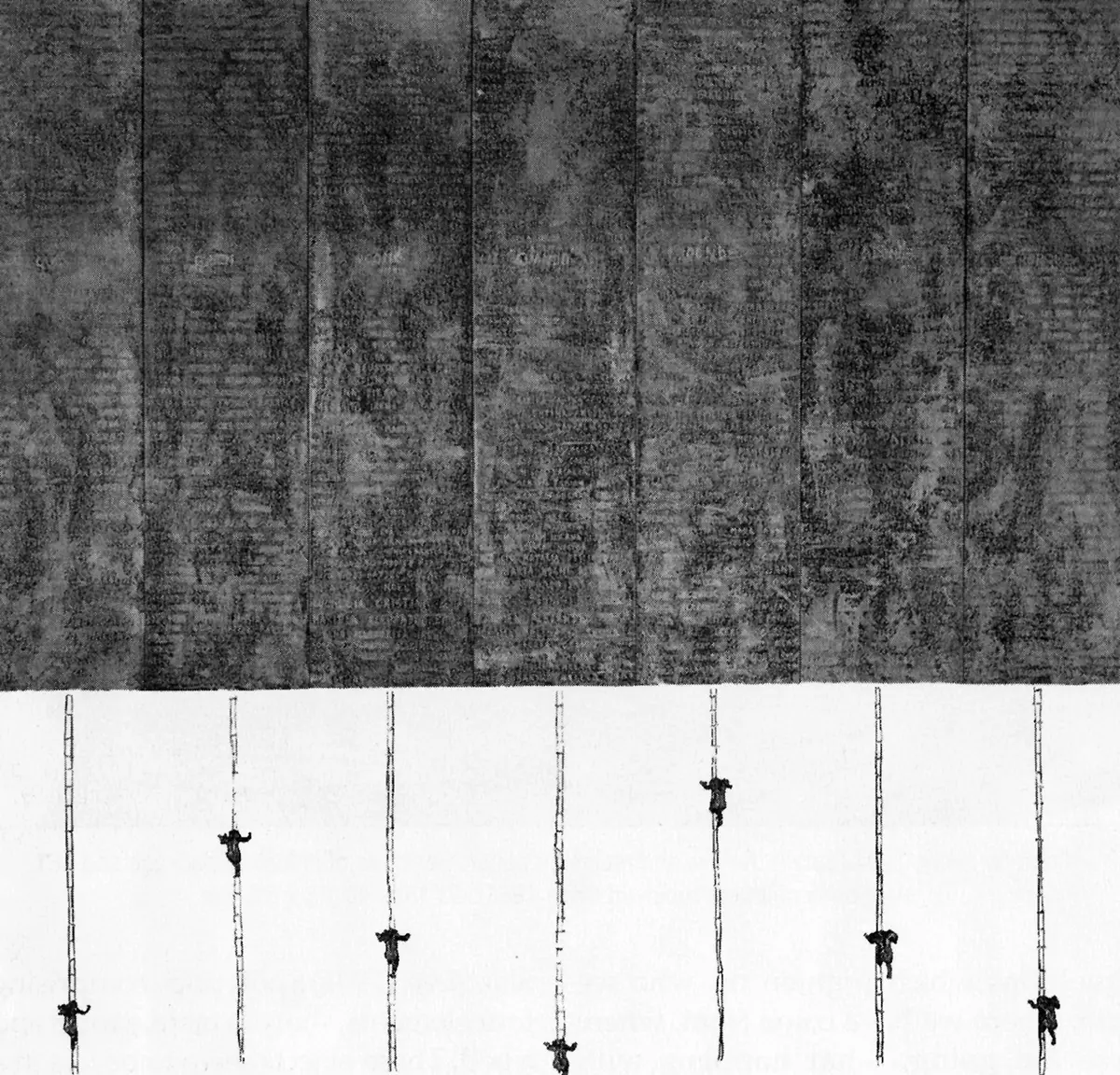
In this respect, The Divine Comedy (1994) is perhaps even more expressive. It consists of a television set which is turned on and sheds a cone of light on a trivial kind of setting; down its base there are some chairs and several numbers; underneath appears hell in the form of a pit of fire, and to the left, a ladder leading down to the chasm, which Dante also describes as being cone-shaped. Gallardo constantly brings us face to face with the questions which we are afraid to ask, or which the world as we know it makes us shun. They are seven in number: what, who, how, when, where, where to and why. For Gallardo, these are the essential question words with which all human beings are faced. Perhaps together they encompass all human life, with the answers multiplying over the centuries. Although lacking in answers, Gallardo tries to find them. A work from 1993, entitled The Seven Questions, presents the questions in seven panels, written on hundreds of male and female names. But in each panel, there is a little resin angel climbing up a ladder. The angels have no religious meaning for Gallardo: they are rather the symbol of something which has not been contaminated. Thus they climb up towards the human beings who; on trying to avoid asking the essential questions, flee from what they really are.
Three works from 1995 go even further: each one consists of six panels, arranged with three above and three below, which contain photocopies of dictionaries, the grammatical conditions and the meaning of six words in Spanish (Gestures and Certainties), English (Sound of Time) and French (L'Oubli).

The Kosuthian echoes in these works, if indeed they exist, stop here: for the linguistic information provided by Gallardo does not constitute the work, but rather the reverse: each panel has a handle, as if it were the lid of a box, and the replies might or might not be inside. Our ignorance about what might be inside is a yet another source of incitation for the spectator who is confronted these word- questions.
In this way Gallardo explores his individual time. While collective time, the time of his epoch, is analyzed in terms of social, economic and political data, individual time es explored through the artist's memory. Memory is an expression of time, one of its more characteristic and unusual expressions. Bergson distinguished between memory as habit or psycho-physiological memory as consciousness or pure memory. For Bergson, the latter supposes the continuity of the person, the fundamental reality, the «essential being of man», who thus preserves his past and updates it into the present. Gallardo's memory is of this kind, and he gives it substance through memory as habit, in line with Bergson's argument.
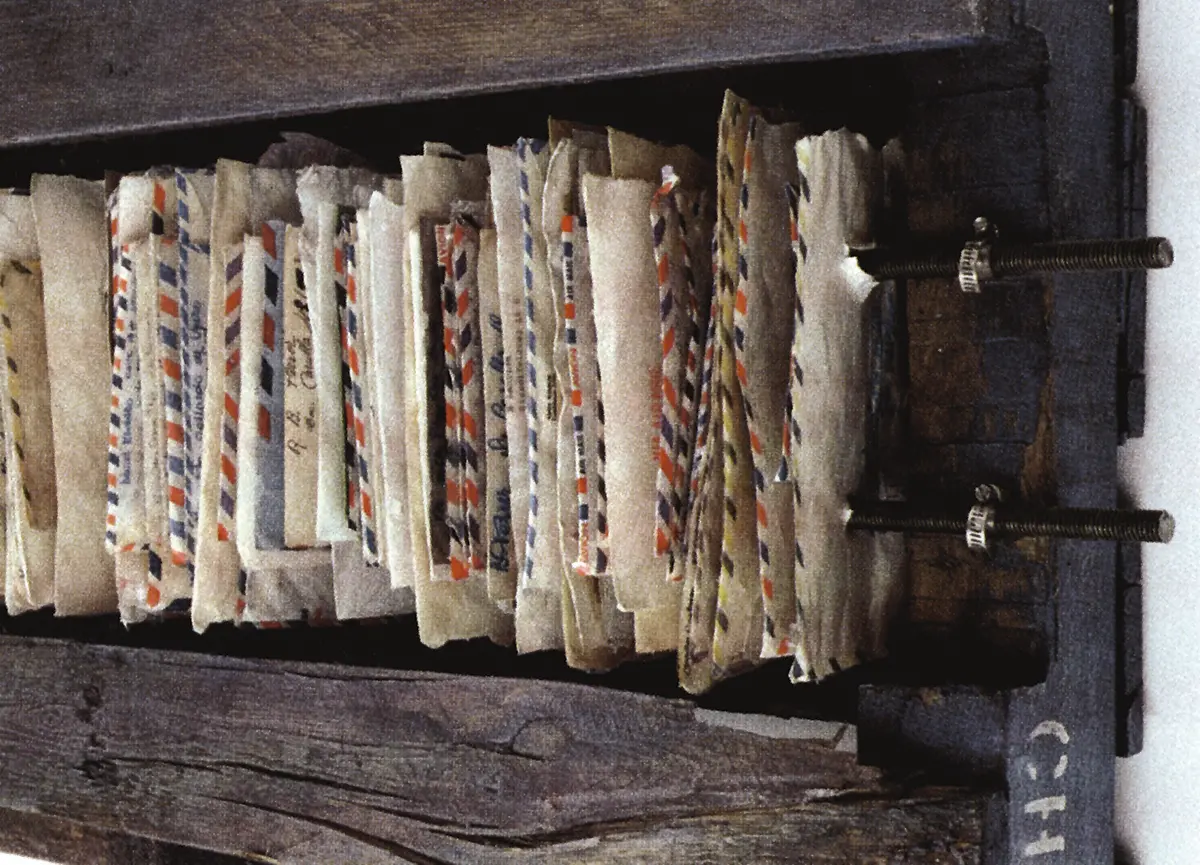
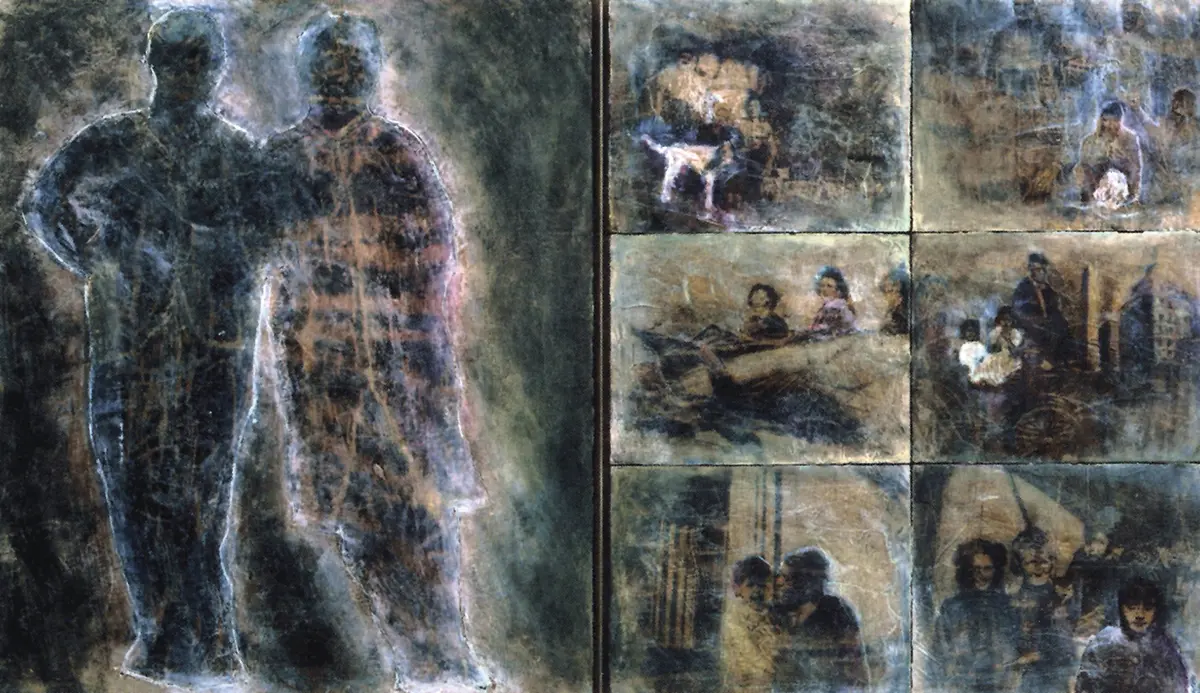
In this way Gallardo uses all possible kinds of testimony: envelopes from the correspondence he has received over the years (From Far Away, 1994), agendas (Out of Time, 1994), letters, notebooks, photographs, school grade books. His series entitled Other Skies (1995) is almost a biography of the artist, made up of images and family objects, which Gallardo places on the support and shapes or distorts with acrylic paint.
These works, whose titles express the experiences which they embody (Substances, Perplexity, Evidence, Chimera, Melancholy, Exiles) transform the artist's individual memory into the general memory of society as a whole. Whereas collective time required the presence of individual time, the latter on the other hand reveals the absence which characterizes our collective time.
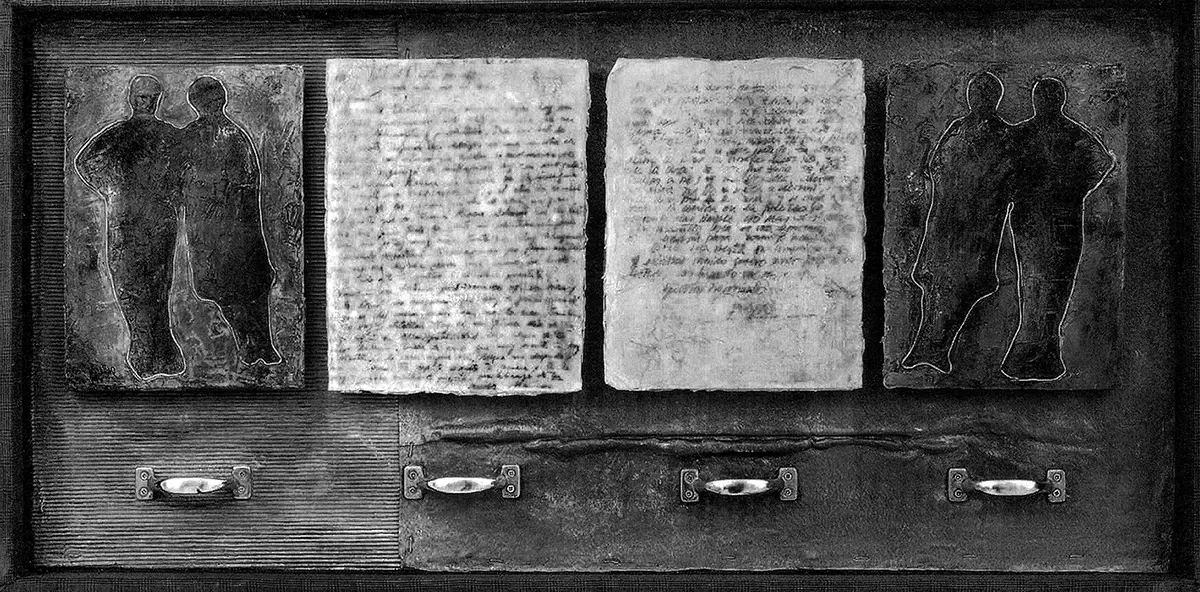
But Gallardo does not restrict himself to family memories or personal objects: handles, screws, clamps, wire, pieces of used wood, marbles all bear witness to the memory of time in his work, like the names and numbers, and the constant use of lead, a metal which was discovered before historical records were first established. In one of his exhibitions, Gallardo referred to the following quotation from Schopenhauer: «No-one has lived in the past, no-one will live in the future, the present is the form of all life» («The World as Will and Representation^ 1819 and 1844). But it is the present which embodies both its past and its future, and it is between these two extremes that Gallardo moves. Because, as Borges pointed out in connection with Schopenhauer, time is the substance of which we are all made.
JORGE GLUSBERG
Argentinian art critic. He lives in Buenos Aires where he is Director of the Museo de Bellas Artes.