
Corina Briceno’s Venezuelan landscapes question civilization’s ability to comprehend the significance of even a single tree. At the same time, they warn us of the irreparable consequences that accompany our failure to appreciate the natural world’s imperatives.
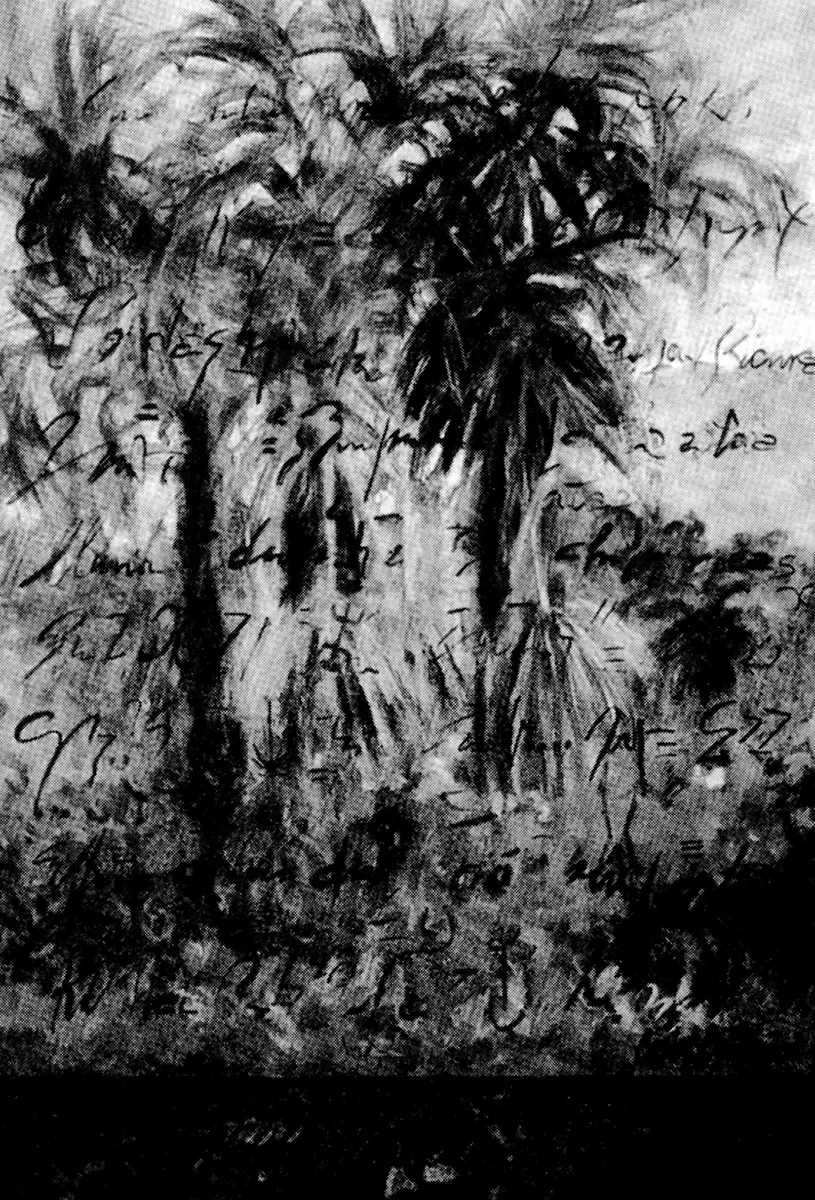
Briceno imposed an apparently scientific text over the delicate tracery of a grove of palms in Textos para formar una palma (Text to Form a Palm). The texts, however, only appear to convey meaning. What looks, at first, like formulas are little more than random letters and symbols. To further complicate the viewer’s ability to decipher this text, Briceno’s lacy green palms assert visual dominance over the emphatic black script of the scientist. Even if the writing had conveyed a description of some botanical aspect of the tree and its surroundings, the reality of the trees themselves would have been obscure to our understanding. No amount of description can ever replace the complex roles the trees play in their setting.
A series of innovative printed paintings representing the ancestral spirits of the area’s tribes convey a similar message. Here, the monsense texts are covered by the engraved surfaces of constructed stone plates bearing pictographs of a monkey, a flower, a plant, a man and fish. The spiritual reality of the thing, expressed through «primitive» ideograms again becomes more «real» than the writing.
Briceno reworks the large scale landscapes she paints on site in her studio using annotations from her journals. These annotations, which appear in works like Odocha jidi y signos (Odocha Jidi and Signs), include both ideograms and words. In this context, her interposition of symbols and landscape suggests a world that includes the visible, but that also extends beyond ordinary perception. Humanity has a place in the world that she paints, but it is a place that affirms our role in rather than our dominance of the whole of creation.
Her most recent works, based on the forms and concepts of indigenous architecture, extend these ideas of interconnectedness. In Atta de espiritus(House of Spirits), the words and symbols used in her landscapes are interwoven into the thatch of the indigenous house, or atta, that dominates the pictorial space. Through related paintings in the series, attas of yuca, ovens, and seeds, Briceno shows that the indigenous concept of the house includes more than a roof, a wall and a floor. It also embraces the life of the house, the agriculture that supports its residents, and the land, sky and water that make agriculture possible. The atta is more than a house, it is a microcosm of the world. The elegiac tone that permeates Briceho’s paintings and prints is still only a warning. Through them, she encourages us to adopt a similarly broad interpretation of the word house -an approach that will help to preserve the physical reality of the landscape that still surrounds us.
K. MITCHELL SNOW