
There is a sector of new sculpture in Colombia in
which the solutions proposed are projected through installations. A variety of
opinions can be seen in which artists comment on political events, examine the
phenomenon of violence, the lack of communication as a sign of the times, the
damage being done to the environment, the exploration of cultural production in
terms of marginalized rites, as well as the debates on such themes as love,
disease and death.
The artistic languages and meta-languages are used to
construct arguments expressed through various materials and the appropriation
not only of a variety of ideas but of the vulnerable and reducible elements, in
contrast to those which are technological and mechanical.
It is in this context that we must place the work of Elias Heim (Cali, 1966), which reflects a concern with the multi-directional problems of his experiences and observations through objects, interventions, transfers, and assemblages which allow him to express opinions on a wide spectrum of contrasting situations in contemporary society.
Heim received his initial training at the Bezalel Academy of Art and Design in Jerusalem, where he won the El Janani Prize in 1990. While still a student, he won a scholarship to follow a course in Munich, where he carried out a work both with and within landscape, camouflaging a wooden structure inspired by the cells of the concentration camp at Dachau in Germany, which he had visited . The transportation of an image from one place to another, camouflaging it and its poetical and sentimental relationship with one's own experiences were themes which Heim had explored in Israel and which he now recreated on the old territory of the Third Reich. His status as a foreigner, both Latin and Jewish, emphasized the impact of the aesthetic Museum of the Holocaust.
When Heim returns to Colombia after his course with Eduardo Paolozzi in Munich, he is impressed by the Choco and the architecture and characteristic elements of the Noanama indigenous community. The ladders made with a single tree trunk, with their rounded, minimalist design, reminds Heim of Brancusi. In 1991, Heim presents his first exhibition in Colombia (Jenni Vila Gallery,
Cali, Gaula Gallery, Bogota), with work which explored different arguments concerning the problems of art, such as materials, conformation, museography, etc.
The coherence of his works shown in the sample lies in
the reflection and intelligence with which he materializes his ideas, and at
the same time questions their own elaboration. The light boxes with photographs
of the indigenous creators of the ladders, and the objects themselves, embodied
a proposal which was not only of an anthropological kind but which referred to
documentation and physical dependency as supports. This work, which underscores
the idea of a trophy, is made up of three parts, with a real and photographed
image, and entitled Souvenir. In another work, entitled Preservative, Heim
ironically transfers the waste material from a workplace and enshrines it in a
metal box, so that the museographical element becomes more important than the
object exposed. Heim had already carried out work along similar lines in
Israel, based on the aesthetics of Anthony Caro and Mario Merz. A third theme
was presented in the Portable Box for Instantaneous Exhibitions, where the
objects suggested images of a subversive, political, and mental game, reflected
in other frames with cuttings of dramatic scenes: buses and houses burning,
public demonstrations of protest, all rationalized in geometric planes - a
social phenomenon seen in terms of a formal structure.
In 1992, Heim shared the prize at the Museum of Modem
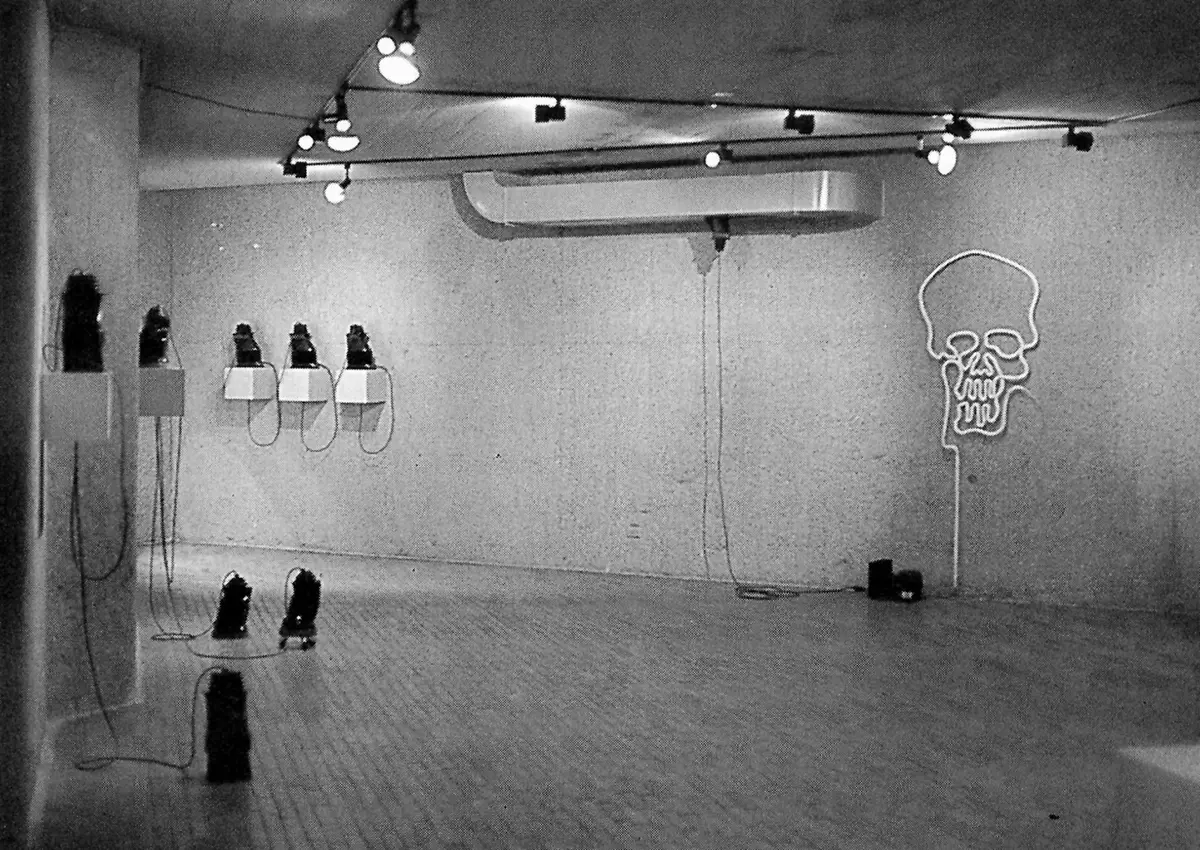
Art Biennial in Bogota for his works entitled The Teacher of Celan and Trainer
for Curators. The latter associated useless objects with strategic instruments
for mounting and arranging works of art in the temple of the museum. The black
rubber dummies and the impeccable metal boxes, arranged like shelves and over
the floor, were intriguing and beautiful utensils. But The Teacher... was more
concentrated and required greater expressive richness. A copper tube emerged
from the hermetic system of the air conditioning apparatus and sketched out a
skull, fit to concentrate the humidity of the environment and to produce an icy
tone to the work. The piece was a recreation of Celan's idea, the Death is the
Teacher of Germany, a receded commentary in order to illustrate our own
violence. At the same time, Heim is interested here in relating the
Judean-Christian and the German-Colombian elements in his work, through the
sensitiveness of the object which reacts, changes, and lives. The work becomes
transformed and survives, although its form is death and its purpose
self-protection.
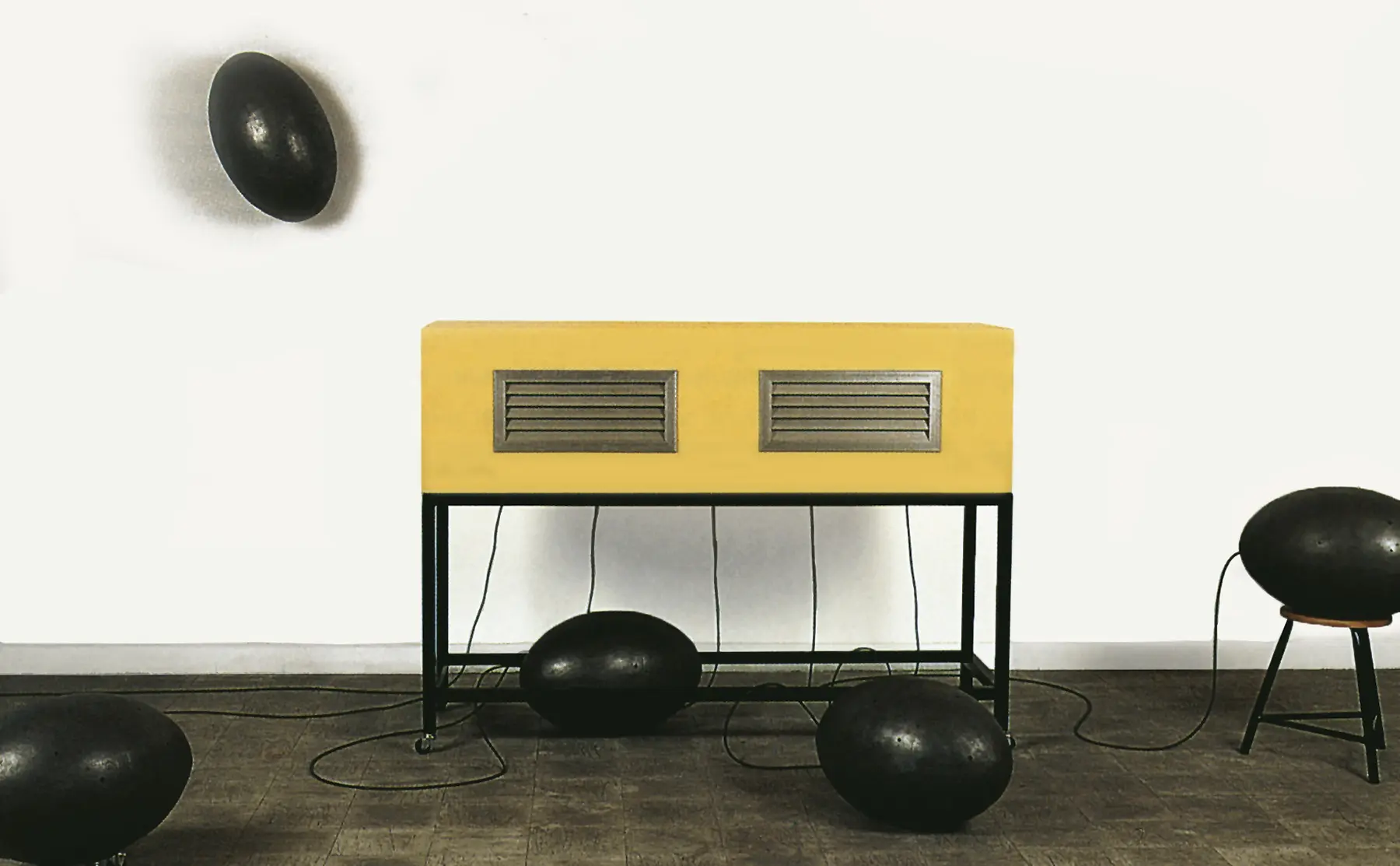
Also in 1992, Heim participates in the XXIVth National Salon of Artists with a work entitled Portable Cooler for Works of Art, a powerful and minimalist object which formally evoked the spirit of a cooler, with eggs in fiber glass, a reference to the animal world. It produced the sound of an air conditioner, but without really cooling. It was the nostalgic sound of a false air conditioner. Heim was here making a dry and humorous allusion to art for art's sake.
In 1993,1 organized in the La Tertulia Museum of Modem Art an exhibition of installations which included works by 12 Colombian artists from recent generations (including Miguel Angel Rojas, Alicia Barney, Fernando Arias, Doris Salcedo, Pablo Van Wong, Becky Mayer, Jose Alejandro Restrepo, among others), who all presented special or selected works. Heim produced a clear and alert piece, which coherently reflected his interests in such topics as exchange, conservation, physical life, and active and mechanical functioning. His work was entitled Inter-Museum Hybrid Flora, which was conceived as a large mechanical plant with materials from two contexts serving as its support. (1)
Heim described the work as follows: This work explores such concepts as foreign influence, contextual revitalization, and a kind of agglutinating phenemonon of joint external proliferation. These concepts are seen in a physical way and encourage the implantation of a portion of «living» tissue extracted and moved from the Museum of Modern Art in the city ofDusseldorf into a deep wound or open and receptive tissue in a Museum of Art in South America - an attentive watchtower of the changes and fluctuating attitudes in cultural phenomema abroad.
Inter-Museum Hybrid Flora was initially installed in the place which gave it validity and meaning as such. At the same time it originated its theory proposed as a useless vehicle, but which also becomes necessary in its reflective context. But it is also a work which recreates the monumental kind of botany: a plant on the offensive against the innocent, both baroque and ludic. The mechanical elements concern the periods of operation, ventilation, the swelling up of the petal-bellows characterizing these processes of a vegetable kind.
In 1992, Heim also participated in the Regional Salon of Pasto, with a work entitled Endowment for Museums Threatened with Extinction, an anthropomorphous work reducible to a mechanical and erotic world, in which the sound of the air, the antisceptic coloring, and the humanoid reference created an impression which was both critical and acute. This figurative and-emotional work won the First Prize at the event. (2)
In November 1993, the La Tertulia Museum of Modem Art of Cali presented Heim's second one-man show in Colombia. This time, the artist examined the area of the Museum and for the Collection Room planned three large works which in fact complemented one another and highlighted the characteristics of the exhibition area. They were works of place for the place, although they contain memories, experiences, and nostalgic allusions from cities through which the artist had travelled: Dussel- dorf, Venice, New York, and Cali.
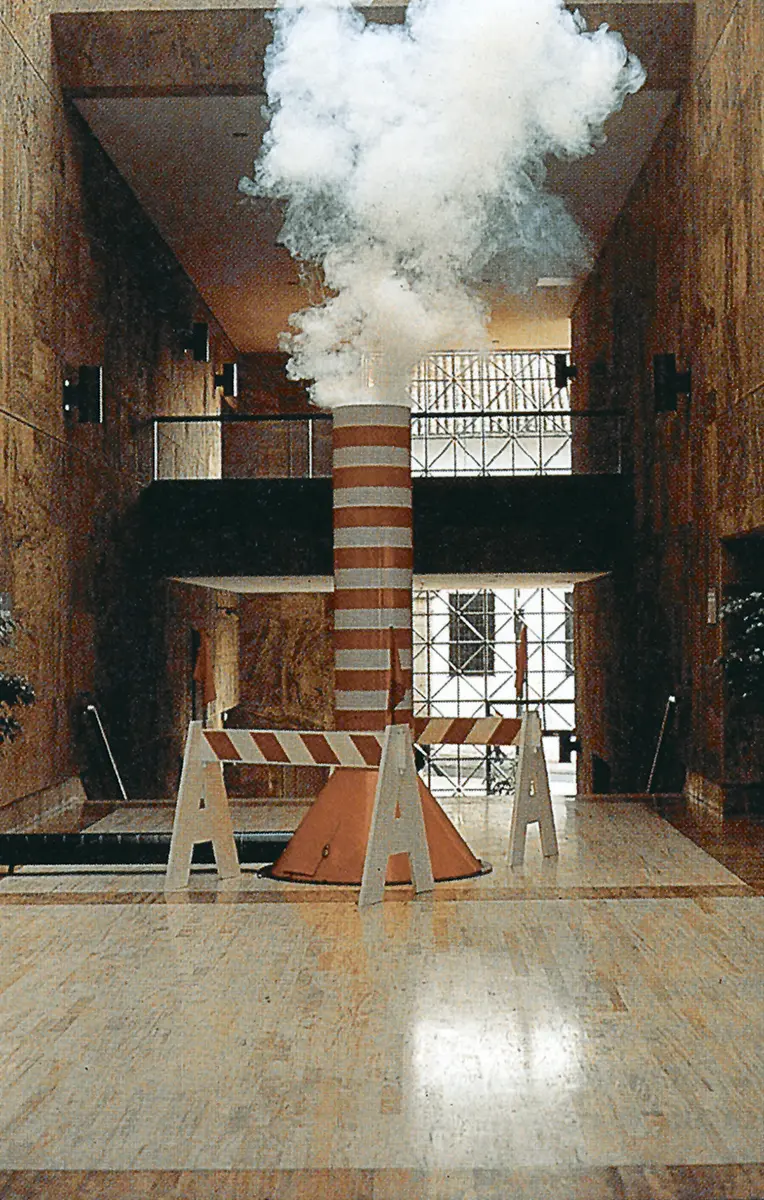
Extractor of Accumulated Atmospheres(3) consists of three large cone-shaped suction devices, connected together by flexible tubes placed at three typical places in the exhibition area: the wall, the floor, and pointing towards the void between the two. The connected conic forms refer to a mechanical floor cleaner, an air extractor, and an illuminator (with intermittent light). The internal atmosphere is projected outwards through a chimney giving off white smoke. The reference here is to the memory of works of art which have been exhibited in their enclosure, the memory which we have of them. Heim materializes this experience in the objects he selects, and with which he tries and wishes to inspire a .poetics of mechanical forms, questioning the very setting which he is projecting.
Extractor of Accumulated Atmospheres is an internal
and external contemplation. It uses implements and mechanical actions to
explore the references of a predetermined artistic environment. The place gives
power and strength to the work. The suction device is finally seen in the
chimney which gives off white (papal) coconut-smelling smoke.
Automatic Museum Drill proposes a mechanical breaking device which on the basis of an anatomical pattern strives towards expansion and the generation of new space. This exercise in spatial expansion is proposed in an erotic manner. The machine sexualizes the setting and tries to stimulate it, make it bigger, and awaken physical ambitions. Placed in the center of things, it draws attention to its necessity and presence in the only place where its existence is logical. Although it is an autonomous entity, it is related to the other figurative elements and the action of the parodistic machines.
Echoes of a Venetian Game is one of the most ambitious and successful works by Heim to date. It was inspired by the flooding of the La Tertulia Museum of Modem Art in Cali a decade ago, when the river broke its banks. Heim relates this event with the constant invasion of Venice by its lagoon.
Heim is interested in both the text and context of artistic work, and this piece is nurtured by both these facets. The six fishermen appear as restorers, assistants, or nurses of art who are there to symbolize the redemption of the place exposed to the risks, hazards, and deterioration caused by nature. These ghosts of salvation protect, like guardian angels, the sacred place of the museum, creating a ritual, religious, and sacramental air in the midst of inevitable sarcasm, with a humor which encompasses all Heim's works and is part of their spiritual essence. (4)
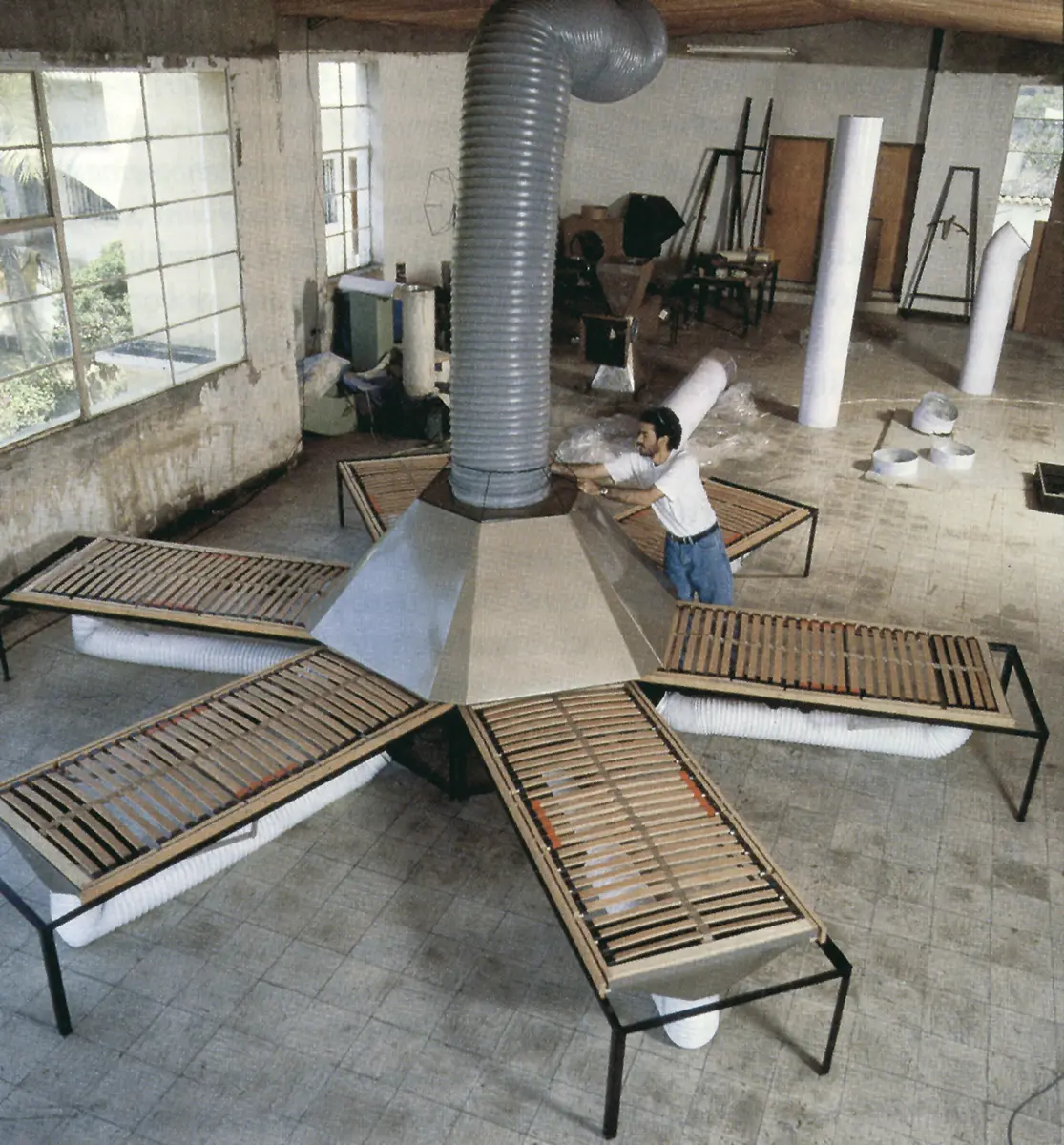
For the last Bogota Art Biennial, he designed his most recent project, entitled Consoler of solitary spaces. Sinthetic evocation of an overturned tortoise, Narcissus. It consists of an apparatus in metal, plastic, wood and aluminum which refers to the museum and its relationship with the public. The aparatus functions as a prosthesis which circulates still and compressed air, symbolizing presenceand absence. At the same time the image evokes the myth of Narcissus, with petals (beds) which stretch and shrink and a stem (phallus) which activates and set the apparatus in motion. Similarly the allegory evokes a tortoise, a creature which if overturned on its back risks danger and death. The duality between life and death, danger and risk is also a political and sarcastic opinion which Heim is interested in exploring. The artist has said that this vital synthetic fact is the source of movement in the work; rather than and added formal characteristic, this movement is the existential response to an anomaly. Indeed, this marriage between the inverted Narcissus and the overturned Tortoise stimulates the museum and makes it quiver with potential and definition.
Elias Heim is an important figure in the contemporary
production of sculpture in Colombia and represents an important alternative.
His proposals concern not only the use of dissimilar materials and processes,
but invite us to think about art in terms of ecology, technology, and semantics
as clear indications of an art which is addressing the problems of the next
millenium.
NOTES
1. With this work Heim represented Colombia at the San Giovanni Church Pavillion (Italo-Latin American Institute), at the Venice Biennial in I995.
2. Endowment for Museums Threatened with Extinction is now part of the collection of the La Tertulia Museum of Modern Art of Cali.
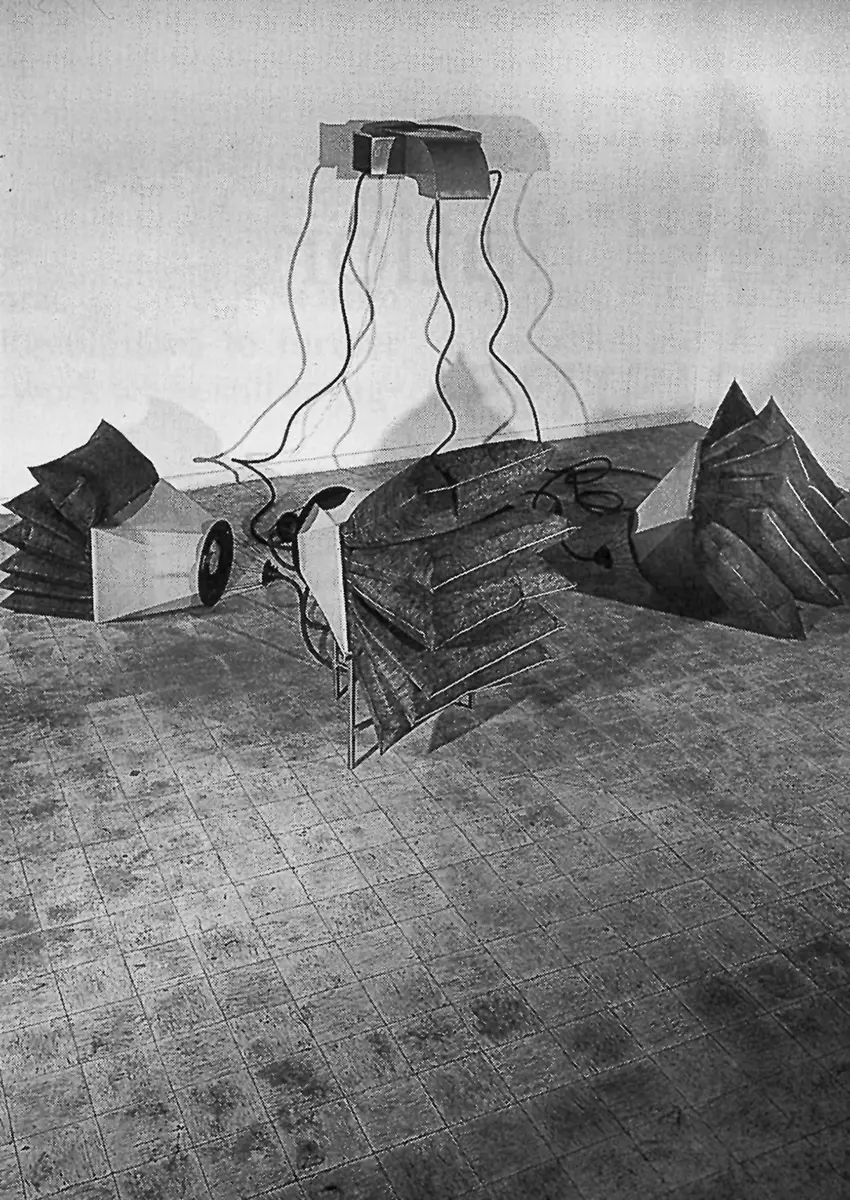
3. This work was included in the show of New Names of the Bank of the Republic at the Luis Angel Arango Library in Bogota presented between January and March I995, along with a video installation by Ana Claudia Munera.
4. This exhibition, with the same works, was presented
at the Museum of Modern Art of Bogota in July-August I995.
MIGUEL GONZÁLEZColombian art critic. Resident in Cali