
Since 1970, Fabio Herrera has displayed an intensive activity through a series of exhibitions, the fruit of his relentless and copious work characterized by the versatility of his media and the plastic and thematic concepts which he has explored. The artist, who is conscious of all this, has said: «lam inspired by everyday elements and use different materials so as to have and expand in my pictorial possibilities. I like to feel that I am a free painter».
After the show of his work from 1993 to 1996 at the Museum of Costa Rican Art, Herrera recently presented his most important latest paintings at the gallery which is run by another major Costa Rican artist, Roberto Lizano. The show was entitled Primitive, a title which might suggest the essence of the works presented, whose concept and main themes referred to certain images, both abstract and semi-figurative, linked with magic, rituals and conceptions of the cosmogonies of rupestrian culture. But they are also related to many of the tendencies which have characterized the work of the «new savages». In his paintings, Herrera includes real fragments, taken from everyday life and from his existential interests, within an artistic structure which oscillates between gestualist abstraction and conceptual representation. The gesture and stain are two basic formal elements in this painting, subject to the world of nature and the vision created by the artist throughout his career. It is a vision which takes him towards abstract expressionism, and to which he has added figurative elements of representation.
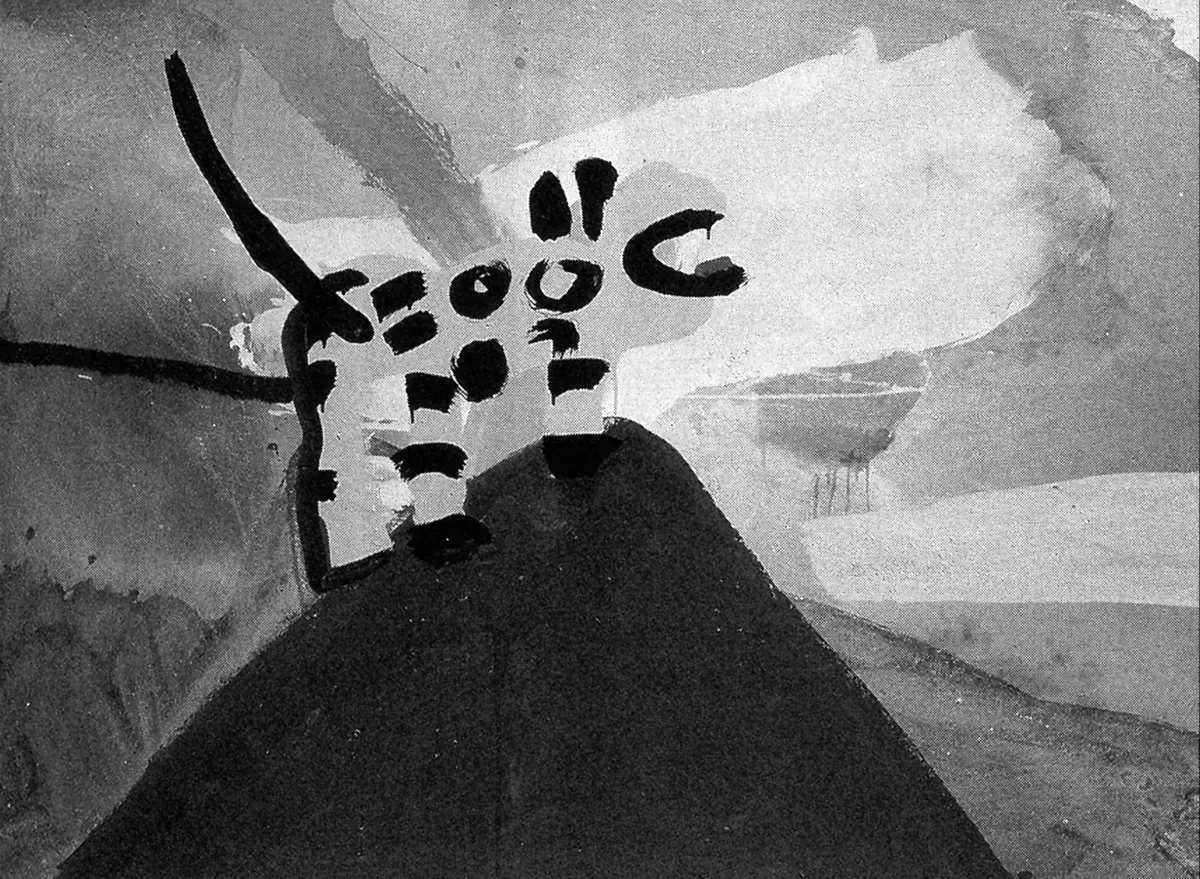
Because of this thematic unity, which is identified more than visually by the titles of the works, Herrera’s painting can be seen as a response to sensuality. The conceptual control is evident in the handling of pictorial space. Stains and gestual brush-strokes of painting of different sizes move and roll around the support, coming together simultaneously in the background and surface of the support to form an extremely dynamic texture. The stains and traces of color move forwards and backwards before the spectator’s eye to create non-conven- tional perspectives. The referential figures, such as the shadow of the head of a bull, a jaguar or the summary image of a horse, help make the texture of the brush-strokes even more complex.
Herrera has interested himself in many themes, beginning with water colors and landscapes and the adobe house as part of a vernacular Costa Rican architecture. But the continuation of an artistic tradition did not in his case become one of his objectives. Little by little Herrera freed himself of certain bonds and in an almost demiurgic act concentrated his talent on the observation of certain fragments, interesting pieces, which more forcefully expressed the essence of a given landscape, or the walls of a house. His objective was to seek out the spirit, the soul of a part of man and his surroundings. In this way he gradually moved towards abstraction. The stains, graffism and gestual strokes little by little replaced the naturalist figuration. The investigation of materials soon followed, with collages in rich textures on different kinds of supports. Each stage seemed to be the synthesis of all the preceding ones, not so much in that they showed a purification of pictorial space, but because they brought together many different plastic and thematic interests. The artist gives particular attention to the visual richness of his surfaces, with texture being an essential part of the plastic proposal.
The paintings on show can now be considered as a synthesis of his art. The abstract-gestual elements are related perfectly with the figurative elements, since the latter also reflects an abstract vocation which has permeated Herrera’s art since the time he abandoned his pictures of landscape and the adobe house. Reminiscences of ancestral atmospheres is what closes him to the essential cosmogonies of pre-historic culture, or rather to pre-Hispanic culture. Herrera’s work is an attempt to capture a cultural essence, a decantation of the many different cultural inter-actions which he has had to face, in his training, his travels and his long study and work periods in countries with a high level of cultural development.
BELGICA RODRIGUEZ