There are two Venezuelan artists of pronounced figurative language and who differ substantially in this respect from others of their generation and from what might be called, rather audaciously, the aesthetics of the times: they are Felipe Herrera, a painter, and Alexis Mujica, a sculptor.
Both Herrera and Mujica have been present on the Venezuelan art scene for more than twenty years. Their first influences date back to the I970s, heavily characterized by the militant features of figurative art, drawing and the investigation of the individual and the city. That period of re-examina- tion was dominated by Cuevas at the continental level and by Borges and Regulo within Venezuela. Both Herrera and Mujica began to frequent the salons, participate in group adventures, although curiously, neither had many one-man shows.
The Exhibition Hall, on the ground floor of the Ministry of Foreign Affairs "in Caracas usually presents shows and the one entitled The Axe and Its Shadows, has been one of the most ambitious which it has presented to date. There were in it eight works by Herrera and ten by Mujica. Both artists share an emotional kind of humanism, an interest in the passing of time and the feelings of isolation, the discours of figures and places. The works were presented by the poet Eugenia Montejo.
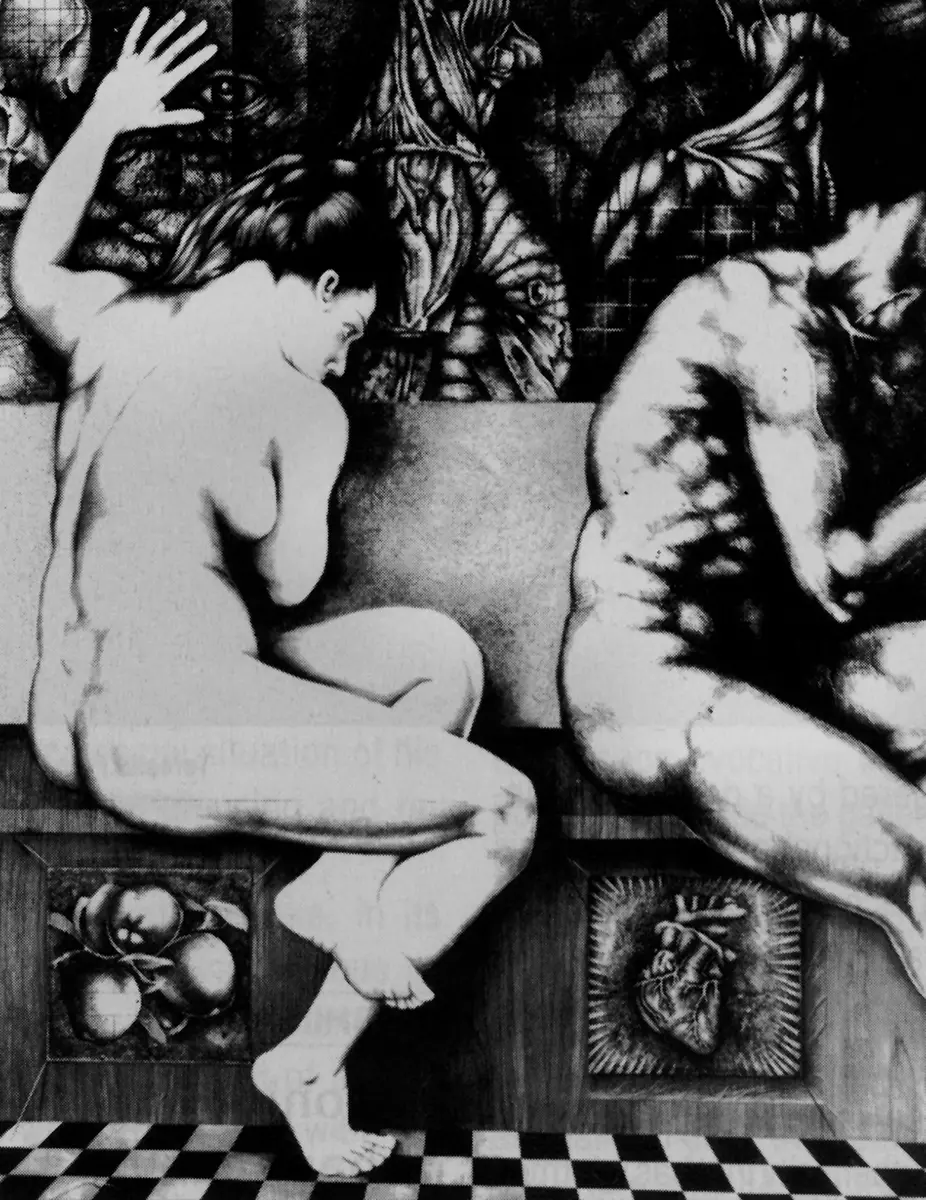
Felipe Herrera uses the techniques of painting, drawing, sculpture and collage. His support is wood, with some areas being flat and pictorial, and others including real objects, with the rest being in low relief. The overriding notion is that of a polyptych.
Herrera seems to explore the world of the academy - whether Venezuelan or international - of the last century to fix references and establish the mythology of his own interests. In this way the iconography of Cristobal Rojas becomes his personal guide in his obsessions and reiterated studies. The
Arm, a classic work by the master, is shown as such, like an anatomical drawing in relief. The work, in the form of a suitcase, has compartments which can be opened to show other “pictures” or scenes.
Figures of the Italian Renaissance, a Siennese range of color “in earth temperature”, as Herrera would say, an insistence on the checkerboard - and by extension, the sense of play, the challenge of opening doors, the eye ever present, as an object, something portable, a scientific drawing, an organ or a sacred symbol, and the heart which is painting or volume, bloody, with thorns or like a piece of meat - everything will refers to time, its weight and rationality, occult passions and the transition from one plane to another.
Alexis Mujica’s sculptures, consisting mainly of figures and dogs, combine wood, chains, or tilling instruments as metaphors of death, of useless violence or everyday fantasy.
His models appears in situations of duality: inside-outside, forwards-back- wards. We are never sure and this is the intriguing and indeterminate part of his work. Where are these beings? On which side of excess?
This oscillation between one reality and other is felt not only because the individual appears before a closed door (entering or leaving?), but because of what covers his body: his skin or his clothes, it does not matter and has the same value. The figures seem to be naked or half covered by a skin which is a caparison which is a void. This work speaks of the desolation of being, the sculptor’s real subject.
Mujica’s work oscillates between the unknown and the unfolding of tension. Insistently, his dogs seem to be on the point of attack, while the children “play” with a pistol.
Now the artist incorporates the female figure into his thematic repertoire. This brings a false sense of calm, since the scars, the marks of anger reflected in the female faces speak clearly and silently in the comings and goings of existence.
The dialogue between both artists is based on the overwhelming nature of things around us, the sense of vivisection, the “sensitive closeness”, as the poet Montejo would say, of the otherness. Of the unknown which lies waiting.
JUAN CARLOS PALENZUELA