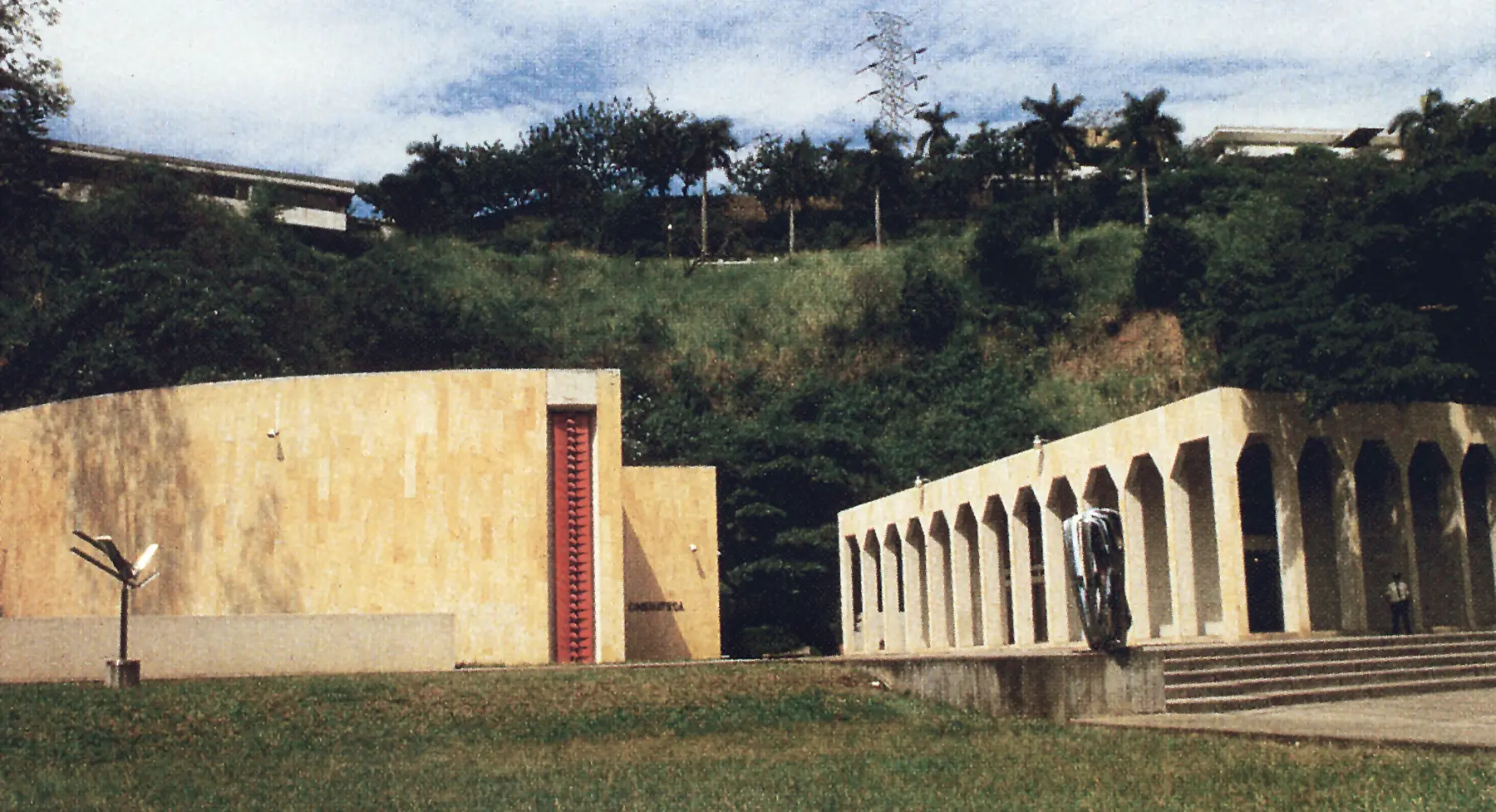
A though the La Tertulia Museum in Cali was founded on 9 March 1956, its fortieth anniversary was commemorated only in September last year. During these four decades, the institution has carried out some extraordinary work, to the point that today it is without doubt the country's most important museum of modern art. Such a conclusion is based on its presentation of such major events as the graphic arts biennials covering the Americas, which ran to five editions and achieved an international reputation (the last was in 1986); the salons of young artists, initiated in 1972, which subsequently be came the Marta Traba salons, specializing in photography and video (the last was in 1989); the many exhibitions based on its own collection, as well as other historical exhibitions, such as Painting and Sculpture in the 1930s, and the exhibitions focused on specific procedures, such as Colombian Sculpture, Twelve Colombian Sculptors; Small Format Works, historical situa tions —Avant-garde Cali (1974)— and trends —Pulsions (installations and objects) (1993)—; as well as publications such as Marta Traba’s Historia abierta del arte colombiano (1974), the three volumes of the catalogue raisonné of its collection and a number of exhibition catalogues; the acquisitions of its permanent collection, specialized in the graphic arts and with excellent works ranging from Canada and the United States to the countries of the Southern Cone; its cinematheque programs, children’s workshop activities, a workshop for the restoration of art works and extension activities in the marginalized neighborhoods of the city.
For its celebrations in 1996, the Museum presented two exhibitions: The Representation of the Body, with work by 32 outstanding artists from its colection (including Tamayo, Segui, Dittborn, Milton, Caballero, Santiago Cardenas, Beatriz Gonzalez and Lorenzo Jaramillo), which explored the theme of man through various attitudes and behavior, and Allegory and Reflection, also with work in different techniques from its own collection, including major pieces by Lam, lanelli, Porter, Soto, Nevelson, Ruscha, Negret, Obregon, Roda, Ramirez Villamizar and many others. The Museum also recently launched the third volume of the catalogue raisonné of its collection, which currently totals 1.355 works, including sculpture, objects, paintings, drawings and above all prints. This publication, which reproduces hundreds of work in full color, included a selection of texts prepared by Miguel González, assistant to the Presidency. The artists include Pedro Alcántara, Leonard Baskin, Miguel Bresciano, Luis Camnitzer, Santiago Cardenas, Fernando de Szyszlo, Hernán Diaz, Fernell Franco, Alberto Gironella, Beatriz González, Eliam Heim, Manuel Hernández, Lorenzo Jaramillo, Becky Meyer, Negret, Ramírez Villamizar, amongst many others.
Since the museum's beginnings, its driving force has been Maritza Uribe de Urdinola. At her side for many years has been Gloria Delgado, President the first and Director the second, both have carried out, without any prominence, an exemplary and commendable work that, of course, has not ended. Thinking about the next century, they are already announcing the new expansion of the institution's well-designed spaces. In the near future, Lago and Sáenz, the usual architects, will build a three-story building where there will be a library, another exhibition hall, a warehouse, a cafeteria and parking lots. We hope this will be the case and congratulate them sincerely.
GERMÁN RUBIANO CABALLERO
Profesor Emeritus. Universidad Nacional de Colombia