During a torrential October downpour, the third
edition of the Painting Biennial of the Caribbean and Central America opened
its doors to the public at the Museum of Modern Art of Santo Domingo. The event
was organized and curated by Porfirio Herrera, Director of the Museum, with the
assistance of his team and the curatorial assistance of the art critic Marianne
de Tolentino, Director of International Relations of the Museum. With this new
edition and the difficult circumstances in which it was organized and
presented, the Biennial continues to project itself as the history of the
future, with its illusions and disappointments, and has endeavored to reaffirm,
not always successfully, the values of the traditions of the participating
countries, their artistic definitions, thematic repertoires and aesthetic
concerns.
That being said, I should like to emphasize the importance of the event in promoting knowledge about artistic activities in this part of Latin America, activities which even within the region are practically unknown. It is also important to establish comparative possible options between countries and their opening up to other artistic codes, through the adoption of serious analytical and critical positions and the clarification of the different levels of cultural development within which each operates. It is not just a matter of considering them in terms of countries which are «open» or «closed» to foreign cultural influences, as established by Marta Traba, but seeing how their economic development has been dramatically different, and how this in turn influences their artistic production.
As regards painting, the Biennial is limited to a
discipline which is indeed showing signs of exhaustion in those media in which
there has been little reflection on creation as a human endeavor or on the
study of the problems of art and the analysis of these problems in the light of
the critical circumstances affected by a country at a given moment in its
history. In most cases, the objective is to broaden the art market - a very
important aspect is the above-mentioned points are given creative and positive
attention.
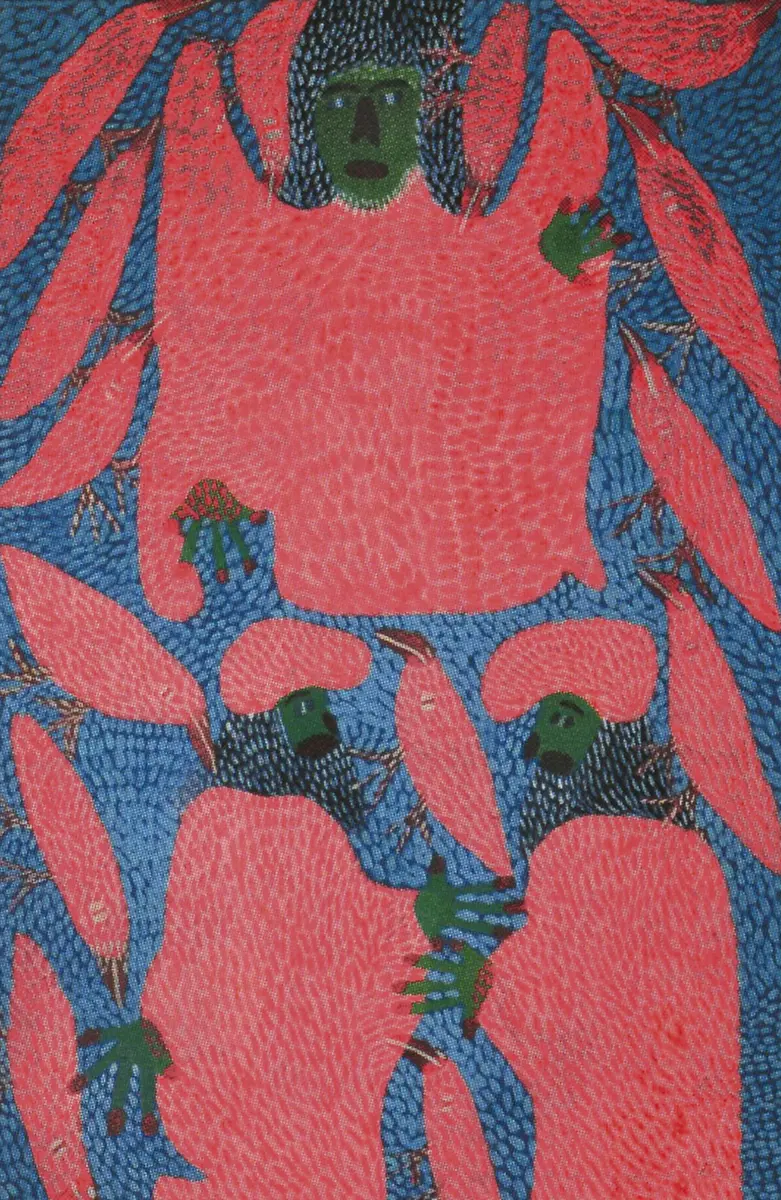
As regards the pictorial representation of several'countries, it must be said with some concern that the event did not even remotely illustrate the quality and strength of their painting. Clearly this is due to the fact that invitations to participate in the Biennial are generally made through official channels, which is a careful way of proceeding, but the persons designated or acting as curators in such cases are not experts in the process of selecting works. It is a pity that countries which have achieved such a dynamic and broad-ranging production as Venezuela, Mexico and Colombia had been so poorly represented. The fact that an artist from Venezuela had obtained a prize does not redress this situation. A better role was played by some countries from the Caribbean and Central America. In fact, the mentions for the best national representations went to Haiti, Barbados and Cuba, and the exhibits by Honduras, Martinique, Nicaragua and Curacao were also noteworthy.
It is always difficult to analyze events such as a
Biennial. In general, their collective and multinational character emphasizes
certain aspects which lead to an uneveness in the quality of the works on show,
as well as differences in formats, media, techniques and even the presentation
of the works. This last point is particularly reflected in the comparison
between large countries with highly developed economies and smaller and
economically weaker countries. Such a situation necessarily affects cultural processes,
and in a perverse way has particularly negative and primarily commercial
consequences in some cases rather than others - for example, in some of the
Caribbean islands, such as Haiti, where the valorization of the naif tradition
has led to a kind of paralyis in innovation. Fortunately, some artists have
been able to break out of this line, such as Sacha Tebo, Philippe Dodard and
Edouard Duval Carre, three magnificent artists who were quite rightly the
special guests of this third edition.
The Biennial did not reflect any dominant tendencies or styles. There was a predominance of eclectic figurativism, in which a number of artistic and extra-artistic factors led to postures reflecting the inconsistency of post-modernism. At the same time, other artists who did not exactly come from the «major countries» made proposals with a sense of propriety and without any stridency that were situated between the sense of tradition and rupture: once again, we can mention here the above-mentioned Haitian artists, as well as Isabel de Obaldia and Roosevelt Diaz, a special guest of the Biennial who presented a one man show, both from Panama; Ines Tolentino, Grecia Rivera and Mariano Sanchez (Dominican Republic), Francois Bonnier (French Guyane), Tina Spiro (Jamaica), Armando Marino (Cuba), Roberta Stoddart (Jamaica), Barbara Joyce (Saba), Gerville Larsen (U.S. Virgin Islands), Patricia Baffin (Martinique), Walter Iraheta (El Salvador) and Winston Branch (St. Lucia). Special mention must also be made of Honduras and Nicaragua, countries which although they were not awarded any of the mentions for national representations, did play a stupendous role in the excellent quality of the artists they presented. Seven artists from Nicaragua - Orlando Sobalvarro, Efren Medina, Roger Perez de la Rocha, Hilda Vogl, Genaro Lugo, Luis Urbina and Alfonoso Ximenez, and eight from Honduras - Virgilio Guardiola, Alfredo Martinez, Armando Lara, Ezequiel Padilla, Oscar Mendoza, Xenia Mejia, Bias Aguilar and Victor Lopez, all illustrated the imaginative energy characteristic of painting in their respective countries.
Just as it is difficult for an event of this kind to
maintain an overall high level of quality throughout, so the task of the jury
is no less difficult. It is not easy for nine persons to reach agreement on
such matters - and neither is it easy to select twelve artists from 189 from 35
different countries. At this edition, the prizes went to some of the winners of
previous editions, such as Jose Garcia Cordero (Dominican Republic) and Ras
Ishi and Ras Akyen (Barbados). The other winners of the gold prize and diploma
were Jose Pablo Solis (Costa Rica), Carlos R. Aguilera (Cuba), Moises Barrios
(Guatemala), Frantz Zephirin and Joseph Jorelus (Haiti), Santos Arzu
(Honduras), Diogenes Ballester (Porto Rico), Oscar Soles (El Salvador) and
Carlos Alberto Garcia (Venezuela).
The problems faced by the Painting Biennial of the
Caribbean and Central America are the same as those faced by any other event of
this kind. Similar problems also beset the great Biennials, such as those of
Venice or Sao Paulo. What is important is that the Santo Domingo Biennial has
from its outset provided a regional forum for the production of pictorial work
that is not very well known. To date, the Biennial has complied with the two
parameters of such events: in structural-artistic terms which refer exclusively
to the act of creation as a sensitive and human one, it shows part of pictorial
development in all its dimension, i.e. with its high points and low points, its
plastic and thematic proposals, its investigation of materials, its technical
audacity or more simply, the presentation of the most traditional elements of
painting. It is only a part, because the selection of artists has always been
and will be only partial, with the risk of not being representative. The other
parameter is of a conjunctural nature - the fact that painting is considered in
terms of social creation, since it endeavors, perhaps unconsciously, to offer a
comparative option and the possibility of pictorial dialogue between countries,
a dialogue which is rooted in specific realities.
BELGICA RODRÍGUEZ
Crítica de arte venezolana. Reside en Caracas