Ancient legends always speak of a “general balance”, in which the multiplication and re-interpretation ohsym- bols appear before the spectator like some long corridor in a palace, full of mystery and mirrors - not because the projected images can be explored by the anonymous visitor, but because of the thousands of meanings which they suggest, reflecting truths and opinions about the realities form which they have been taken. Margot Romer, in her recent exhibition at the Sofia Imber Museum of Contemporary Art in Caracas, explores memory and oblivion in forty large format works, most of which dated from I995, in oil and lithographic ink on canvas.
From I972, this Venezuelan artist has been an important figure in the visual arts in the country and, as the art critic Roberto Guevara has said, “gives herself up entirely to the sustance of her work, questioning, exploring, revealing astonishing links.
Showing us naked, both physically and spiritually, overwhelming us with questions and discoveries...A challenging encounter between the unusual and the public, almost anonymous, combined with the private and personal aspects of everyday life”. Today, Romer continues to grapple with the same problems, in which images, whether comfortable or uncomfortable in terms of their relationship with the object from which they have emerged and the philosophical dimension of their titles, question things in the context of the circumstances affecting this country in crisis.
In the years up to the end of the I970s, Romer explored the Venezuelan flag as a plastic and social symbol, in particular the seven stars appearing on the yellow, blue and red tricolor. In her recent series, this image re-emerges in geometric contexts. The title, Venezuela Negative-Positive Vertical, evokes a dialogue of shared responsibilities between artistic and thematic elements which is resolved on tense geometric surfaces full of pure, clean colors, without any modulation. White stars drill into the surface, becoming empty holes which are paradoxically full of content and questions. The stars on the Venezuelan flag have an historical meaning, while in the sky there are metaphysical and planetary bodies. In Romer's paintings, these meanings are superimposed to create multiple readings.
Towards the mid-1980s, the flags covered or formed part of the grandiose mesetas of the Venezuelan Guiana known as tepuyes, a period of her work considered as one of a revision of self-identity. By 1984, she was separating the stars from the context of the flag, making them into autonomous forms filled with other meanings. The theme culminated in 1987 in a major show at the Museum of Fine Arts, entitled The Star is the Star, and then gradually disappeared and gave way to the emergence of new thematic interests at the beginning of the 1990s, related to the environment.
An analysis of the process of Romer’s work shows the extraordinary coherence which has always guided her production. The thematic discourse has always reflected her consciousness of both creation and reality. Involved with her surroundings, both socially and culturally, she has never failed in her commitment, both conscious and unconscious, to artistic languages of universal value, together with a disposition resulting from a culture considered as periphereal, but whose originality can be codified.
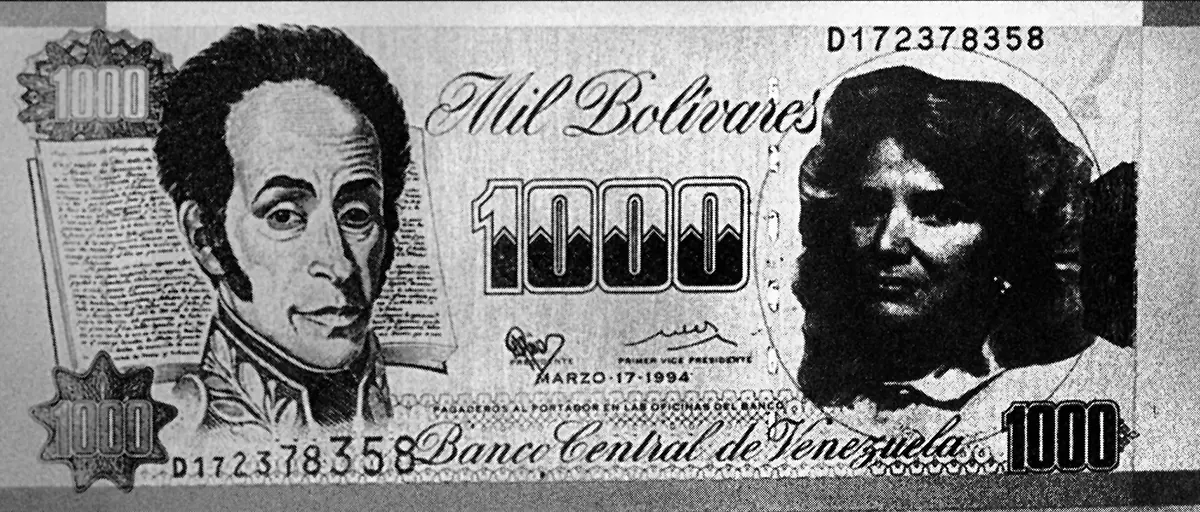
Romer is a multifaceted figure - artist, teacher and cultural promoter. Her new exhibition, which was full of semantic richness, illustrated her splendid research into aspects of the country’s reality, such as her banknotes and their meaning in societies sunk in corruption, in a country like Venezuela, in a very short period of time money has suffered a brutal process of devaluation. She shows a banknote of 100 or 1,000 bolivares, which has on the one side the face of Simon Bolivar, who has also been devalued by the loss of national values, and on the other, she places the face of local personalities who have in one way or another honestly contributed to enhancing the country. It is a solid and consistent kind of work which offers a way of interpreting reality providing a number of readings for the coming years.
With this indirectly romantic series, Romer offers a critical discourse that questions values, expressed in terms of plastic visual images which disturb what we have seen and point us towards the human condition and destiny.
BELGICA RODRIGUEZ